GHK-Cu Handling: Reconstitution, Storage and Half-Life
How to reconstitute 50 mg and 100 mg GHK-Cu vials, whether it needs refrigeration, what its stability study showed, and why half-life claims are unreliable.

Cover illustration: AI-generated editorial artwork. Conceptual only; not an exact molecular structure, actual laboratory result or evidence of clinical effects.
GHK-Cu is handled differently from an ordinary peptide because it is a metal complex. Dissolution is easy, the compound is unusually robust in neutral water, and the solution’s blue colour gives an instant quality check. The things to protect it from are chelators, high pH and oxidants rather than the usual peptide concerns.
For laboratory research use only. The research materials supplied by HealthyWelness are not approved medicines, foods or cosmetics and are not for human or veterinary use. This article summarises published research and is not medical advice.
Key points
- Vials are large (50 and 100 mg), so small volumes give high concentrations.
- Highly hydrophilic: log D about −2.4 at pH 4.5–7.4; dissolves readily.
- Stable in water and pH 4.5–7.4 buffers for at least two weeks at 60 °C in a stress study.
- Degrades under basic and oxidative conditions; keep away from EDTA and alkali.
- No published human half-life; copper exchange is rapid, which complicates the concept.
Reconstitution
- Warm the sealed vial to room temperature.
- Swab the stopper and let it dry.
- Add solvent slowly down the inside wall; swirl gently.
- Confirm a clear blue solution with no particles.
- Label with volume, concentration and date; refrigerate, protected from light.
Bacteriostatic water suits a vial that will be sampled repeatedly; sterile water suits single use (DailyMed prescribing information). The general method is in how to reconstitute peptides.
Concentration tables
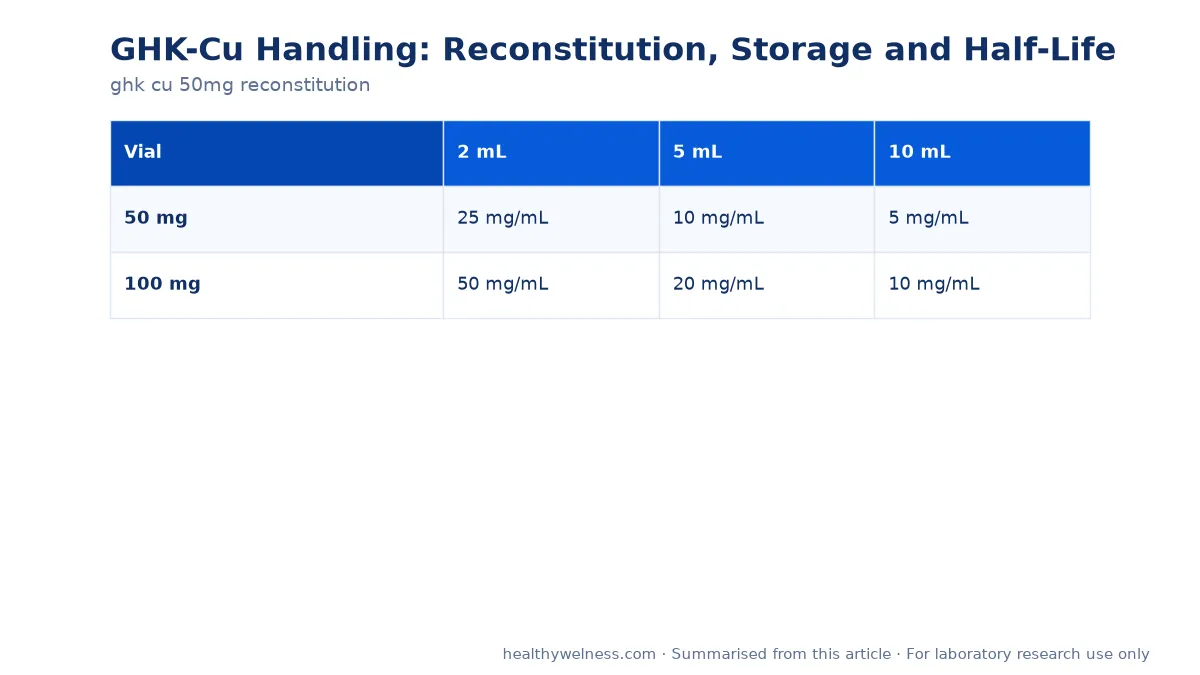
| Vial | 2 mL | 5 mL | 10 mL |
|---|---|---|---|
| 50 mg | 25 mg/mL | 10 mg/mL | 5 mg/mL |
| 100 mg | 50 mg/mL | 20 mg/mL | 10 mg/mL |
Check that the volume fits the vial with headspace before starting; 10 mL will not fit a small vial, and the solution would need transferring to a larger sterile container. For molar calculations, check the mass basis on the lot’s certificate of analysis: free GHK, the copper complex and a hydrated or counter-ion-containing preparation do not have the same molecular weight. Use the molecular weight and net content reported for that preparation; the free-GHK value of 340.4 g/mol must not be applied to a weighed GHK-Cu complex without conversion. Use the peptide reconstitution calculator for other combinations.
What the stability study showed
A preformulation study used a validated stability-indicating RP-HPLC method with MS to examine GHK-Cu under stress (Badenhorst et al., 2016):
| Condition | Result |
|---|---|
| Water and pH 4.5–7.4 buffers, 60 °C | Stable for at least two weeks |
| Basic stress | Hydrolytic cleavage, first-order kinetics |
| Oxidative stress | Degradation |
| Acidic stress | Degradation, to a lesser extent |
| Degradation products | Three identified, one of them free histidine |
Two weeks at 60 °C is an unusually good result for a peptide. It is why GHK-Cu works in topical cosmetic formulations, and it means refrigerated research solutions are at the forgiving end of the spectrum. “Forgiving” is not “indefinite”, so date the vial and keep it cold.
What to keep away from it
| Avoid | Why |
|---|---|
| EDTA and other chelators | Compete for copper and strip it from the peptide |
| High pH | Copper precipitates as hydroxide; the peptide also hydrolyses faster |
| Oxidising agents | Oxidative degradation was demonstrated in the stress study |
| Strong light | Metal complexes can act as photosensitisers (Schöneich, 2020) |
| Albumin-rich media, if copper speciation matters | GHK forms ternary complexes with albumin (Bossak-Ahmad et al., 2021) |
The last point is subtle but important for cell work. GHK’s copper exchanges quickly (Hureau et al., 2011), and in plasma GHK is most concentrated in the albumin-rich fraction, where two ternary albumin–Cu–GHK complexes have been characterised. Adding serum to a culture medium therefore changes what the cells actually see.
Why the half-life question has no clean answer
For most peptides, half-life means how fast the intact molecule disappears from plasma. GHK complicates that in three ways. The peptide occurs naturally in plasma, so there is a baseline. The copper is exchangeable rather than covalently bound, so the complex and the free peptide have different fates. And GHK interacts with albumin, which alters clearance. We found no peer-reviewed study reporting a human half-life for GHK-Cu, and figures quoted without citation should be treated as unsupported. The related question of whether GHK buffers copper’s redox activity has been studied: GHK reduced copper redox activity and prevented copper- and zinc-induced protein aggregation and cell death in vitro (Min et al., 2024).
Storage summary
- Powder: −20 °C, sealed, dark. Warm before opening.
- Solution: 2–8 °C, dark, upright; avoid freeze–thaw.
- Colour check: blue is normal. Green, colourless or cloudy means investigate before use; see GHK-Cu powder and colour.
- Label: solvent, volume, concentration, date.
Our GHK-Cu copper peptide is supplied in 50 mg and 100 mg vials. Certificates are available for listed products — contact us for the latest report. General principles: storing reconstituted peptides.
Open questions
- What is the fate of the copper after GHK-Cu enters a biological system?
- How does copper stoichiometry in commercial research material vary between lots and suppliers?
- Does the free peptide or the complex account for the activities reported in cell studies?
Related research
Frequently asked questions
How do you reconstitute 50 mg of GHK-Cu?
Add a measured volume of sterile or bacteriostatic water slowly down the vial wall and swirl gently. 50 mg in 5 mL gives 10 mg/mL; in 2 mL it gives 25 mg/mL. The solution should be clear and blue.
Does GHK-Cu need to be refrigerated?
Store the lyophilized powder at −20 °C long-term and protect it from light. Reconstituted solutions are best at 2–8 °C, although a preformulation study found GHK-Cu unusually robust in water at pH 4.5–7.4.
What is the half-life of GHK-Cu?
No peer-reviewed human pharmacokinetic study giving a half-life was found. GHK occurs naturally in plasma and exchanges copper rapidly, which makes a single half-life figure difficult to define.
How stable is GHK-Cu in solution?
In a preformulation study it was stable in water and pH 4.5–7.4 buffers for at least two weeks at 60 °C, while degrading under basic and oxidative stress and, to a lesser extent, acidic stress.
What should I avoid adding to GHK-Cu solutions?
Chelators such as EDTA, strong bases that precipitate copper hydroxide, and oxidising agents. Any of these can disturb the copper complex.
For laboratory research use only. The research materials supplied by HealthyWelness are not approved medicines, foods or cosmetics and are not for human or veterinary use. This article summarises published research and is not medical advice.
Sources
- Badenhorst T, et al. Physicochemical characterization of native glycyl-l-histidyl-l-lysine tripeptide for wound healing and anti-aging: a preformulation study for dermal delivery. Pharm Dev Technol. 2016. PMID: 25384620
- Hureau C, et al. X-ray and solution structures of Cu(II) GHK and Cu(II) DAHK complexes: influence on their redox properties. Chemistry. 2011. PMID: 21780203
- Bossak-Ahmad K, et al. Ternary Cu(2+) Complexes of Human Serum Albumin and Glycyl-l-histidyl-l-lysine. Inorg Chem. 2021. PMID: 34730942
- Min JH, et al. Glycyl-l-histidyl-l-lysine prevents copper- and zinc-induced protein aggregation and central nervous system cell death in vitro. Metallomics. 2024. PMID: 38599632
- Schöneich C. Photo-Degradation of Therapeutic Proteins: Mechanistic Aspects. Pharm Res. 2020. PMID: 32016661
- DailyMed. Bacteriostatic Water (water) injection, solution — prescribing information. U.S. National Library of Medicine.