Ipamorelin Stability and Storage in the Laboratory
Ipamorelin has no tryptophan, histidine or cysteine, which makes it unusually forgiving. What that removes, and what still governs storage.

Cover illustration: AI-generated editorial artwork. Conceptual only; not an exact molecular structure, actual laboratory result or evidence of clinical effects.
Ipamorelin is one of the easier peptides in a research catalogue to keep intact, and the reason is worth stating precisely rather than as a general impression. It contains none of the residues that cause most chemical degradation in peptide reagents. That removes one failure route entirely and leaves the others untouched.
For laboratory research use only. The research materials supplied by HealthyWelness are not approved medicines, foods or cosmetics and are not for human or veterinary use. This article summarises published research and is not medical advice.
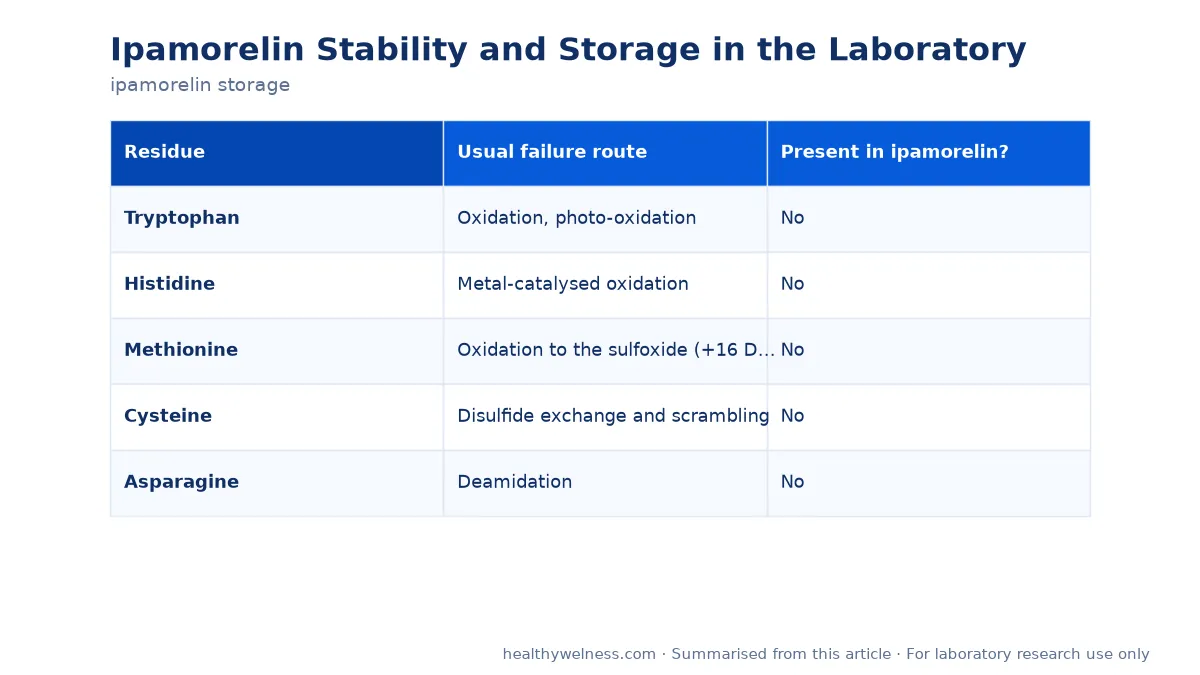
What the composition removes
| Residue | Usual failure route | Present in ipamorelin? |
|---|---|---|
| Tryptophan | Oxidation, photo-oxidation | No |
| Histidine | Metal-catalysed oxidation | No |
| Methionine | Oxidation to the sulfoxide (+16 Da) | No |
| Cysteine | Disulfide exchange and scrambling | No |
| Asparagine | Deamidation | No |
Compare that with the tryptophan-rich secretagogues it is usually listed beside. GHRP-6 and hexarelin each carry two tryptophans and a histidine, which makes them light- and oxidation-sensitive reagents requiring amber vials and low-metal diluents — see what GHRP-6 is and what hexarelin is.
The 1998 work by Khossravi and colleagues on metal-catalysed oxidation of histidine in model peptides is the reference that explains why that difference matters. Where there is no histidine and no tryptophan, trace metal in the diluent has far less to catalyse. It is still worth using a clean diluent, but the consequence of not doing so is smaller.
What the composition does not remove
Three routes are unaffected, and they are the ones that govern practice:
- Proteolysis. In any protease-containing medium a peptide is cleaved, regardless of which residues it contains. D-amino acids in the sequence resist this to a degree, which was part of the original design, but they do not make the peptide inert.
- Hydrolysis in solution. Slow, pH-dependent, and inevitable. The 1998 study by Gietz and colleagues on recombinant hirudin illustrates how strongly pH governs the rate; the molecule differs but the framework transfers.
- Moisture uptake in the solid. Universal for lyophilized peptides and independent of sequence.
The moisture point deserves more than a line. The 1999 study by Lai and colleagues separated two distinct roles water plays in a solid: it is the solvent in which degradation occurs and a plasticiser that gives molecules enough mobility to react. The 1992 study by Pikal and colleagues found freeze-dried stability governed by moisture and oxygen content rather than temperature alone. A dry solid is protected on both counts; one that has taken up a few per cent water is protected on neither.
Storage
| State | Condition | Why |
|---|---|---|
| Sealed lyophilized | −20 °C, desiccated, dark | Moisture and oxygen govern solid-state stability |
| Before each opening | Warm the sealed vial to room temperature | Prevents condensation into a hygroscopic powder |
| Opened lyophilized | Reseal with desiccant, return to −20 °C | Hygroscopic once exposed |
| Reconstituted, in use | Refrigerated, short period | For days of working use, not months |
| Reconstituted, stored | Aliquoted, frozen, dated | One warming round per aliquot |
| Dilute working solution | Prepare fresh | Surface loss and faster degradation |
Aliquoting is the single highest-value step and the one most often skipped. A tube thawed twenty times has had twenty opportunities to warm, to concentrate solutes at an ice interface and to take up moisture when opened. Twenty aliquots thawed once each have had one. The general practice is in storing reconstituted peptides.
The analytical consequence of the D-residues
Ipamorelin was characterised in the 1998 report by Raun and colleagues as the first selective growth hormone secretagogue, and like the rest of that compound family it contains D-amino acids by design.
That carries a check worth making. Changing the handedness of an amino acid does not change molecular mass. A preparation with the wrong stereochemistry has the correct mass and will pass a mass-only confirmation. What distinguishes it is chromatographic retention, which is why both the observed mass and the chromatogram matter for peptides of this family rather than either alone.
Two further checks are routine: compute the expected mass for the stated sequence yourself rather than accepting a pass statement, and confirm the lot number on the report matches the vial. The framework is in how to read a certificate of analysis.
Concentration
For a short peptide the counterion and residual water are a proportionally large share of vial weight, so molarity should be computed from net peptide content rather than from the nominal label figure. Our reconstitution calculator takes the net mass and molecular weight; the counterion arithmetic is explained in peptide counterions: TFA versus acetate.
Our ipamorelin research material is supplied for laboratory research use. Certificates are available for listed products — contact us for the latest report.
Open questions
- How much slower is ipamorelin’s measured degradation than a tryptophan-rich secretagogue under identical conditions?
- What is the practical shelf life of a frozen aqueous aliquot?
- Is chiral verification feasible as a routine release test at this peptide length?
Related research
Frequently asked questions
Why is ipamorelin easier to store than other secretagogues?
Composition. It contains none of the residues responsible for most chemical degradation in peptide reagents: no tryptophan, no histidine, no methionine and no cysteine. Oxidation, the dominant route for tryptophan-rich peptides like GHRP-6 and hexarelin, has little to act on.
Does that mean it is stable in solution indefinitely?
No. Proteolysis in any protease-containing medium is unaffected by residue composition in that way, and hydrolysis proceeds slowly in any aqueous solution. What the composition removes is the oxidative route, not every route.
How should the lyophilized powder be stored?
Sealed, dry and dark at minus 20 degrees Celsius with desiccant. Let the vial reach room temperature before opening so atmospheric moisture does not condense into a hygroscopic powder.
How many freeze-thaw rounds can it take?
The useful practice is to aliquot on first reconstitution so that no tube goes through more than one. Counting acceptable rounds is less reliable than removing the question, and aliquoting costs a few minutes once.
Does the D-amino acid content help stability?
Against enzymes, yes: D-residues resist proteases that act on L-peptide bonds. They do nothing for chemical degradation, and they have an analytical consequence, since stereochemistry does not change molecular mass.
For laboratory research use only. The research materials supplied by HealthyWelness are not approved medicines, foods or cosmetics and are not for human or veterinary use. This article summarises published research and is not medical advice.
Sources
- Raun K, et al. Ipamorelin, the first selective growth hormone secretagogue. Eur J Endocrinol. 1998. PMID: 9849822
- Khossravi M, et al. Chemical pathways of peptide degradation: IX. Metal-catalyzed oxidation of histidine in model peptides. Pharm Res. 1998. PMID: 9688066
- Lai MC, et al. Chemical stability of peptides in polymers. 2. Discriminating between solvent and plasticizing effects of water on peptide deamidation in poly(vinylpyrrolidone). J Pharm Sci. 1999. PMID: 10514359
- Pikal MJ, et al. Formulation and stability of freeze-dried proteins: effects of moisture and oxygen on the stability of freeze-dried formulations of human growth hormone. Dev Biol Stand. 1992. PMID: 1592171
- Gietz U, et al. Chemical degradation kinetics of recombinant hirudin (HV1) in aqueous solution: effect of pH. Pharm Res. 1998. PMID: 9755900