FOXO4-DRI Human Trials: What the Evidence Covers
Searches for FOXO4-DRI human trials return nothing. The evidence is structural and cell-based, and one study found senolysis made things worse.


Cover illustration: AI-generated editorial artwork. Conceptual only; not an exact molecular structure, actual laboratory result or evidence of clinical effects.
People search for FOXO4-DRI human trials. There are none in the indexed literature that we can find. What exists instead is a structural identification of the compound’s target, cell-based work, and one study in a major cardiology journal reporting that removing senescent cells made its model worse. Setting all three out honestly is more useful than assembling the positive findings into something that reads like clinical evidence.
For laboratory research use only. The research materials supplied by HealthyWelness are not approved medicines, foods or cosmetics and are not for human or veterinary use. This article summarises published research and is not medical advice.
- No published clinical trial of FOXO4-DRI appears in the indexed literature.
- A 2025 Nature Communications study identified the disordered p53 transactivation domain as the target of both FOXO4 and FOXO4-DRI (Bourgeois et al., PMID 40593617).
- A 2025 Communications Biology study reported nuclear exclusion of phosphorylated p53 in keloid senescent fibroblasts after FOXO4-DRI exposure (Kong et al., PMID 39994346).
- A 2023 Circulation study found that eliminating senescent cells promoted pulmonary hypertension development and progression (Born et al., PMID 36515093).
- D-retro-inverso peptides have the same molecular mass as their L-peptide parents, so mass alone cannot confirm identity.
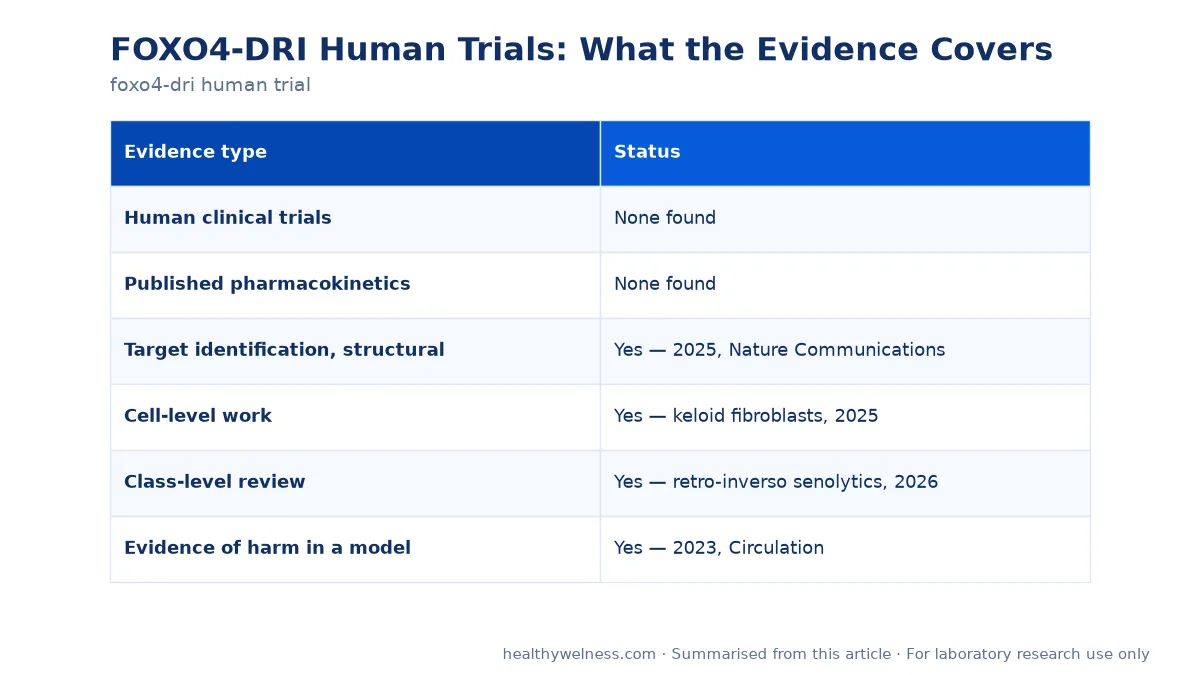
What does the evidence base actually contain?
| Evidence type | Status |
|---|---|
| Human clinical trials | None found |
| Published pharmacokinetics | None found |
| Target identification, structural | Yes — 2025, Nature Communications |
| Cell-level work | Yes — keloid fibroblasts, 2025 |
| Class-level review | Yes — retro-inverso senolytics, 2026 |
| Evidence of harm in a model | Yes — 2023, Circulation |
We write “none found” rather than “none exist”: an unindexed or very recent study could exist. But a compound with clinical work behind it is normally easy to find, and this one is not.
Why is the target identification unusually strong?
Because it names a binding site rather than inferring a pathway from downstream effects.
The 2025 study by Bourgeois and colleagues identified the disordered p53 transactivation domain as the target of both FOXO4 and the FOXO4-DRI compound. Two things make that satisfying for a compound of this type.
- It is a binding-site identification. Most research peptides have mechanisms reconstructed from what changes downstream, which is weaker evidence by a clear margin.
- The target is an intrinsically disordered region, which explains why a flexible peptide is a plausible ligand for it. Disordered regions are poor targets for rigid small molecules and relatively good ones for peptides, so the compound class fits the target class.
The proposed logic follows: if FOXO4 binds p53 and holds it where it cannot act, a competitor for that interaction releases p53. The 2025 study by Kong and colleagues reports the kind of downstream observation that logic predicts, describing nuclear exclusion of phosphorylated p53 in keloid senescent fibroblasts.
What does the Circulation study change?
It changes the framing of the whole field, and it is the paper we would put in front of anyone planning a senolytic experiment.
The 2023 study by Born and colleagues reported that eliminating senescent cells promoted pulmonary hypertension development and progression in its model. Not “failed to help” — made it worse.
That matters because discussion around senolytics tends to treat removing senescent cells as desirable by definition. It is an empirical claim, and in at least one well-conducted study in a major journal it did not hold. Senescent cells have functions; removing them changes a system in more than one direction.
The design consequence is concrete and cheap to act on: a senolytic experiment needs a readout capable of detecting harm, not only one capable of detecting benefit. An assay that measures only the hoped-for direction cannot distinguish a compound that works from one that also does something else.
What does the retro-inverso design mean for verification?
That mass spectrometry cannot confirm what is in the vial.
A D-retro-inverso peptide is built by reversing the sequence and switching every residue to the D enantiomer. Those two inversions largely cancel at the level of side-chain geometry, so the molecule presents a similar surface while resisting L-specific proteases. But neither change touches the molecular formula.
| Property | L-parent | DRI version |
|---|---|---|
| Amino acid composition | Same residues | Same residues |
| Molecular mass | Identical | Identical |
| Sequence direction | N to C | Reversed |
| Stereochemistry | L | D |
| Chromatographic retention | Differs | Differs |
So the checks that matter are the stated sequence with direction and stereochemistry, the chromatogram rather than a purity percentage, and chiral analysis where the work depends on it. The 2016 study by Stalmans and colleagues on quality control of cationic peptides is a useful reminder of how far peptide behaviour can diverge from assumption. The framework is in how to read a certificate of analysis and the compound background in what FOXO4-DRI is.
What should an experiment with it look like?
- Confirm the material is the DRI form, by chromatography or chiral analysis, since mass will not tell you.
- Measure senescent cell markers directly rather than inferring clearance from a functional endpoint.
- Include a readout that could show harm, chosen for the tissue in question. This is the lesson of the 2023 Circulation result.
- Use a scrambled or L-parent control where feasible, to separate sequence-dependent activity from the behaviour of a peptide of that composition.
- Do not assume exposure. With no published pharmacokinetics, timing has to come from measurement in the system rather than from a borrowed figure.
The 2026 review by Alameen and colleagues places retro-inverso senolytics as a class, which is useful for seeing which findings are compound-specific and which belong to the approach.
Our FOXO4-DRI research material is supplied for laboratory research use. Certificates are available for listed products — contact us for the latest report. Concentration should be computed from net peptide content, which our reconstitution calculator applies.
How to read a field where the framing is doing the work
Senolytics are unusual among research compound classes in how much the framing carries. “Removing senescent cells” sounds self-evidently desirable in a way that “inhibiting an enzyme” does not, and that framing can stand in for evidence if a reader is not watching for it.
Three habits help when reading this literature:
- Separate target validation from compound validation. Evidence that senescent cells matter in a condition is not evidence that a particular compound removes them selectively or safely.
- Look for the tissue. Senescent cell burden and function differ between tissues, so a finding in one says little about another. The pulmonary hypertension result is the clearest demonstration of that.
- Check whether selectivity was measured or assumed. A senolytic that also affects non-senescent cells is running a different experiment from the one described, and selectivity is measurable rather than inherent.
None of this is specific to FOXO4-DRI. It applies to the class, and applying it is what separates reading the literature from collecting its conclusions.
One further point about reading absences: a compound with no clinical record is not thereby disqualified, but it is also not partway along a path. Preclinical work and clinical work answer different questions, and the gap between them is not a matter of degree.
Scope note
This material is supplied for laboratory research use only. It is not a medicine, not a supplement, and not for human or veterinary use. Nothing above describes administration to any organism.
Open questions
- In which tissues does senescent cell elimination produce harm rather than benefit?
- How selective is the FOXO4–p53 disruption against other p53 interactions?
- Can the DRI form be distinguished from its L-parent by a routine release test?
Related research
Frequently asked questions
Are there published human trials of FOXO4-DRI?
No. A search of the indexed literature returns no clinical trial of this compound. The published evidence is structural, biophysical and cell-based, with animal and review work alongside it.
What is the strongest published evidence?
A 2025 Nature Communications study identifying the disordered p53 transactivation domain as the target of both FOXO4 and FOXO4-DRI. That is a binding-site identification rather than an inference from downstream readouts, which is stronger than most research peptides have.
Does eliminating senescent cells always help?
No. A 2023 Circulation study reported that eliminating senescent cells promoted pulmonary hypertension development and progression in its model. That result should be read alongside the positive findings rather than after them.
Can mass spectrometry confirm a retro-inverso peptide?
No. A D-retro-inverso peptide has the same amino acid composition and therefore the same molecular mass as its L-peptide parent. Only chromatographic behaviour or explicit chiral analysis distinguishes them.
What should an experiment measure?
Both directions. A senolytic experiment needs a readout capable of detecting harm as well as benefit, because the published literature contains at least one well-conducted study where senescent cell removal worsened the outcome.
For laboratory research use only. The research materials supplied by HealthyWelness are not approved medicines, foods or cosmetics and are not for human or veterinary use. This article summarises published research and is not medical advice.
Sources
- Bourgeois B, et al. The disordered p53 transactivation domain is the target of FOXO4 and the senolytic compound FOXO4-DRI. Nat Commun. 2025. PMID: 40593617
- Kong YX, et al. FOXO4-DRI induces keloid senescent fibroblast apoptosis by promoting nuclear exclusion of upregulated p53-serine 15 phosphorylation. Commun Biol. 2025. PMID: 39994346
- Alameen AAM, et al. Targeting the FOXO4-p53 axis by retro-inverso peptide senolytic agents: a pharmacological strategy to mitigate brain aging and cognitive decline. Naunyn Schmiedebergs Arch Pharmacol. 2026. PMID: 42024235
- Born E, et al. Eliminating Senescent Cells Can Promote Pulmonary Hypertension Development and Progression. Circulation. 2023. PMID: 36515093
- Stalmans S, et al. Quality control of cationic cell-penetrating peptides. J Pharm Biomed Anal. 2016. PMID: 26397208