BPC-157 vs BPC-159: Verifying Which One You Have
BPC-159 has no published literature. Several BPC-157 name variants circulate, and only the sequence and observed mass settle which is in a vial.


Cover illustration: AI-generated editorial artwork. Conceptual only; not an exact molecular structure, actual laboratory result or evidence of clinical effects.
People search for BPC-159 expecting a sibling compound. There is no published literature on a peptide by that name. That absence is the most useful fact here, and it opens the broader question worth answering: several name variants of BPC-157 do circulate, some real and some not, and only the sequence and observed mass tell you which one is in a vial.
For laboratory research use only. The research materials supplied by HealthyWelness are not approved medicines, foods or cosmetics and are not for human or veterinary use. This article summarises published research and is not medical advice.
- No published studies of a compound named BPC-159 appear in the indexed literature.
- BPC-157 is a defined 15-residue peptide with published pharmacokinetics in rats and dogs (He et al., 2022, PMID 36588717).
- Salt forms such as acetate and arginate contain the same peptide with different counterions, which is a different situation from a different peptide.
- At 15 residues, computing the expected mass and comparing it against the reported value rules out most wrong sequences. It does not establish identity on its own: stereoisomers and rearrangements of the same composition share a mass, so a match is consistent with the stated sequence rather than proof of it.
- Impurities in commercial synthetic peptides have been documented with practical consequences for experiments (Currier et al., 2008, PMID 18077621).
What does “no literature” mean, and what does it not?
It means the claim cannot be evaluated on evidence, which is a weaker statement than “the compound does not exist” and a stronger one than it sounds.
A compound with no published studies has no characterised mechanism, no reported pharmacokinetics, no safety observations and no independent replication. Nothing can be inferred about it from the literature of a differently numbered compound, because peptide numbering is not a chemical relationship — it is a label.
Compare that with BPC-157’s position. The 2022 study by He and colleagues characterised pharmacokinetics, distribution, metabolism and excretion in two species. The 2025 narrative review by McGuire and colleagues, titled “Regeneration or Risk?”, surveys the musculoskeletal evidence while explicitly leaving the question open. That is a body of work a reader can argue with. A name with nothing behind it is not.
Which variants are real?
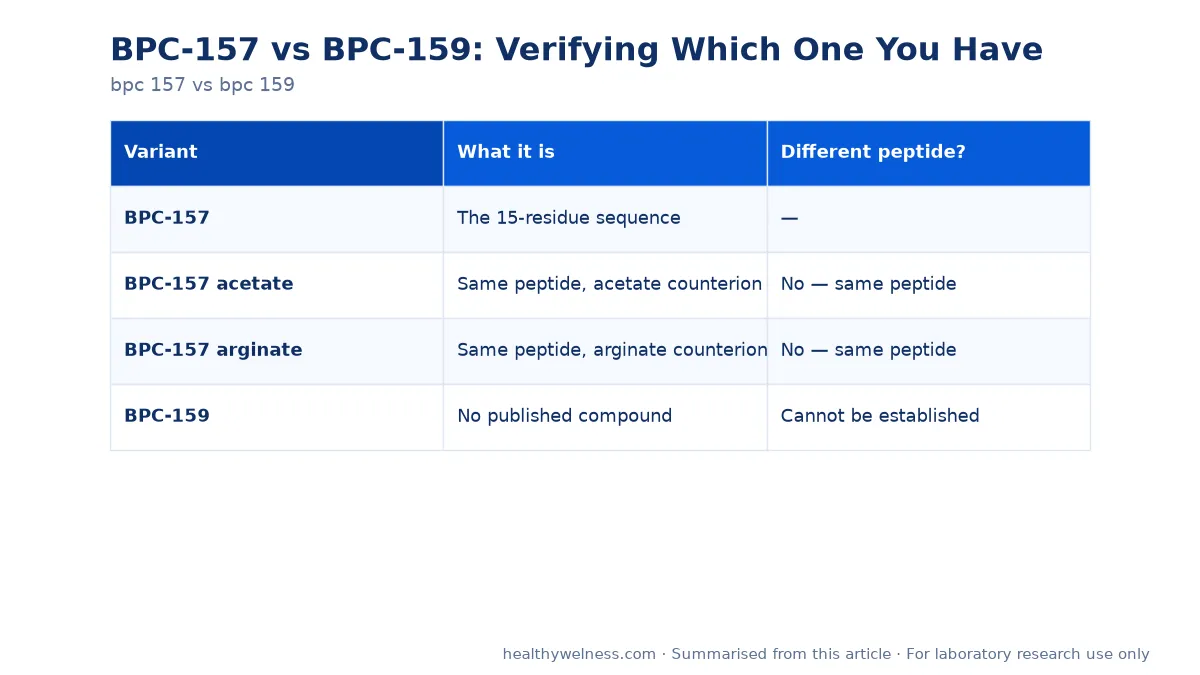
| Variant | What it is | Different peptide? |
|---|---|---|
| BPC-157 | The 15-residue sequence | — |
| BPC-157 acetate | Same peptide, acetate counterion | No — same peptide |
| BPC-157 arginate | Same peptide, arginate counterion | No — same peptide |
| BPC-159 | No published compound | Cannot be established |
The distinction between the middle rows and the last one is the point of this article. A salt form is a real, checkable variation: the peptide is identical and the counterion differs. A numeric variation with no literature is not a variation of anything that can be verified.
The salt comparison is covered in BPC-157 arginate compared with acetate.
Why does the counterion change the numbers but not the molecule?
Because a peptide with basic residues has no neutral form. It is isolated as a salt, and the anion is part of the delivered mass.
Reverse-phase purification normally runs with trifluoroacetic acid in the mobile phase, so the peptide comes off the column as its trifluoroacetate salt and is lyophilized that way unless an exchange step is added. The 2008 critical evaluation by Roux and colleagues compared exchange approaches and found them to differ in completeness, which means a label reading “acetate” indicates that an exchange was performed rather than that no trifluoroacetate remains.
Two practical consequences:
- The molecular weight used in calculations must match the supplied salt. Carrying a figure between salt forms introduces a systematic error in one direction.
- Counterion identity can matter biologically. Trifluoroacetate is not inert in cell culture at the levels that can accompany a peptide, which is why exchange is offered at all.
The full treatment is in peptide counterions: TFA versus acetate.
How do you verify which peptide you have?
Five checks, in the order that resolves the question fastest.
- Is the sequence stated? If not, the report has not identified the compound and nothing else on it can be interpreted.
- Does the residue count match? BPC-157 is 15 residues. Count them.
- Is an observed mass given as a number? Compute the expected value for the stated sequence and salt form and compare. A deviation of 16 suggests oxidation; a deviation matching one residue suggests a deletion.
- Is the counterion named? Required for the molecular weight and relevant in cell work.
- Is there a chromatogram? A purity percentage alone cannot show whether the peak is single and clean.
That third step is doing most of the work. At 15 residues the expected mass is distinctive, so a reported value either matches or it does not — and a mismatch is informative about what went wrong rather than merely a fail.
Why does the purity figure deserve less trust than the chromatogram?
Because of what the percentage is a percentage of.
HPLC purity is the target peak area as a proportion of total detected peak area. Two limitations follow. Undetected contaminants are excluded from the calculation entirely. And co-eluting impurities are counted as target peptide — which matters because the impurities most likely to co-elute are the ones most structurally similar to the target, such as single-residue deletions.
The 2018 study by Li and colleagues demonstrated what identifying and quantifying structurally related peptide impurities actually requires: high-resolution LC-MS, not a summary figure. The 2008 study by Currier and colleagues documented impurities in commercial synthetic peptides and their consequences for immunological assessment, which is the clearest published evidence that this is a practical problem rather than a theoretical one.
So the useful request is the trace. A single sharp peak and a cluster of partly resolved peaks summing to the same area give the same percentage and mean entirely different things. The general framework is in how to read a certificate of analysis.
What cannot be checked from a report?
Being explicit about the limits matters as much as the checks. Routine certificate data does not establish:
- Endotoxin content, unless tested. Relevant for any immune or inflammatory readout.
- Peptide content as distinct from purity, unless reported separately. Without it, weight-based concentrations are systematically high.
- Traceability to a reference standard. For most research peptides none exists, so purity is an internal comparison rather than a traceable measurement, and two suppliers’ figures are not strictly comparable.
Our BPC-157 research material is supplied for laboratory research use. Certificates are available for listed products — contact us for the latest report. Concentration should be computed from net peptide content, which our reconstitution calculator applies.
Why a name with no literature is a commercial signal, not a chemical one
New numbers appear in this market regularly, and they are worth treating as what they are: product naming rather than compound identification. A genuinely new peptide normally arrives with a sequence, a synthesis route and at least one publication describing it.
So the question to ask of any unfamiliar designation is not whether it works but whether it exists as a defined substance. A stated sequence answers that in one line. Without one, there is nothing to verify, nothing to compute a mass against and nothing to compare with the literature — and no amount of further description substitutes for it.
Scope note
This material is supplied for laboratory research use only. It is not a medicine, not a supplement, and not for human or veterinary use.
Open questions
- Does any indexed study of a compound named BPC-159 exist?
- How often does material sold under a BPC name prove to be a different sequence on analysis?
- How much do purity figures for the same material differ between laboratories?
Related research
Frequently asked questions
Is there such a thing as BPC-159?
Not in the published literature. Searches return no studies of a compound by that name, while BPC-157 has a substantial body of work including pharmacokinetics in two species. A name with no literature behind it cannot be evaluated on evidence.
What name variants of BPC-157 circulate?
Several: the plain peptide, salt forms such as acetate and arginate, and occasional numeric variations. The salt forms are real and distinguishable; numeric variations usually are not backed by any published compound.
How do you tell which compound is in a vial?
By the stated sequence and the observed mass. BPC-157 is a defined 15-residue sequence, so computing the expected mass and comparing it against the reported value is close to decisive at that length.
Does the salt form change the molecule?
It changes the delivered mass and can matter in cell work, but the peptide is the same. Arginate and acetate salts of BPC-157 contain the same peptide with different counterions, which is a different situation from two different peptides.
What should a report contain to be usable?
A stated sequence, an observed mass as a number rather than a pass statement, a named counterion, a purity figure with its method, a chromatogram, and a lot number matching the vial.
For laboratory research use only. The research materials supplied by HealthyWelness are not approved medicines, foods or cosmetics and are not for human or veterinary use. This article summarises published research and is not medical advice.
Sources
- He L, et al. Pharmacokinetics, distribution, metabolism, and excretion of body-protective compound 157, a potential drug for treating various wounds, in rats and dogs. Front Pharmacol. 2022. PMID: 36588717
- McGuire FP, et al. Regeneration or Risk? A Narrative Review of BPC-157 for Musculoskeletal Healing. Curr Rev Musculoskelet Med. 2025. PMID: 40789979
- Currier JR, et al. Peptide impurities in commercial synthetic peptides and their implications for vaccine trial assessment. Clin Vaccine Immunol. 2008. PMID: 18077621
- Li M, et al. Identification and accurate quantification of structurally related peptide impurities in synthetic human C-peptide by liquid chromatography-high resolution mass spectrometry. Anal Bioanal Chem. 2018. PMID: 29862433
- Roux S, et al. Elimination and exchange of trifluoroacetate counter-ion from cationic peptides: a critical evaluation of different approaches. J Pept Sci. 2008. PMID: 18035848