AICAR vs MOTS-c: Direct Activator or Signalling Peptide
AICAR mimics AMP and activates AMPK directly. MOTS-c is AMPK-linked but has no identified receptor. Two very different kinds of evidence.


Cover illustration: AI-generated editorial artwork. Conceptual only; not an exact molecular structure, actual laboratory result or evidence of clinical effects.
Both compounds appear in metabolic research and both are discussed alongside AMPK, which is where the similarity ends. AICAR activates AMPK by chemical mimicry of AMP, a mechanism that is defined and measurable. MOTS-c has AMPK-linked effects but no identified proximal partner. One is a tool with a known handle; the other is a biological signal whose entry point is unmapped.
For laboratory research use only. The research materials supplied by HealthyWelness are not approved medicines, foods or cosmetics and are not for human or veterinary use. This article summarises published research and is not medical advice.
- AICAR is a small-molecule nucleoside analogue, not a peptide.
- MOTS-c is a 16-residue peptide encoded within mitochondrial DNA rather than nuclear DNA.
- AICAR is converted inside the cell to a species resembling AMP, and AMPK responds to AMP as a low-energy signal.
- MOTS-c’s literature repeatedly implicates AMPK-linked signalling, but no receptor or direct binding partner is established.
- AICAR’s published work spans several organ systems, including kidney, bone and peripheral nerve models.
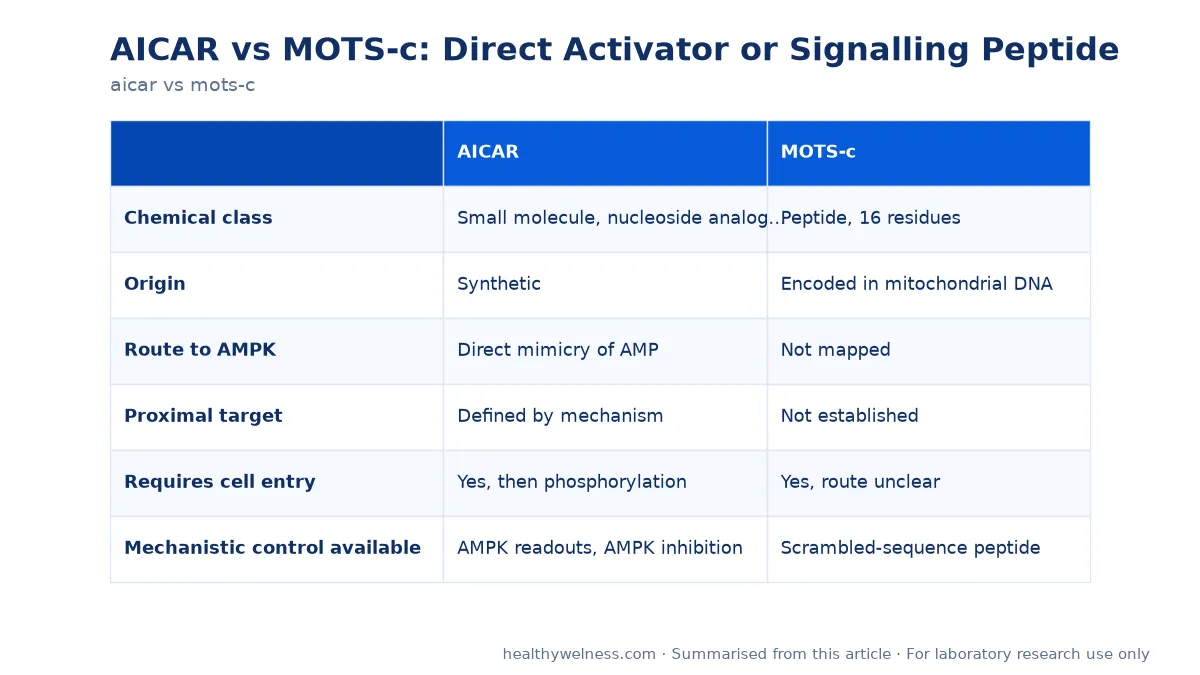
Side by side
| AICAR | MOTS-c | |
|---|---|---|
| Chemical class | Small molecule, nucleoside analogue | Peptide, 16 residues |
| Origin | Synthetic | Encoded in mitochondrial DNA |
| Route to AMPK | Direct mimicry of AMP | Not mapped |
| Proximal target | Defined by mechanism | Not established |
| Requires cell entry | Yes, then phosphorylation | Yes, route unclear |
| Mechanistic control available | AMPK readouts, AMPK inhibition | Scrambled-sequence peptide |
| Diluent | Per certificate; small-molecule practice | Aqueous; peptide practice |
How does AICAR actually work?
Through a deliberate case of mistaken identity.
AMPK is an energy sensor. It responds to rising AMP concentrations, which a cell produces when ATP is being consumed faster than it is made. AICAR enters cells and is phosphorylated to a species that resembles AMP closely enough for AMPK to respond to it. The kinase therefore behaves as though the cell were energy-stressed when it is not.
That has two useful properties for an experiment and one caution:
- Engagement is measurable. AMPK activation can be read directly through its phosphorylation state and through downstream substrates, so target engagement is confirmable rather than assumed.
- The intervention is uncoupled from real energy stress. AMPK can be activated without starving the cell, which separates kinase activation from the metabolic state that normally causes it.
- A compound that mimics a nucleotide is unlikely to mimic only one thing. Effects outside AMPK should be excluded rather than assumed away, which is what AMPK inhibition or knockdown controls are for.
The published work spans systems: the 2024 study by Chandrasekaran and colleagues in peripheral nerve, the 2019 study by Tsogbadrakh and colleagues in cisplatin-induced kidney injury via JAK/STAT/SOCS signalling, and the 2008 study by Kim and colleagues in osteoblasts. Breadth across organ systems is a reasonable sign that the mechanism is real rather than model-specific.
What is known about MOTS-c’s route to AMPK?
Less, and the gap is worth stating rather than glossing.
The 2016 review by Lee and colleagues and the 2023 review by Zheng and colleagues document MOTS-c’s downstream effects in detail, with AMPK-linked signalling appearing repeatedly. What neither establishes is the proximal step: no receptor, no identified binding partner, no mapped route from peptide outside the cell to kinase inside it.
For experimental design the consequence is specific:
- There is no antagonist, no competitive ligand and no receptor knockout to confirm that an effect runs through the proposed route.
- Negative controls carry the argument. A scrambled-sequence peptide of identical composition is close to the only way to show the result depends on the sequence rather than on the presence of a short peptide.
- AMPK readouts are correlative here, not confirmatory. Seeing AMPK activation after adding MOTS-c is consistent with the hypothesis and does not establish directness.
What does MOTS-c’s provenance add?
A reason the compound is interesting that has nothing to do with potency.
Almost every signalling peptide in a research catalogue is encoded in nuclear DNA. MOTS-c is encoded within the mitochondrial genome — a small, separate genome that otherwise mostly codes for components of the respiratory chain.
A signalling peptide emerging from that genome implies the organelle communicates outward about its own state. That framing is why MOTS-c sits alongside exercise physiology and mitochondrial biology rather than receptor pharmacology, and it is a different kind of claim from “this compound activates AMPK”. The comparison with a mitochondria-targeted synthetic peptide is in SS-31 compared with MOTS-c.
Which should an experiment use?
| If the question is | Use | Why |
|---|---|---|
| Is this effect AMPK-dependent? | AICAR | Defined mechanism, measurable engagement |
| Does a mitochondrial signal change this system? | MOTS-c | That is the question it is suited to |
| Does AMPK activation reproduce the peptide’s effect? | Both, in parallel | The contrast tests the AMPK hypothesis |
| A control for peptide-handling artefacts | AICAR | Chemically unrelated to any peptide |
| Comparison with published metabolic work | Whichever that work used | They are not interchangeable |
The third row is the experiment worth running. If MOTS-c’s effects are AMPK-mediated, then AICAR should reproduce them on a shared readout; if it does not, the AMPK account is incomplete. That is a real test rather than a comparison, and it uses the better-defined compound to interrogate the less-defined one.
How does handling differ?
Entirely, because one is a small molecule and the other a peptide. Treating them alike is the usual error when both appear in one study.
- AICAR: small-molecule practice. Use the diluent named on the certificate, confirm full dissolution against a dark background, and match any co-solvent in the vehicle control. Expect small-molecule analytical data — purity with a method, a mass matching the molecular formula, residual solvent — rather than a peptide content figure, which does not apply. The compound background is in what AICAR is.
- MOTS-c: peptide practice. Aqueous diluent, gentle swirling, aliquot on first reconstitution, and molarity computed from net peptide content rather than vial weight — the correction is proportionally large for a 16-residue peptide. Our reconstitution calculator applies it.
- Both: store the solid sealed, dry and dark at −20 °C, and warm the container to room temperature before opening.
Our AICAR research material is supplied for laboratory research use. Certificates are available for listed products — contact us for the latest report.
What a shared readout should actually measure
If the two compounds are being compared on AMPK, the readout has to report AMPK rather than something downstream of it. Phosphorylation state of the kinase and of a known substrate are the proximal measures; a metabolic endpoint several steps away can move for reasons that have nothing to do with AMPK at all.
That distinction matters more for the peptide arm than for the small molecule. AICAR’s engagement is confirmable, so a null AMPK readout in its arm is evidence about the assay. In the MOTS-c arm the same null is ambiguous, because the route from peptide to kinase was never mapped — which is exactly why running both in one experiment is more informative than running either alone.
Scope note
This material is supplied for laboratory research use only. It is not a medicine, not a supplement, and not for human or veterinary use. The published work described above is in cells and animal models.
Open questions
- Does AICAR reproduce MOTS-c’s effects on a shared readout in the same system?
- What is MOTS-c’s proximal receptor or binding partner?
- How much of AICAR’s activity is AMPK-dependent rather than off-target?
Related research
Frequently asked questions
What is the difference between AICAR and MOTS-c?
Directness. AICAR is a small molecule that enters cells, is converted to a compound resembling AMP, and activates AMPK through that resemblance. MOTS-c is a peptide whose effects are AMPK-linked but whose proximal binding partner has not been identified.
Is AICAR a peptide?
No. AICAR is a small molecule nucleoside analogue. MOTS-c is a 16-residue peptide encoded in mitochondrial DNA. They appear in the same catalogues because of the research area, not because of shared chemistry.
How does AICAR activate AMPK?
By mimicry. Once inside a cell it is phosphorylated to a species that resembles AMP, and AMPK responds to rising AMP as a signal of low energy availability. The compound therefore produces an energy-stress-like signal without the cell being energy-stressed.
Does MOTS-c activate AMPK the same way?
Not in the same sense. AMPK-linked signalling appears repeatedly in the MOTS-c literature, but no receptor or direct binding partner is established, so the route from peptide to kinase is not mapped.
Which is the cleaner experimental tool?
AICAR for engaging AMPK, because the mechanism is defined and the engagement is measurable. MOTS-c for asking whether a mitochondrially encoded signal changes a system, which is a different question.
For laboratory research use only. The research materials supplied by HealthyWelness are not approved medicines, foods or cosmetics and are not for human or veterinary use. This article summarises published research and is not medical advice.
Sources
- Chandrasekaran K, et al. Administration of AICAR, an AMPK Activator, Prevents and Reverses Diabetic Polyneuropathy (DPN) by Regulating Mitophagy. Int J Mol Sci. 2024. PMID: 39795939
- Tsogbadrakh B, et al. AICAR, an AMPK activator, protects against cisplatin-induced acute kidney injury through the JAK/STAT/SOCS pathway. Biochem Biophys Res Commun. 2019. PMID: 30616891
- Kim JE, et al. AMPK activator, AICAR, inhibits palmitate-induced apoptosis in osteoblast. Bone. 2008. PMID: 18502715
- Lee C, et al. MOTS-c: A novel mitochondrial-derived peptide regulating muscle and fat metabolism. Free Radic Biol Med. 2016. PMID: 27216708
- Zheng Y, et al. MOTS-c: A promising mitochondrial-derived peptide for therapeutic exploitation. Front Endocrinol (Lausanne). 2023. PMID: 36761202