Gonadorelin vs hCG: Two Points on the Same Axis
Gonadorelin acts at the GnRH receptor on the pituitary; hCG acts at the LH receptor on the gonad. Different molecules, different levels of one axis.

Cover illustration: AI-generated editorial artwork. Conceptual only; not an exact molecular structure, actual laboratory result or evidence of clinical effects.
Gonadorelin acts on the pituitary; hCG acts on the gonad. They sit at two different levels of the same hypothalamic-pituitary-gonadal axis, which is why their effects look related and their pharmacology has almost nothing in common.
For laboratory research use only. The research materials supplied by HealthyWelness are not approved medicines, foods or cosmetics and are not for human or veterinary use. This article summarises published research and is not medical advice.
- Gonadorelin is gonadotropin-releasing hormone, a decapeptide, acting at the GnRH receptor on pituitary gonadotrophs.
- Human chorionic gonadotropin is a heterodimeric glycoprotein acting at the LH/CG receptor on gonadal tissue.
- The GnRH receptor decodes pulse frequency; pulsatile and sustained signalling at it produce different outcomes (Armstrong et al., 2009).
- Changing GnRH pulse frequency alters the gonadotropin output of the pituitary, which is the control principle the axis runs on (Marshall et al., 1993).
- Glycoprotein hormone receptors such as the LH/CG receptor have a large extracellular domain that binds the hormone, structurally unlike the peptide-binding GnRH receptor (Duan et al., 2021).
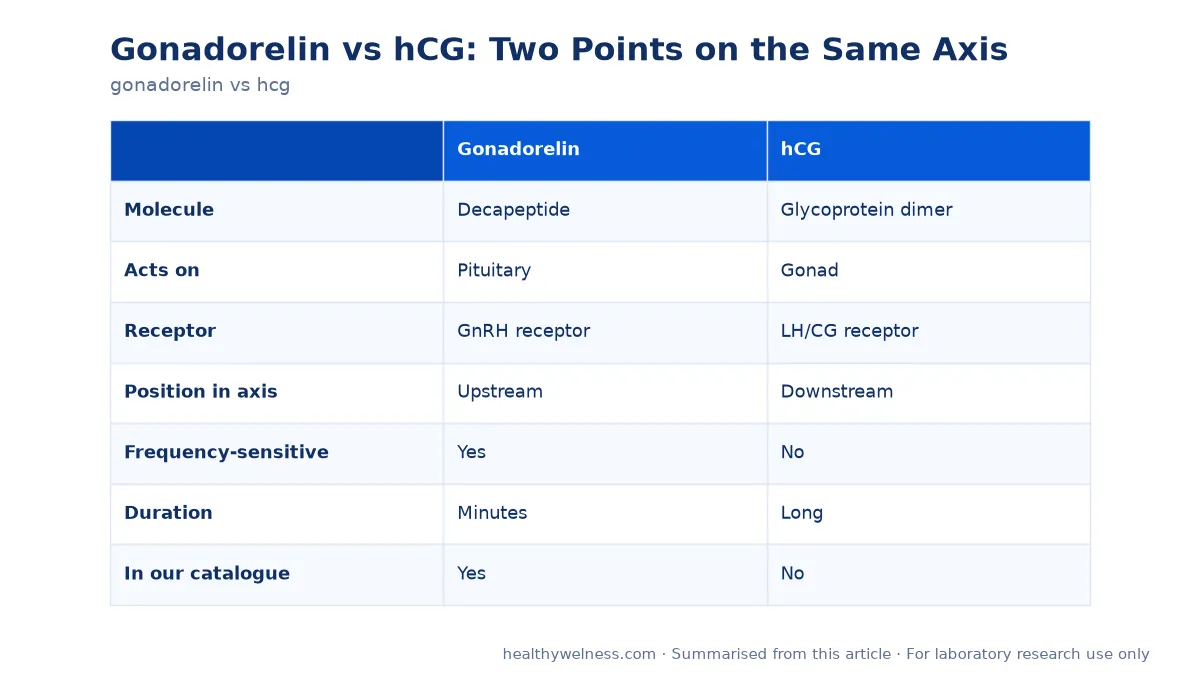
Side by side
| Gonadorelin | hCG | |
|---|---|---|
| Molecule | Decapeptide | Glycoprotein dimer |
| Acts on | Pituitary | Gonad |
| Receptor | GnRH receptor | LH/CG receptor |
| Position in axis | Upstream | Downstream |
| Frequency-sensitive | Yes | No |
| Duration | Minutes | Long |
| In our catalogue | Yes | No |
Two levels of one axis
The hypothalamic-pituitary-gonadal axis runs in sequence: the hypothalamus releases GnRH, the pituitary responds by releasing LH and FSH, and the gonad responds to those. Gonadorelin and hCG enter that chain at different points.
Gonadorelin is GnRH itself. Introducing it engages the pituitary step, and whatever happens downstream happens because the pituitary responded. The gonadal effect is therefore indirect and depends on an intact pituitary.
hCG enters further down. It binds the same receptor LH binds, on gonadal tissue, bypassing the pituitary entirely. A gonadal response to hCG tells you nothing about pituitary function, because the pituitary was not involved.
That difference is the whole of the comparison. Any experiment choosing between them is choosing which part of the axis to interrogate and which part to bypass.
Why frequency matters on one side and not the other
GnRH is not released continuously. It arrives in pulses, and the pituitary reads the pattern, not just the amount. Changing pulse frequency changes the gonadotropin output, and this frequency-coding is the control principle the axis operates on (Marshall et al., 1993).
The mechanism by which a receptor distinguishes a pulse train from a steady level has been examined directly. Pulsatile and sustained GnRH receptor signalling give different outcomes, and the Ca2+/NFAT pathway has been investigated as one route by which frequency might be decoded (Armstrong et al., 2009).
One consequence is counterintuitive and well established: sustained GnRH receptor occupancy does not produce a sustained large response. Continuous stimulation desensitises the system, which is the pharmacological basis of GnRH receptor agonists used for suppression and the backdrop to the development of antagonists (Huirne et al., 2001).
No equivalent frequency-decoding applies to the gonadal LH receptor in the same sense. A design that treats “more signal for longer” as equivalent at both levels has mischaracterised the upstream one.
Structurally different receptors
| Feature | GnRH receptor | LH/CG receptor |
|---|---|---|
| Ligand size | Ten residues | Glycoprotein |
| Extracellular domain | Small | Large |
| Binding site | Within membrane bundle | Extracellular domain |
| Tissue | Pituitary | Gonad |
The LH/CG receptor is a glycoprotein hormone receptor, and the defining feature of that family is a large extracellular domain that captures the hormone before the signal reaches the transmembrane bundle. Its structure has been characterised in detail over decades (Ascoli et al., 1989) and more recently in full-length signalling complexes (Duan et al., 2021).
The GnRH receptor is built for a ten-residue ligand and has no such domain. These are not variations on a theme; they are two different architectures for two different kinds of ligand, which is the structural reason a peptide and a glycoprotein hormone are not interchangeable tools.
What each one can and cannot tell you
Because they enter the axis at different points, the two compounds answer different questions, and a result obtained with one does not substitute for the other.
| Question | Gonadorelin | hCG |
|---|---|---|
| Is the pituitary responsive? | Yes | No |
| Is the gonad responsive? | Indirectly | Yes |
| Does frequency change output? | Yes | Not applicable |
| Steps between stimulus and readout | Two | One |
The row that matters most for experimental design is the last. A gonadal readout following gonadorelin has two steps in between, and a negative result is ambiguous: the pituitary may not have responded, or it may have responded and the gonad did not. The same readout following hCG has one step, so a negative result localises more cleanly.
That is an argument for using the downstream compound when the downstream tissue is the subject, and the upstream one only when pituitary function is itself the question. It is also an argument against reading the two as interchangeable stimulators of the same system, which is how they are often presented side by side.
Desensitisation is a property of the upstream receptor
Sustained occupancy of the GnRH receptor reduces rather than increases gonadotropin output over time. This is not a quirk of a particular preparation: it is the basis on which GnRH receptor agonists came to be used for suppression, and the reason antagonists were developed as an alternative route to the same endpoint without an initial stimulatory phase (Huirne et al., 2001).
An experiment that increases exposure to gonadorelin expecting a proportional increase in response may therefore observe the opposite, and the direction of the effect will depend on how exposure was delivered rather than on how much was used.
Handling in the lab
- A decapeptide cleared on a minutes timescale needs a sampling schedule built for that; the half-life calculator plots decay for a stated half-life and species.
- Where the experimental question concerns frequency, the delivery method has to be capable of producing a pulse. A single addition is a step, not a pulse train, and will answer a different question.
- Use net peptide content from the batch documentation rather than label weight for concentration work.
- Note which level of the axis a readout sits at. A gonadal measurement downstream of gonadorelin has two steps between stimulus and signal, and either can be the variable.
Our gonadorelin acetate research material is supplied with its specification stated on its own documentation. hCG is not in the catalogue.
Related research
For the compound itself see what gonadorelin is, and for preparation gonadorelin reconstitution. An upstream comparison is in gonadorelin versus kisspeptin.
A related confusion is worth naming. Because both compounds raise gonadal output under the right conditions, catalogue copy sometimes treats them as alternatives at different price points. They are not alternatives in any experimental sense: one requires a functioning pituitary for its effect and the other does not, which is a difference in what is being tested rather than in how it is being tested.
Open questions
How closely an artificial pulse delivered in a laboratory system reproduces endogenous GnRH pulsatility is not settled, and it matters for how far frequency-coding results transfer. As of 2026-11-07, a PubMed search combining “GnRH pulse” with “in vitro reproduction” or “artificial pulse fidelity” returned no study comparing delivered and endogenous pulse profiles directly; that is a statement about this search, not evidence that the question has gone unexamined elsewhere.
Frequently asked questions
What is the difference between gonadorelin and hCG?
Where they act. Gonadorelin is the decapeptide GnRH and binds the GnRH receptor on pituitary gonadotrophs. Human chorionic gonadotropin is a large glycoprotein that binds the LH/CG receptor on gonadal tissue. They act at two different levels of the same axis.
Are they the same class of molecule?
No. Gonadorelin is a ten-residue peptide. hCG is a heterodimeric glycoprotein of two subunits with extensive carbohydrate, and its receptor is a glycoprotein hormone receptor with a large extracellular domain (Duan et al., 2021).
Why does pulse timing matter for gonadorelin but not for hCG?
Because the GnRH receptor decodes frequency. Pulsatile and sustained GnRH receptor signalling produce different downstream outcomes, and the Ca2+/NFAT pathway has been examined as one route by which pulse frequency is decoded (Armstrong et al., 2009). A gonadal LH receptor is not reading a pulse pattern in the same way.
Which has the longer duration of action?
hCG, by a wide margin. Native GnRH is cleared within minutes, while hCG’s glycosylation substantially slows its clearance. That difference is structural and is the main reason the two cannot be substituted for one another in a design.
Is hCG in our catalogue?
No. It appears here because the comparison is a question people ask. Our gonadorelin acetate is a research-use material; hCG is a prescription biologic and is not listed.
For laboratory research use only. The research materials supplied by HealthyWelness are not approved medicines, foods or cosmetics and are not for human or veterinary use. This article summarises published research and is not medical advice.
Sources
- Armstrong SP, et al. Pulsatile and sustained gonadotropin-releasing hormone (GnRH) receptor signaling: does the Ca2+/NFAT signaling pathway decode GnRH pulse frequency?. J Biol Chem. 2009. PMID: 19858197
- Marshall JC, et al. The role of changing pulse frequency in the regulation of ovulation. Hum Reprod. 1993. PMID: 8276970
- Duan J, et al. Structures of full-length glycoprotein hormone receptor signalling complexes. Nature. 2021. PMID: 34552239
- Ascoli M, et al. On the structure of the luteinizing hormone/chorionic gonadotropin receptor. Endocr Rev. 1989. PMID: 2666109
- Huirne JA, et al. Gonadotropin-releasing-hormone-receptor antagonists. Lancet. 2001. PMID: 11734258