NAD+ and Glutathione: Two Linked Redox Systems
NAD+ and glutathione are separate redox pools joined by NADPH and glutathione reductase. What each one measures and why they move together.

Cover illustration: AI-generated editorial artwork. Conceptual only; not an exact molecular structure, actual laboratory result or evidence of clinical effects.
NAD+ and glutathione are separate redox pools connected by one enzyme: glutathione reductase, which spends NADPH to regenerate reduced glutathione. They are often discussed together for that reason, but they are different molecules, report different things, and are regulated independently.
For laboratory research use only. The research materials supplied by HealthyWelness are not approved medicines, foods or cosmetics and are not for human or veterinary use. This article summarises published research and is not medical advice.
- NAD+ is a dinucleotide; glutathione is a tripeptide. They belong to different chemical classes entirely.
- The enzyme joining the two systems is glutathione reductase, which reduces GSSG to two GSH using NADPH as the electron donor.
- Glutathione reductase is a flavoenzyme: NADPH reduces its bound FAD first, and an active-site lysine has been modelled as influencing that step (Bonanata, 2024).
- The cytoplasmic and mitochondrial NADPH-coupled systems are described in the literature as separately regulated compartments rather than one pool (Bradshaw, 2019).
- NADPH, not NAD+, is the direct cofactor in this reaction, and the cell holds those two nucleotide pools at deliberately different redox states.
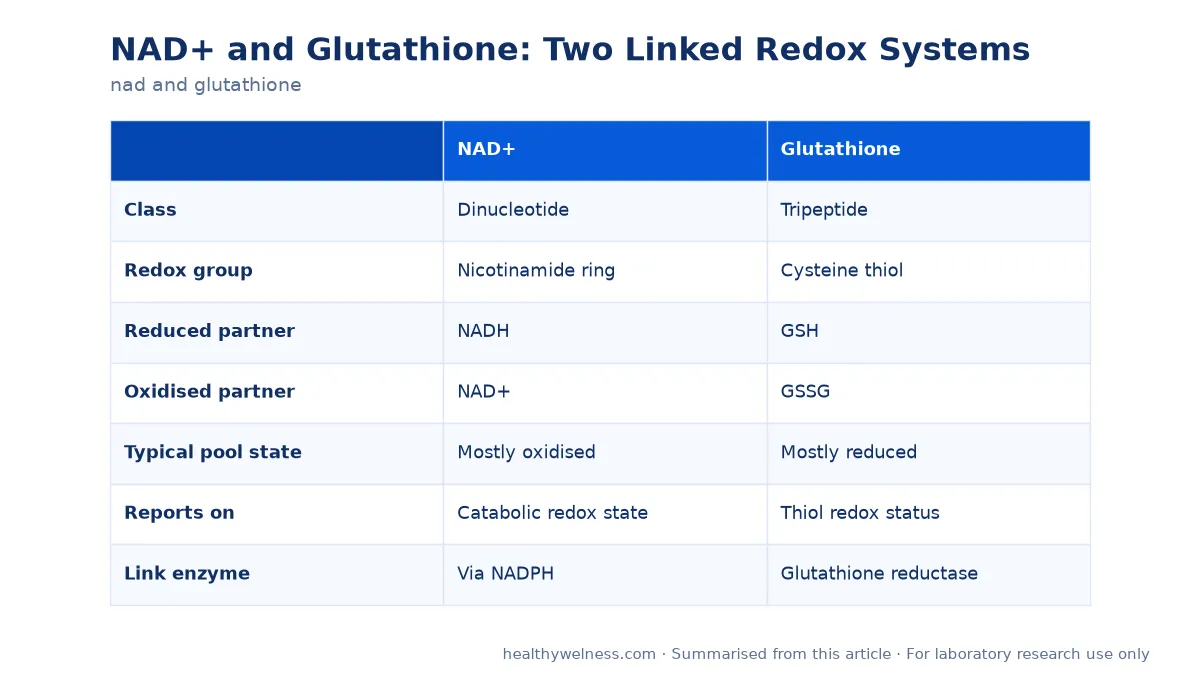
Side by side
| NAD+ | Glutathione | |
|---|---|---|
| Class | Dinucleotide | Tripeptide |
| Redox group | Nicotinamide ring | Cysteine thiol |
| Reduced partner | NADH | GSH |
| Oxidised partner | NAD+ | GSSG |
| Typical pool state | Mostly oxidised | Mostly reduced |
| Reports on | Catabolic redox state | Thiol redox status |
| Link enzyme | Via NADPH | Glutathione reductase |
How the two systems are joined
The connection is a single reaction, and its direction matters.
When reduced glutathione donates electrons, two GSH molecules are consumed and one disulfide, GSSG, is produced. Nothing about that reaction regenerates the reduced form. Glutathione reductase does that job, and it pays for it with NADPH.
The mechanism runs through a flavin rather than directly. NADPH reduces the FAD cofactor bound in the enzyme; the reduced flavin then reduces an active-site disulfide, and that in turn reduces GSSG. Computational work on the enzyme has examined how an active-site lysine affects the first of those steps, the FAD reduction by NADPH (Bonanata, 2024). The practical point for an experimenter is that this is a multi-step enzyme, not a direct hydride transfer from nucleotide to glutathione.
Why NADPH and not NADH
Cells maintain NAD+ mostly oxidised and NADP+ mostly reduced, and the separation is not accidental. The NAD+/NADH couple is held in a state suited to accepting electrons from catabolism; the NADP+/NADPH couple is held in a state suited to donating them to biosynthesis and to reductive defence. Glutathione reductase draws on the second pool.
This is why the chain of reasoning “more NAD+ means more reduced glutathione” does not hold as stated. The step from NAD+ to NADP+ requires phosphorylation, and the compartments are regulated separately: reviews of the cytoplasmic and mitochondrial NADPH-coupled systems treat them as distinct, differently controlled pools (Bradshaw, 2019). An experiment that changes one and assumes the other followed has not measured what it claims.
What each pool is actually measuring
| Readout | What it reports | What it does not |
|---|---|---|
| NAD+/NADH ratio | Catabolic redox state | Thiol status |
| NADP+/NADPH ratio | Reductive capacity | Catabolic flux |
| GSH/GSSG ratio | Thiol redox status | Nucleotide pools |
| Total glutathione | Pool size | Its redox state |
Two of these are routinely conflated. Total glutathione and the GSH/GSSG ratio are different measurements: a pool can shrink without changing its ratio, and a ratio can collapse without the pool changing size. A study reporting only “glutathione levels” has left that ambiguity in place.
The thiol system is wider than glutathione
Glutathione is not the only thiol relay in the cell. The glutaredoxins use glutathione to reduce protein disulfides and to reverse glutathionylation, and their literature has expanded well beyond a simple antioxidant role (Ogata et al., 2021). Reviews of glutathione itself place conjugation chemistry and electrophile handling alongside radical scavenging rather than below it (Averill-Bates, 2023). Designing around “glutathione as the antioxidant” leaves most of that out.
Where the “boost one to boost the other” reasoning breaks
The argument runs: glutathione reductase needs NADPH, NADPH comes from NADP+, NADP+ comes from NAD+, therefore raising NAD+ raises reduced glutathione. Each link in that chain is real. The conclusion still does not follow, for three separate reasons.
| Link | Why it is not a lever |
|---|---|
| NAD+ to NADP+ | Kinase-regulated step |
| NADP+ to NADPH | Separate reducing pathways |
| NADPH to GSH | Enzyme-limited, not substrate-limited |
| Compartments | Cytosol and mitochondria differ |
The phosphorylation step is regulated. Converting NAD+ to NADP+ is an enzymatic step under its own control, not a passive overflow from a larger pool. Increasing the upstream pool does not oblige that step to run faster.
The reduction step draws on other pathways. NADPH is generated by routes that have their own inputs and their own regulation, which is why the NADP+/NADPH ratio is held far more reduced than the NAD+/NADH ratio in the same cell.
The final step may not be substrate-limited at all. If glutathione reductase is operating below saturation for reasons other than NADPH availability, adding NADPH changes nothing. Whether it is NADPH-limited in a given system is an empirical question for that system.
On top of those, the compartments are not one pool. Reviews treating cytoplasmic and mitochondrial NADPH-coupled systems separately do so because they behave separately (Bradshaw, 2019), and a whole-cell measurement averages across that difference without resolving it.
Handling in the lab
The two compounds fail in different ways, and the precautions do not transfer.
- Glutathione oxidises on air contact. Limit vial entries, minimise headspace, and prepare working solutions near the time of use. Any handling step that admits oxygen is also changing the measurement.
- NAD+ is sensitive to pH and to hydrolysis at the nicotinamide-ribose bond rather than to oxygen. Its practical risk is a solution held too long or at the wrong pH, not an opened vial.
- Neither compound’s label weight is its net content. Convert using the batch documentation with the peptide calculator rather than assuming the stated weight is all active material.
Our NAD+ research material is supplied as a solid; the specification for a given batch is stated on its own documentation.
Related research
The nucleotide side is covered in what NAD+ is and NAD+ versus NADPH, which is the distinction this article turns on. For the peptide side see what glutathione is, and for storage behaviour whether NAD+ needs refrigeration.
None of this argues that the two systems are unconnected. They plainly are connected, through an enzyme whose mechanism is well characterised. The argument is narrower: a connection that exists is not automatically a lever that can be pulled, and whether it behaves as one in a given system is something to measure rather than to assume from the pathway.
Open questions
How tightly the two pools track each other in an intact cell, as opposed to in a purified enzyme assay, is not well characterised. The compartmentalisation of NADPH between cytosol and mitochondria complicates any whole-cell measurement, and most published designs report one pool well and the other incidentally. As of 2026-11-07, a PubMed search combining “NAD+” with “GSH/GSSG” and “compartment” returned no study measuring both couples simultaneously in both compartments; that is a statement about this search rather than evidence no such work exists.
Frequently asked questions
Are NAD+ and glutathione the same kind of molecule?
No. NAD+ is a dinucleotide built from nicotinamide and adenine riboside units joined through a pyrophosphate. Glutathione is a tripeptide of glutamate, cysteine and glycine. They are different chemical classes that happen to participate in connected redox chemistry.
How are the two systems connected?
Through glutathione reductase, which uses NADPH to reduce oxidised glutathione back to the reduced form. NADPH is derived from NADP+, which cells phosphorylate from the NAD+ pool, so the supply chain runs NAD+ to NADP+ to NADPH to glutathione.
Does raising NAD+ raise glutathione?
That does not follow from the pathway. NADPH rather than NAD+ is the direct cofactor for glutathione reductase, and the two nucleotide pools are kept at very different redox states by design. Published work treats the cytoplasmic and mitochondrial NADPH-coupled systems as separately regulated (Bradshaw, 2019).
Which one is measured in a redox assay?
Both are measured, but they answer different questions. The GSH/GSSG ratio reports thiol redox status. The NAD+/NADH ratio reports the catabolic redox state. A study that reports only one has not characterised the other.
Do they need the same storage?
No. Glutathione’s free thiol oxidises on air exposure, so its handling is about excluding oxygen. NAD+ in solution is sensitive to pH and hydrolysis of the nicotinamide-ribose bond, which is a different failure mode with different precautions.
For laboratory research use only. The research materials supplied by HealthyWelness are not approved medicines, foods or cosmetics and are not for human or veterinary use. This article summarises published research and is not medical advice.
Sources
- Bradshaw PC. Cytoplasmic and Mitochondrial NADPH-Coupled Redox Systems in the Regulation of Aging. Nutrients. 2019. PMID: 30818813
- Bonanata J. The role of the active site lysine residue on FAD reduction by NADPH in glutathione reductase. Comput Biol Chem. 2024. PMID: 38678729
- Ogata FT, et al. Glutaredoxin: Discovery, redox defense and much more. Redox Biol. 2021. PMID: 33932870
- Averill-Bates DA. The antioxidant glutathione. Vitam Horm. 2023. PMID: 36707132