TB-500 Science: What PubMed Says on Inflammation and Immunity
The anti-inflammatory and immune literature behind TB-500 is mostly about full thymosin beta-4 and its Ac-SDKP fragment. What each study used and found.

Cover illustration: AI-generated editorial artwork. Conceptual only; not an exact molecular structure, actual laboratory result or evidence of clinical effects.
Most of the “TB-500 science” on inflammation and immunity is research on full-length thymosin beta-4 and on Ac-SDKP, a different fragment from the opposite end of the protein. TB-500 itself, the short actin-binding fragment Ac-LKKTETQ, has little primary literature of its own. Reading the evidence means checking which molecule each study actually used.
For laboratory research use only. The research materials supplied by HealthyWelness are not approved medicines, foods or cosmetics and are not for human or veterinary use. This article summarises published research and is not medical advice.
- Thymosin beta-4 is a 43-amino-acid peptide released after injury by platelets, macrophages and other cells, and binds actin to promote cell migration (Goldstein et al., 2012).
- Thymosin beta-4 and thymosin beta-10 are primarily actin monomer sequestering proteins rather than profilin-like regulators (Yu et al., 1993).
- The anti-inflammatory tetrapeptide Ac-SDKP is released from thymosin beta-4 only when meprin-alpha and prolyl oligopeptidase act in sequence (Kumar et al., 2016).
- A 2026 orthopaedic review found that thymosin beta-4 and TB-500 promoted angiogenesis and tissue repair in preclinical models, but that human orthopaedic data are lacking (Mayfield et al., 2026).
- Thymosin beta-4 has been in phase 3 human trials for dry eye disease (Sosne and Berger, 2023).
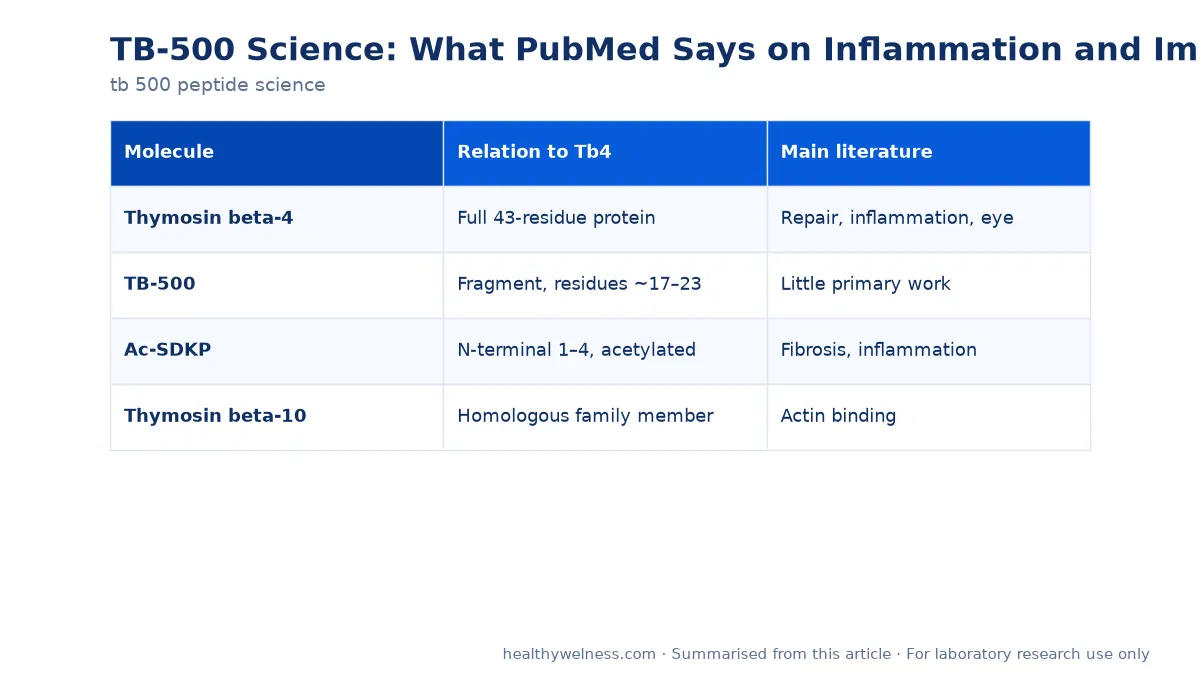
Which molecule is which
| Molecule | Relation to Tb4 | Main literature |
|---|---|---|
| Thymosin beta-4 | Full 43-residue protein | Repair, inflammation, eye |
| TB-500 | Fragment, residues ~17–23 | Little primary work |
| Ac-SDKP | N-terminal 1–4, acetylated | Fibrosis, inflammation |
| Thymosin beta-10 | Homologous family member | Actin binding |
The table is the key to the rest of this review. A paper titled “thymosin beta-4 reduces inflammation” is evidence about the full protein, which contains both the actin-binding region that TB-500 is modelled on and the N-terminal sequence from which Ac-SDKP is cut. Our TB-500 research peptide is the short fragment, not the full protein.
Certificates are available for listed products — contact us for the latest report.
The actin story: what thymosin beta-4 does in a cell
Thymosin beta-4’s best-established role is structural. Yu and colleagues expressed thymosin beta-4 and its homologue thymosin beta-10 in bacteria and showed that both bind skeletal muscle actin and inhibit its polymerisation with similar affinities. They concluded that, unlike profilin, beta-thymosins act primarily by sequestering actin monomers, although some kinetic details did not fit a pure sequestering model (Yu et al., 1993).
This is the activity TB-500 is associated with. The central actin-binding motif of thymosin beta-4 lies in the region the fragment reproduces. Actin sequestration influences cell migration, which links it to wound and repair models, but it is not in itself an anti-inflammatory mechanism. Claims that TB-500 is “anti-inflammatory” usually borrow from the next two sections, which concern other parts of the protein.
The Ac-SDKP story: an anti-inflammatory fragment from the other end
Ac-SDKP (N-acetyl-seryl-aspartyl-lysyl-proline) is a natural tetrapeptide with reported anti-inflammatory and antifibrotic properties, corresponding to the first four residues of thymosin beta-4. Kumar and colleagues worked out how it is released. Prolyl oligopeptidase can only cleave peptides shorter than about 30 residues, so another enzyme must act first. Incubating thymosin beta-4 with both meprin-alpha and prolyl oligopeptidase released Ac-SDKP; either enzyme alone did not. Kidneys from meprin-alpha knockout mice had lower basal Ac-SDKP and their homogenates could not release it (Kumar et al., 2016).
| Study | Molecule tested | Model | Finding |
|---|---|---|---|
| Kumar et al., 2016 | Tb4 to Ac-SDKP | Enzymes, rat, KO mice | Meprin-a + POP needed |
| Conte et al., 2015 | Tb4 and Ac-SDKP | IPF fibroblasts, mice | Ac-SDKP antifibrotic in vitro |
| Othman et al., 2023 | Tb4 | APP/PS1 mice + LPS | Less plaque, more glia in WT |
| Sosne and Berger, 2023 | Tb4, topical | Keratitis model | Fewer inflammatory cells |
Conte and colleagues compared the two molecules directly. In primary lung fibroblasts from patients with idiopathic pulmonary fibrosis, Ac-SDKP was significantly anti-proliferative and inhibited TGF-beta-induced alpha-smooth muscle actin and collagen expression. In bleomycin-treated mice, full thymosin beta-4, protective at 7 days in their earlier work, failed to prevent fibrosis at 14 and 21 days. The authors concluded that Ac-SDKP may have greater antifibrotic potential in the lung than the parent protein (Conte et al., 2015). Readers should note that the journal published an expression of concern about this article in November 2025, recorded on its PubMed entry; its findings should be weighed with that in mind.
Inflammation and immune models using the full protein
Systemic LPS and the brain
Othman and colleagues challenged 12.5-month-old male APP/PS1 Alzheimer’s model mice and wild-type littermates with intravenous lipopolysaccharide, then gave thymosin beta-4 or vehicle over seven days. Thymosin beta-4 reduced sickness behaviour more in APP/PS1 mice, limiting LPS-induced weight reduction and loss of burrowing, and prevented the LPS-induced increase in amyloid burden. In wild-type mice treated with LPS, however, it increased astrocyte and microglia proliferation in the hippocampus (Othman et al., 2023). The result is a reminder that “anti-inflammatory” is too simple a label: the same protein dampened one inflammatory consequence and promoted a glial response in another genotype.
Infection in the eye
The most clinically advanced line is ophthalmic. Sosne and Berger review work in which topical thymosin beta-4, added to ciprofloxacin in a Pseudomonas aeruginosa keratitis model, reduced inflammatory mediators and infiltrating neutrophils and macrophages while enhancing bacterial killing and activating wound healing pathways. They note that thymosin beta-4 was then in phase 3 trials for dry eye disease (Sosne and Berger, 2023). The authors are investigators in this programme, and their article is a perspective rather than a new trial report.
The broad review
Goldstein and colleagues’ 2012 review summarises thymosin beta-4 as a multi-functional regenerative peptide: released after injury, protecting cells, reducing apoptosis, inflammation and microbial growth, promoting stem and progenitor cell migration, and reducing myofibroblast numbers and scarring, with trials planned in skin, eye, heart and brain (Goldstein et al., 2012). It is a useful map of the field but was written by researchers closely involved with the protein’s development, and it concerns the full protein throughout.
What this means for TB-500 specifically
Putting the strands together gives a clear conclusion about attribution. The anti-inflammatory and antifibrotic signals in this literature come from full thymosin beta-4 and from Ac-SDKP. TB-500 contains neither the complete protein nor the Ac-SDKP sequence. It reproduces the actin-binding region, for which the best evidence concerns cytoskeletal dynamics.
| Claim often made | Molecule the evidence used | Applies to TB-500? |
|---|---|---|
| Binds and sequesters actin | Full Tb4, Tb10 | Plausibly, by sequence |
| Antifibrotic | Mainly Ac-SDKP | Not shown |
| Reduces inflammatory cells | Full Tb4, topical | Not shown |
| Modulates glia after LPS | Full Tb4, intravenous | Not shown |
The 2026 orthopaedic primer reached a similar position from the clinical side, grouping thymosin beta-4 and TB-500 together as compounds with preclinical support for angiogenesis and repair, lacking human orthopaedic data, and banned in sport (Mayfield et al., 2026). The difference between the full protein and the fragment is set out in more detail in what is TB-500 and thymosin fragments compared.
Handling in the lab
TB-500 is a short, charged, water-soluble peptide. Its N-terminal acetyl group is part of the defined structure, so mass spectrometry should confirm it; an unacetylated impurity differs by 42 Da. Solutions are best kept cold and in single-use portions. The procedure is in TB-500 reconstitution, reported pharmacokinetic information is in TB-500 half-life, and concentrations are calculated with the peptide calculator.
Related research
The fragment’s most common comparator is discussed in BPC-157 versus TB-500, and the published work on combining those two in BPC-157 and TB-500 combination research.
Frequently asked questions
Is there published research on TB-500 itself?
Very little that uses the TB-500 fragment by name. Most PubMed records on anti-inflammatory and immune effects study full-length thymosin beta-4 (43 amino acids) or its N-terminal fragment Ac-SDKP. TB-500 is a short synthetic fragment, so those results cannot be transferred to it without testing.
What is the difference between TB-500 and Ac-SDKP?
They come from opposite ends of thymosin beta-4. TB-500 corresponds to the actin-binding region around residues 17-23 (Ac-LKKTETQ). Ac-SDKP is the acetylated first four residues, released from thymosin beta-4 by meprin-alpha followed by prolyl oligopeptidase (Kumar et al., 2016).
Does thymosin beta-4 have anti-inflammatory effects?
Several models report them. A review describes thymosin beta-4 being released after injury by platelets, macrophages and other cells and reducing apoptosis, inflammation and microbial growth (Goldstein et al., 2012). In a mouse model, it limited LPS-induced amyloid burden in APP/PS1 mice but increased glial proliferation in wild-type mice (Othman et al., 2023).
Where does the immune research stand clinically?
Thymosin beta-4 has been in human trials for eye conditions, including phase 3 trials for dry eye disease (Sosne and Berger, 2023). For musculoskeletal uses, a 2026 review found human orthopaedic data lacking for both thymosin beta-4 and TB-500 (Mayfield et al., 2026).
Is TB-500 permitted in sport?
No. A 2026 review notes that thymosin beta-4 and its derivative TB-500 remain banned substances in sports (Mayfield et al., 2026).
Why does the source of a finding matter so much here?
Because thymosin beta-4 is processed into fragments with different activities. A result with the full protein may reflect actin binding, Ac-SDKP release or another region. Reporting exactly which molecule was used is the only way to keep the literature interpretable.
For laboratory research use only. The research materials supplied by HealthyWelness are not approved medicines, foods or cosmetics and are not for human or veterinary use. This article summarises published research and is not medical advice.
Sources
- Goldstein AL, et al. Thymosin β4: a multi-functional regenerative peptide. Basic properties and clinical applications. Expert Opin Biol Ther. 2012. PMID: 22074294
- Yu FX, et al. Thymosin beta 10 and thymosin beta 4 are both actin monomer sequestering proteins. J Biol Chem. 1993. PMID: 8416954
- Kumar N, et al. The anti-inflammatory peptide Ac-SDKP is released from thymosin-β4 by renal meprin-α and prolyl oligopeptidase. Am J Physiol Renal Physiol. 2016. PMID: 26962108
- Conte E, et al. Effects of thymosin β4 and its N-terminal fragment Ac-SDKP on TGF-β-treated human lung fibroblasts and in the mouse model of bleomycin-induced lung fibrosis. Expert Opin Biol Ther. 2015. PMID: 26098610
- Othman O, et al. Thymosin beta 4 prevents systemic lipopolysaccharide-induced plaque load in middle-age APP/PS1 mice. Int Immunopharmacol. 2023. PMID: 36878045
- Sosne G, et al. Thymosin beta 4: A potential novel adjunct treatment for bacterial keratitis. Int Immunopharmacol. 2023. PMID: 37018981
- Mayfield CK, et al. Injectable Peptide Therapy: A Primer for Orthopaedic and Sports Medicine Physicians. Am J Sports Med. 2026. PMID: 41476424