What Is AHK-Cu? The Ala-His-Lys Copper Tripeptide
AHK-Cu explained: the alanyl-histidyl-lysine copper complex, the single hair follicle study behind it, how it differs from GHK-Cu and what remains untested.

Cover illustration: AI-generated editorial artwork. Conceptual only; not an exact molecular structure, actual laboratory result or evidence of clinical effects.
AHK-Cu is the copper(II) complex of the tripeptide alanyl-histidyl-lysine, a close relative of GHK-Cu in which glycine is replaced by alanine. Its indexed research record is essentially a single 2007 study in human hair follicles and dermal papilla cells, which makes it one of the least characterised copper peptides in common laboratory use.
For laboratory research use only. The research materials supplied by HealthyWelness are not approved medicines, foods or cosmetics and are not for human or veterinary use. This article summarises published research and is not medical advice.
- AHK-Cu at concentrations from 10⁻¹² to 10⁻⁹ M stimulated elongation of human hair follicles ex vivo and proliferation of cultured dermal papilla cells (Pyo et al., 2007).
- At 10⁻⁹ M, the Bcl-2 to Bax ratio rose while cleaved caspase-3 and cleaved PARP fell in dermal papilla cells (Pyo et al., 2007).
- The reduction in apoptotic dermal papilla cells measured by annexin V labelling was not statistically significant in that study (Pyo et al., 2007).
- A PubMed search on 2026-11-04 for AHK-Cu and for alanyl-histidyl-lysine copper returned one study specific to the complex.
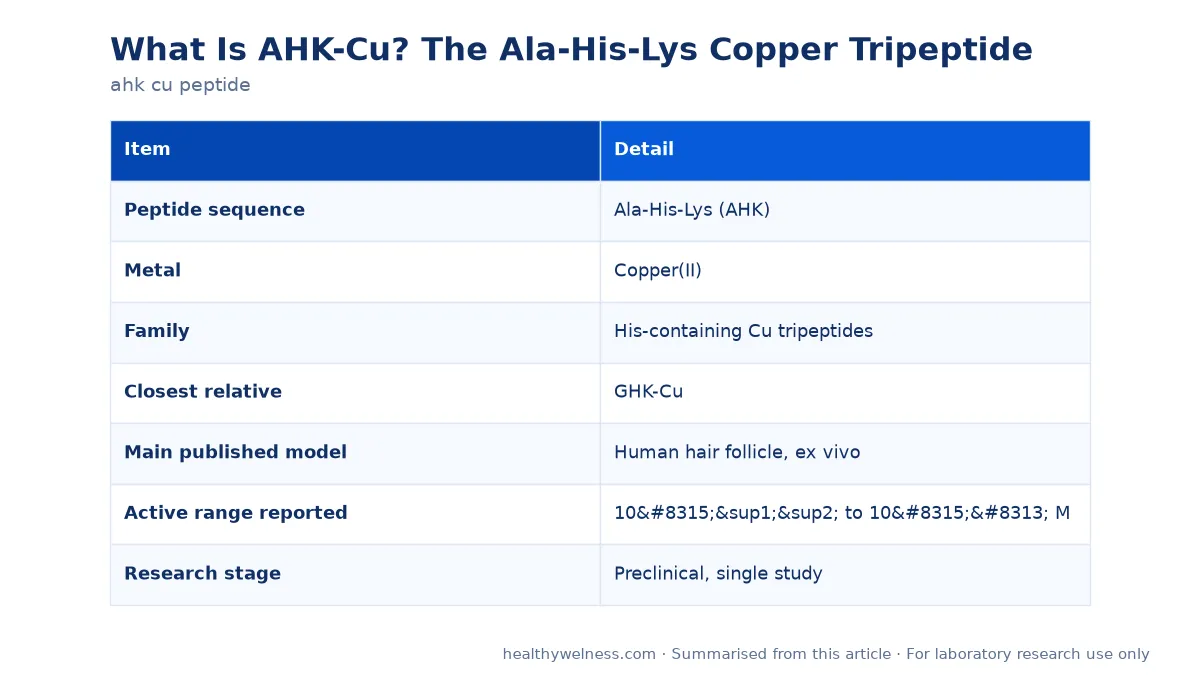
Quick facts
| Item | Detail |
|---|---|
| Peptide sequence | Ala-His-Lys (AHK) |
| Metal | Copper(II) |
| Family | His-containing Cu tripeptides |
| Closest relative | GHK-Cu |
| Main published model | Human hair follicle, ex vivo |
| Active range reported | 10⁻¹² to 10⁻⁹ M |
| Research stage | Preclinical, single study |
Molecular weight and exact mass depend on the salt and complex form supplied, so those values should be read from the certificate for the specific lot rather than taken from a general reference. Material from the AHK-Cu research peptide listing is supplied for laboratory use only. Certificates are available for listed products — contact us for the latest report.
Why the sequence matters
The copper-binding tripeptides of biological interest share a pattern: a histidine in the middle position whose imidazole nitrogen coordinates copper, flanked by residues that complete the coordination sphere. GHK (glycyl-histidyl-lysine) is the best known, identified in human albumin. DAHK is the N-terminal tetrapeptide of albumin itself and a high-affinity copper chelator in plasma. AHK differs from GHK by a single methyl group: alanine in place of glycine at position 1.
That small change is not necessarily trivial, because the N-terminal amine participates in copper coordination. Hureau and colleagues determined X-ray and solution structures of Cu(II) GHK and Cu(II) DAHK using EPR, HYSCORE, X-ray absorption and NMR spectroscopy. For Cu(II) DAHK, the equatorial coordination sphere comprised the N-terminal amine, two amide nitrogens and the imidazole nitrogen, with an apical water molecule. Cu(II) GHK was dimeric in the solid state but monomeric in solution with three nitrogen ligands, the fourth equatorial position being a labile oxygen. Redox behaviour differed too: both complexes were inert at moderate potentials, but unlike the DAHK complex, Cu(II) GHK could be reduced to Cu(I) at around −0.62 V with subsequent release of the copper ion, and copper exchange between GHK peptides was fast while exchange between DAHK peptides was very slow (Hureau et al., 2011).
No equivalent structural or redox study of the AHK complex appears in the records found here. Because stability, lability and redox activity differ measurably between GHK and DAHK complexes, those properties should not be assumed for AHK by analogy. That is a concrete gap a laboratory could address with cyclic voltammetry and spectroscopy on a well-characterised lot.
What the hair follicle study showed
Pyo and colleagues set out from the observation that tripeptide-copper complexes stimulate proliferation of dermal fibroblasts, raise vascular endothelial growth factor production and lower transforming growth factor beta-1 secretion by those cells. Dermal papilla cells are specialised fibroblasts central to hair follicle morphogenesis and growth, which made them a logical target.
Two systems were used: human hair follicles cultured ex vivo and dermal papilla cells in vitro. AHK-Cu across the range 10⁻¹² to 10⁻⁹ M stimulated follicle elongation and cell proliferation. Apoptosis was then examined by annexin V–FITC and propidium iodide labelling with flow cytometry: at 10⁻⁹ M the number of apoptotic cells was reduced, but the authors reported the decrease as not statistically significant. Protein-level markers moved consistently with reduced apoptosis, with a raised Bcl-2 to Bax ratio and lower levels of cleaved caspase-3 and cleaved PARP. Their proposed interpretation was that AHK-Cu promotes follicle growth through proliferation and reduced apoptosis of dermal papilla cells (Pyo et al., 2007).
| Readout | System | Result at 10⁻⁹ M |
|---|---|---|
| Follicle elongation | Human follicle, ex vivo | Stimulated |
| DPC proliferation | Cell culture | Stimulated |
| Annexin V apoptosis | Flow cytometry | Lower, not significant |
| Bcl-2 / Bax ratio | Protein analysis | Raised |
| Cleaved caspase-3, PARP | Protein analysis | Reduced |
Two caveats belong with these results. The flow cytometry endpoint, the most direct measure of apoptosis in the study, did not reach significance, so the apoptosis mechanism rests mainly on the downstream protein markers. And the whole account comes from one laboratory in one paper; independent replication is what would turn it into an established finding.
How the evidence compares with GHK-Cu
The contrast with its better-known relative is stark. Pickart’s 2008 review of GHK and tissue remodelling lists effects reported across many models: chemoattraction of repair cells, suppression of free radicals and of transforming growth factor beta-1 and tumour necrosis factor alpha, increased synthesis of collagen, elastin, metalloproteinases and several growth factors, increased proliferation of fibroblasts and keratinocytes, and effects on angiogenesis and hair follicle size, together with wound healing in numerous models (Pickart, 2008). A later review covers reported gene regulation and antioxidant actions and proposes applications beyond skin (Pickart et al., 2012).
Whether one finds those reviews persuasive is a separate question; the point for AHK-Cu is quantitative. GHK-Cu has a large multi-decade literature, and AHK-Cu has one paper. A direct comparison of the two is in AHK-Cu vs GHK-Cu, and background on the better-studied peptide in what is GHK-Cu.
What has not been studied
Listing the gaps is more useful here than in most profiles, because they are unusually wide. No pharmacokinetic work on AHK-Cu appears in the records found here, in any species. There is no reported stability study of the complex in solution, no formal structural determination, and no independent replication of the 2007 follicle findings. Beyond hair follicles and dermal papilla cells, no other tissue or cell type has been reported for the complex specifically. Searching on 2026-11-04 for AHK-Cu, “AHK copper” and alanyl-histidyl-lysine with copper returned one study of the complex itself; the remaining hits concerned GHK, DAHK or unrelated copper chemistry. Absence from these searches is not proof that no such work exists, but it does mean that claims about AHK-Cu beyond the follicle study have no published basis to cite.
Handling copper peptides in the laboratory
- Copper content is part of the identity. A copper-peptide complex is characterised by its metal-to-peptide ratio as well as peptide purity. A certificate reporting only peptide purity does not establish the complex’s stoichiometry.
- Expect a coloured solution. Copper(II) complexes of these tripeptides are typically blue to violet; the colour itself is a crude check that the complex is intact. Loss of colour suggests dissociation.
- Avoid competing chelators. Buffers containing EDTA, citrate or high phosphate can strip or compete for copper. The GHK work showed fast copper exchange, so buffer choice can change what is actually present.
- Protect from light and keep stocks fresh. Copper complexes can participate in redox chemistry under some conditions, so freshly prepared solutions and dark storage are prudent.
- Nanomolar and below. The reported active range in the follicle study was picomolar to nanomolar, far below concentrations typical for larger peptides, so serial dilution accuracy matters more than usual.
Concentrations should be calculated from the certificate’s reported content using the peptide calculator. General handling steps are in how to reconstitute peptides.
Frequently asked questions
What is AHK-Cu?
AHK-Cu is the copper(II) complex of the tripeptide L-alanyl-L-histidyl-L-lysine. It belongs to the same family of histidine-containing copper-binding tripeptides as GHK-Cu, differing in the first residue: alanine instead of glycine.
What has AHK-Cu been studied in?
The main published study is an ex vivo and cell culture experiment. Pyo and colleagues reported that AHK-Cu at 10^-12 to 10^-9 M stimulated elongation of human hair follicles ex vivo and proliferation of cultured dermal papilla cells (Pyo et al., 2007).
What did that study report about apoptosis markers?
At 10^-9 M, the number of apoptotic dermal papilla cells fell but not significantly; the Bcl-2 to Bax ratio rose, and cleaved caspase-3 and cleaved PARP levels fell (Pyo et al., 2007).
How does AHK-Cu differ from GHK-Cu?
Mainly in evidence base. GHK-Cu has decades of published work across wound models, gene expression and skin studies (Pickart, 2008), while the indexed literature specific to AHK-Cu is essentially one 2007 paper.
Is the copper coordination chemistry of AHK-Cu characterised?
Not in the records found here. Detailed X-ray and solution structures exist for Cu(II) GHK and Cu(II) DAHK (Hureau et al., 2011), but we found no equivalent structural study of the AHK complex.
For laboratory research use only. The research materials supplied by HealthyWelness are not approved medicines, foods or cosmetics and are not for human or veterinary use. This article summarises published research and is not medical advice.
Sources
- Pyo HK, et al. The effect of tripeptide-copper complex on human hair growth in vitro. Arch Pharm Res. 2007. PMID: 17703734
- Hureau C, et al. X-ray and solution structures of Cu(II) GHK and Cu(II) DAHK complexes: influence on their redox properties. Chemistry. 2011. PMID: 21780203
- Pickart L. The human tri-peptide GHK and tissue remodeling. J Biomater Sci Polym Ed. 2008. PMID: 18644225
- Pickart L, et al. The human tripeptide GHK-Cu in prevention of oxidative stress and degenerative conditions of aging: implications for cognitive health. Oxid Med Cell Longev. 2012. PMID: 22666519