Peptide NMR: From Resonance Assignments to Structure
Read peptide NMR research through resonance assignments, experimental restraints and condition-specific structure models, with a worked evidence example.


Peptide NMR can connect observed resonances to particular atoms and use experimental restraints to support solution-structure models. A spectrum, an assignment list and a calculated structural ensemble are different records. Their agreement matters more than the appearance of a single molecular drawing, and every interpretation belongs to the sample conditions actually measured.
- An NMR resonance is an observed spectral signal; its atom assignment is an interpretation supported by correlations and chemical context.
- An assigned chemical shift is not, by itself, a distance between two atoms.
- Structural calculations combine experimental information with a defined molecular topology and modelling assumptions.
- A set of calculated conformers does not automatically give the real population percentage of each conformation.
Follow the evidence from signal to atom to structural model
Imagine opening a supplementary file containing a spectrum and a ribbon image. The missing question is how the two were connected. Which signals were assigned? Which observations constrained geometry? Which portions of the chain remained uncertain? Answering these questions makes the structure assessable rather than merely recognizable.
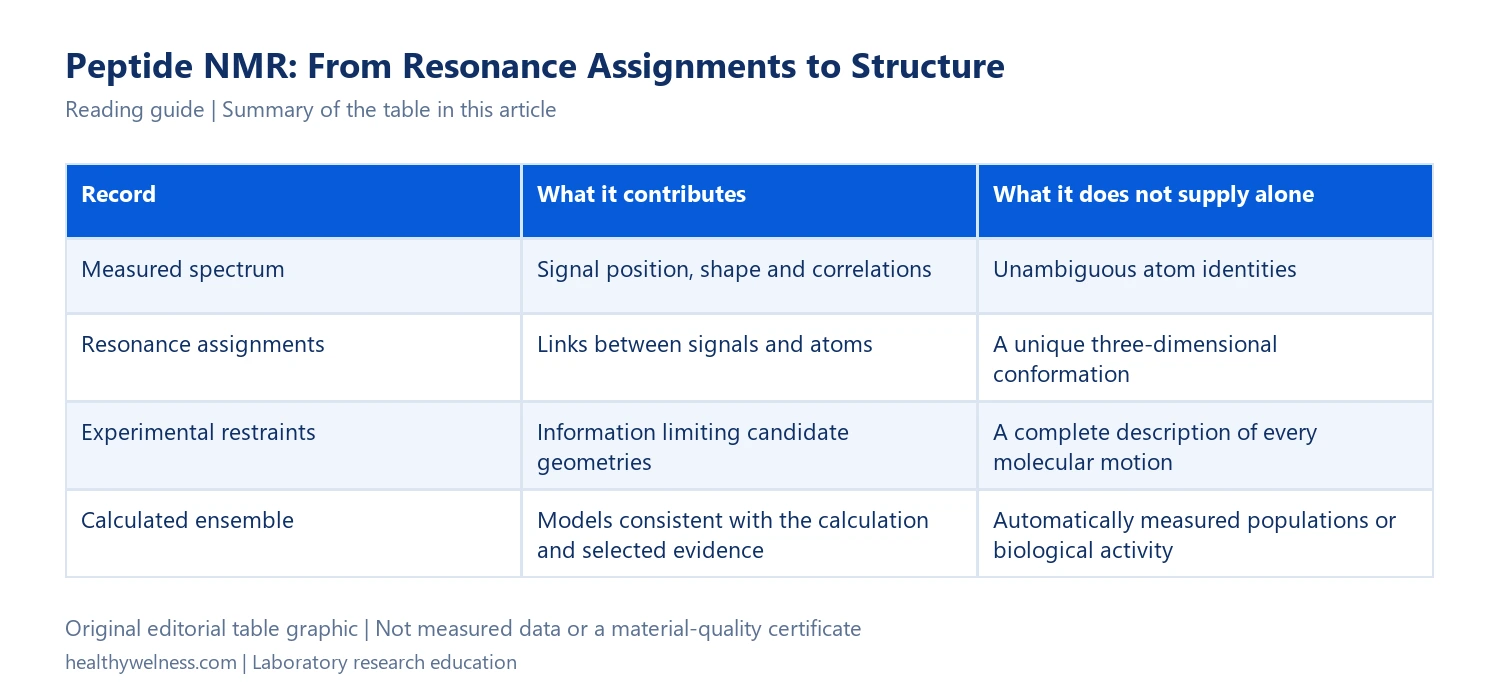
| Record | What it contributes | What it does not supply alone |
|---|---|---|
| Measured spectrum | Signal position, shape and correlations | Unambiguous atom identities |
| Resonance assignments | Links between signals and atoms | A unique three-dimensional conformation |
| Experimental restraints | Information limiting candidate geometries | A complete description of every molecular motion |
| Calculated ensemble | Models consistent with the calculation and selected evidence | Automatically measured populations or biological activity |
These records can fail independently. Good peak positions do not rescue an incorrect assignment. Correct assignments do not ensure enough structural information to position a flexible segment. A physically plausible model does not establish that the reported observations actually distinguish it from alternatives.
For the underlying distinction between chain identity and conformation, see peptide structure levels. Here the task is narrower: tracing how an NMR report justifies atom-level statements about that chain.
Assignments need networks of observations
The American Peptide Society’s technical primer describes homonuclear experiments commonly used for small, unlabelled peptides, including COSY or TOCSY and NOESY or ROESY. Their correlations answer different questions. Through-bond information helps organize connected nuclei, while suitable through-space information can contribute to structural interpretation. Treating all cross-peaks as the same type of evidence loses that distinction. American Peptide Society: peptide NMR analysis
A reader does not need to reproduce a complete assignment to ask whether it is supported. Start with the molecular definition: sequence, termini, nonstandard residues and covalent links. Then identify whether the assignment table names the residue and atom associated with each reported shift. A label such as “alanine signal” is less specific than an atom assignment at a particular sequence position, especially when several alanines occur in the chain.
Marchant, Summers and Johnson’s original 2019 paper describes an assignment method using networks of predicted and observed peaks across spectra. It includes peptide applications but illustrates much of the detailed workflow using RNA. The relevant principle is that several connected observations can resolve ambiguity left by an isolated peak; it is not evidence that a prediction is automatically correct. Marchant et al., Journal of Biomolecular NMR, 2019
Keep prediction and measurement in separate columns when extracting a study. If a predicted position was used to suggest an assignment, ask what observed correlations supported that choice and whether other assignments remained plausible. Merely matching a predicted chemical shift is weaker than resolving a consistent network of measured relationships.
A hypothetical ambiguity cannot be removed by renaming a peak
Hypothetical example: consider a defined peptide containing two leucines, labelled Leu-3 and Leu-8. Suppose one observed signal is compatible with either position. Calling it “Leu-3” in a table makes the record look complete, but adds no experimental distinction between the two possibilities.
Now suppose an additional observed correlation connects that signal to a separately assigned neighbouring residue in a way that supports one position. That new information changes the assignment argument. The same conclusion cannot be obtained simply by choosing the label that makes a preferred structural model look better.
- Observation: a peak and its measured correlations.
- Candidate interpretation: one or more possible atom assignments.
- Discriminating evidence: an observation that separates those possibilities.
- Remaining uncertainty: assignments that the available data still do not distinguish.
This example deliberately supplies no real shifts or purported spectra. It explains a logical requirement: an ambiguous observation remains ambiguous until evidence resolves it. A structural calculation that assumes one assignment may explore the consequences of that assumption, but should not be described as independently proving the assumption.
Restraints narrow possibilities without measuring every coordinate
The Society’s primer describes calculations using NMR-derived distance information and couplings, with structural quality assessed against experimental restraints and molecular geometry. The model is therefore a result of combining evidence and a calculation. It is not a direct three-dimensional photograph.
When reading an ensemble, ask where the information is located. A large total number of restraints can be concentrated in one part of the molecule. It does not follow that a poorly supported terminus or loop is equally well determined. A compact group of models may reflect strong evidence, restrictive calculation assumptions, or both; evaluating the report requires the restraint and validation records.
Three questions help separate these issues. First, do the selected models satisfy the observations used to generate them? Second, is their chemistry and geometry appropriate for the explicitly defined molecule? Third, were meaningful alternatives or ambiguities considered? Passing one of these checks does not make the other two unnecessary.
For modified or cyclic peptides, verify that the calculation represents the actual connectivity. A standard-residue chain model is not automatically an adequate representation of an altered backbone, a noncanonical side chain or an unusual ring closure. For naming context, see nonproteinogenic amino-acid records.
Distinguish an ensemble of models from populations in solution
Hypothetical counting exercise: a supplementary archive contains 20 selected conformers; 15 have a visually similar turn and five look different in that region. The archive fractions are 15/20 = 75% and 5/20 = 25%. Those numbers describe the selected files. They do not, without a population-analysis method and supporting evidence, establish that 75% and 25% of molecules in the solution occupy those states.
Why not? The number of files retained can be a reporting choice. A researcher could save ten, twenty or fifty models using the same selection rule. The count is not automatically a molecular census. A population estimate needs an analysis that relates the measured observables to the proposed conformations and their weights, including its uncertainty and model scope.
This also limits a common illustration habit. Showing a single representative conformer can help readers follow residue numbering, but it can conceal unresolved heterogeneity. The caption should say whether the view is one selected model, an ensemble overlay or a population-weighted representation supported by a separate analysis.
Keep solution conditions attached to deposited structures
BMRB entry 34130 is a useful original-deposition example. It identifies a chemically synthesized, 35-residue peptide derived from the HIV-1 gp41 fusion region, associates it with PDB entry 5NVP, and records chemical shifts, experiments, sample composition and conditions. Its title explicitly specifies dodecylphosphocholine micelles. This is a record of a particular experimental system, not a structure for every peptide or every environment. BMRB 34130: assignment and structure deposition
The example shows why an accession is more useful than an unlabelled downloaded image. It gives readers a route back to the entity and the conditions behind the figure. When comparing a deposited structure with a later experiment, check that the sequence and modifications match and that any change in medium is acknowledged.
A model established in a micellar or other defined medium does not automatically describe a peptide in a different solvent, at a different concentration or in another molecular complex. Transferring a conformational claim requires evidence for that transfer. A sample condition belongs to the claim, rather than being an optional technical detail.
Questions about peptide NMR interpretation
Does a one-dimensional spectrum establish a complete peptide structure?
Not by itself. A complete structural claim needs atom assignments and suitable structural information, together with a defined molecular model and an assessment of unresolved alternatives.
Are chemical-shift assignments the same as distance restraints?
No. Assignments connect resonances to atoms. A structural restraint is an additional interpretation of suitable experimental information that limits candidate geometries.
Does a small spread among calculated conformers prove accuracy?
No. It describes agreement among the selected models. Their agreement with the experimental evidence, chemical representation and alternative explanations still needs assessment.
Can saved conformer counts be read as population percentages?
Only when an appropriate population-analysis method supports that interpretation. Counts of selected output files alone are not counts of molecules in solution.
Can a deposited structure establish the conformation in a different medium?
Not automatically. Identify the original sample conditions and the evidence supporting any proposed transfer to another experimental environment.
Read related analytical evidence
Compare the atom-assignment question with what a peptide mass match establishes and the ensemble optical question with reading peptide CD spectra. For connecting a method to a named sample, use the analytical-document checklist. None of these educational explanations reports characterization of HealthyWelness products.
Cover: AI-generated conceptual editorial artwork, not an exact molecular structure, measured result or a photograph of HealthyWelness staff or facilities.