Free Thiols vs Disulfide Mapping: Reading Connectivity Evidence
Distinguish free-thiol measurements from cysteine-resolved disulfide mapping, with research examples of labeling, coverage and preparation artifacts.


A free-thiol assay estimates reactive sulfhydryl groups; disulfide mapping assigns which cysteine residues are connected. These measurements answer different questions. Low free-thiol signal does not identify a pairing map, and a reduced peptide sequence does not retain the original bridges. A useful connectivity report links cysteine-resolved evidence to the preparation, assignments and unresolved alternatives.
- Ellman’s reagent measures a reaction with free sulfhydryl groups; its signal does not name their original disulfide partners.
- Sequential labeling can preserve information about which cysteines became available at different analytical stages.
- A connectivity assignment needs site-resolved support, not merely a mass compatible with an oxidized chain.
- Sample preparation can rearrange disulfides, so the observed map must be assessed for analytical artifacts.
Begin with the analytical question, not the word oxidized
A research report might say that a peptide is oxidized, contains little free thiol, or has the intended disulfide pattern. Those descriptions are not interchangeable. The first may concern a composition change; the second concerns a reactive-group measurement; the third identifies specific connections. Ask what was actually measured before deciding which description follows.
The underlying chemistry is explained in our peptide-bond versus disulfide-bond guide. This article addresses a different task: interpreting analytical evidence after the molecular specification already defines the intended cysteine partners. It does not rank every oxidized form as correctly folded or every free cysteine as an impurity.
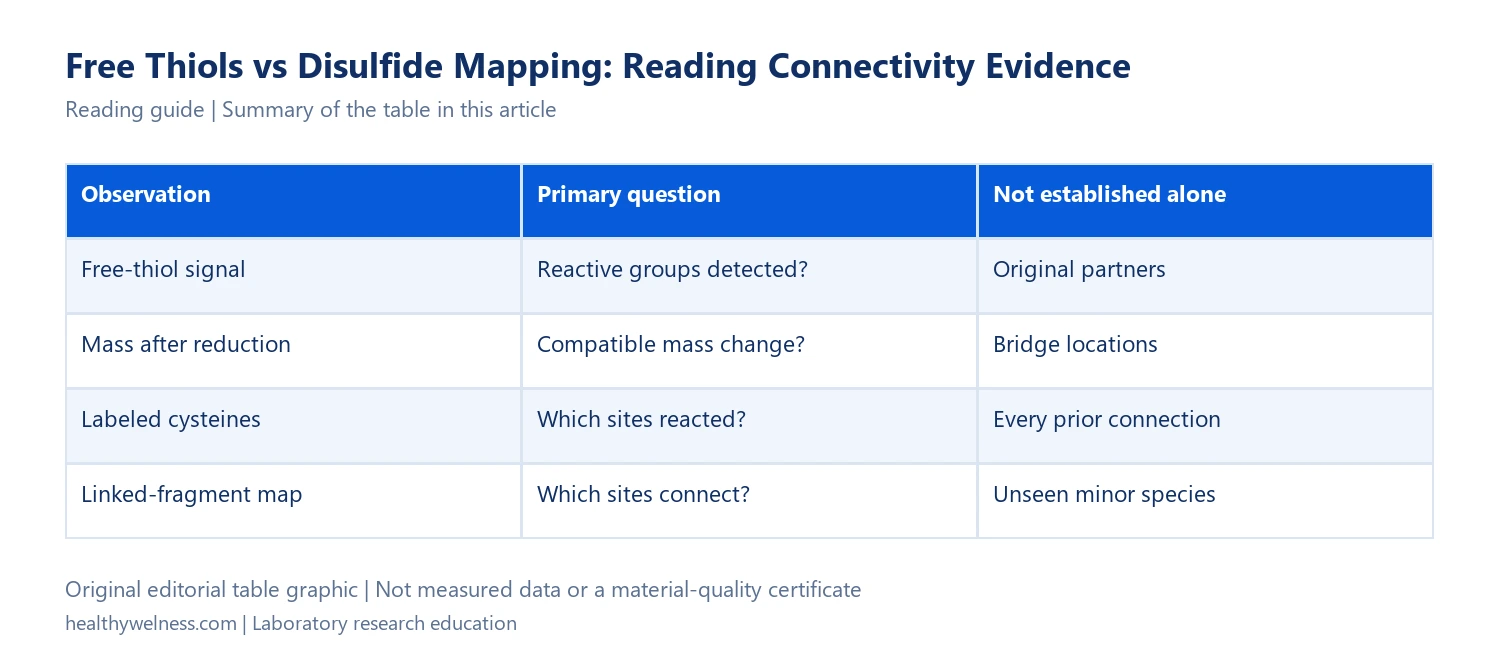
| Observation | Primary question | Not established alone |
|---|---|---|
| Free-thiol signal | Reactive groups detected? | Original partners |
| Mass after reduction | Compatible mass change? | Bridge locations |
| Labeled cysteines | Which sites reacted? | Every prior connection |
| Linked-fragment map | Which sites connect? | Unseen minor species |
This is an evidence worksheet, not a prescribed test package. A free-cysteine question may not need an exhaustive map. Conversely, if the uncertainty is a possible alternative pairing, reporting only total sulfhydryl content leaves that uncertainty unresolved even when the number is very reproducible.
What a free-thiol measurement can actually count
Thermo Fisher’s Ellman’s reagent instructions describe the reaction of DTNB with a free sulfhydryl group to generate a colored TNB species. The guide discusses both standard-curve and absorptivity-based quantification, and notes that reaction behavior depends on pH, sulfhydryl properties and accessibility. Its listed absorptivity changes with the medium. Ellman’s reagent instructions
The measured signal therefore belongs to a defined reaction and preparation. A statement such as “no free thiol detected” needs a sensitivity and sample basis. It is not identical to the stronger statement that every cysteine in every molecule forms the intended bridge. An inaccessible group, an unsuitable analytical range or a different sulfur modification can leave a question that the group assay cannot resolve by itself.
Record whether the preparation was analyzed as received, denatured, reduced or otherwise transformed. Those states are scientifically different. Comparing a value obtained before reduction with one obtained after reduction can be informative, but the comparison still needs correction for dilution, recovery and any contribution from the reagents used.
A hypothetical calculation shows the difference between an average and a molecular map
Hypothetical example: assume a validated, matrix-compatible measurement reports 2 micromoles of reactive thiol per liter and an independent assay establishes 10 micromoles of peptide chains per liter on the same sample basis. The ratio is 2/10 = 0.2 reactive thiols per chain on average. These are stipulated values, not a recommended acceptance limit.
One possible population contains 80% chains with no detected free thiol and 20% chains with one. Another contains 90% with none and 10% with two. Both average 0.2. More possibilities arise when some signal comes from a different thiol-containing component. The average does not identify which mixture exists, which cysteines contribute or which bridges the other molecules carry.
Nor does 0.2 become “20% incorrectly paired peptide” without an explicit molecular model. That conversion quietly assumes one free thiol per affected chain and assumes that every relevant defect produces such a thiol. A fully bridged alternative pairing would violate the second assumption. Report the measured quantity first and state any population calculation as a conditional inference.
The ratio also depends on the denominator. Gross powder mass, peptide-chain molarity and an arbitrary chromatographic area are not interchangeable denominators. Our purity versus content guide explains why the amount basis must remain visible.
Fully reducing a sample removes information as well as revealing sites
If an analysis breaks all disulfides before mapping the sequence, it can make cysteine-containing fragments easier to interpret. But the fully reduced endpoint no longer contains the original sulfur connections. Recovering a sequence with all expected cysteines is valuable sequence evidence; it is not, by itself, a record of their prior partners.
This is an information problem. Imagine a set of labeled endpoints connected in pairs. Cutting every connection and retaining only the endpoint labels preserves the membership list while losing the pair list. A successful connectivity strategy must measure the links before losing them or retain another traceable relationship during their removal.
A reduced reference can still help interpret a non-reduced map. The two preparations address complementary questions, provided the report connects them to the same starting material and documents what changed. Treat “reduced” and “non-reduced” as analytical states, rather than quality grades or guarantees of preserved conformation.
Sequential labeling can retain a history of cysteine availability
Albert and colleagues’ 2016 primary study used sequential reduction and alkylation on solid phase, followed by tandem-MS sequencing, to infer disulfide connectivity from labeling patterns. Its abstract reports demonstrations on seven peptides with two to four bridges. This is an example of preserving site-specific analytical history, not evidence that any generic alkylation result assigns every peptide map. Albert et al., 2016
When reading such a method, ask which cysteines were available before a transformation, which appeared after it, and how their positions were assigned. The identities of the labels and their sequence localization matter. A total increase in label mass is less informative than site-resolved assignments when the question is which particular pair was opened.
Partial reduction also adds an interpretation burden: a preparation can contain multiple intermediate forms. A report should explain how the relevant intermediate was recognized and how alternative assignments were considered. The existence of a sophisticated method name does not remove the need to inspect the actual evidence supporting the stated connection.
Preparation artifacts can create a convincing but wrong map
Kleinberg and colleagues’ 2024 primary study examined artificial scrambling during non-reduced peptide mapping of monoclonal antibodies. They reported that digestive strategies can rearrange connections and investigated ways to limit the problem. The studied materials were antibodies; their conditions are not automatically a validated method for an unrelated short research peptide. Kleinberg et al., 2024
The general reading lesson is to separate the starting material from the material created during preparation. An unexpected link can be a genuine component, an analytical artifact or an unresolved assignment. None of those alternatives should be selected solely because it produces the most convenient narrative.
A useful comparison preserves preparation history and uses discriminating controls appropriate to the method. If changing the preparation changes the apparent map, that is a finding to investigate, not permission to choose the preferred result. Equally, the absence of a detected alternative under one preparation does not establish an unlimited ability to exclude every minor species.
Connectivity coverage is more informative than a single confirmed label
For an invented three-bridge target, suppose two connections are directly assigned while the third is inferred by elimination. Describe that distinction. If the inference assumes that all six cysteines participate only in intrachain pairs, retain the assumption rather than presenting every edge as directly observed.
A transparent report can list each intended link, its supporting fragments or site labels, alternative explanations, and whether the assignment is observed, inferred or unresolved. It should also state the sequence numbering convention and any interchain connections. This makes the map auditable without inventing a universal numerical score for mapping quality.
Quantifying the abundance of an alternative form is a separate task from identifying it. A set of spectra supporting one pairing need not provide a validated fraction for every coexisting form. Keep identification coverage, quantitative sensitivity and the stated sample scope separate, following the broader distinctions in MS identity evidence.
Common questions
Does a low free-thiol value prove correct disulfide pairing?
No. A group measurement does not identify the cysteine partners, and a fully bridged alternative can also have little free thiol.
Can a fully reduced sequence reveal the original map?
Not by itself. Complete reduction removes the original links, so additional evidence must preserve or reconstruct their relationships.
Is an intact mass enough to distinguish two pairings?
No. Structures with the same sequence and bridge count can share an intact mass while differing in sulfur connectivity.
Does an unexpected mapped link prove a defective starting sample?
No. The assignment and preparation must be examined because artifacts can produce apparent rearrangements.
Should inferred connections be omitted?
No. Report them with their assumptions and distinguish them from directly assigned links and unresolved positions.
Scope and related reading
This guide explains analytical reasoning, not an assay protocol or a certificate for any HealthyWelness batch. Continue with sequence annotation and the levels of structural evidence. HealthyWelness operates a commercial catalog of laboratory research materials, not approved medicines for human or veterinary use.
Cover: AI-generated conceptual editorial artwork, not an exact molecular structure, measured result or a photograph of HealthyWelness staff or facilities.