Karl Fischer Water in Peptides: Reading the Measurement
Read Karl Fischer water measurements in lyophilized peptide research: blanks, extraction, sample basis and why loss on drying answers a different question.

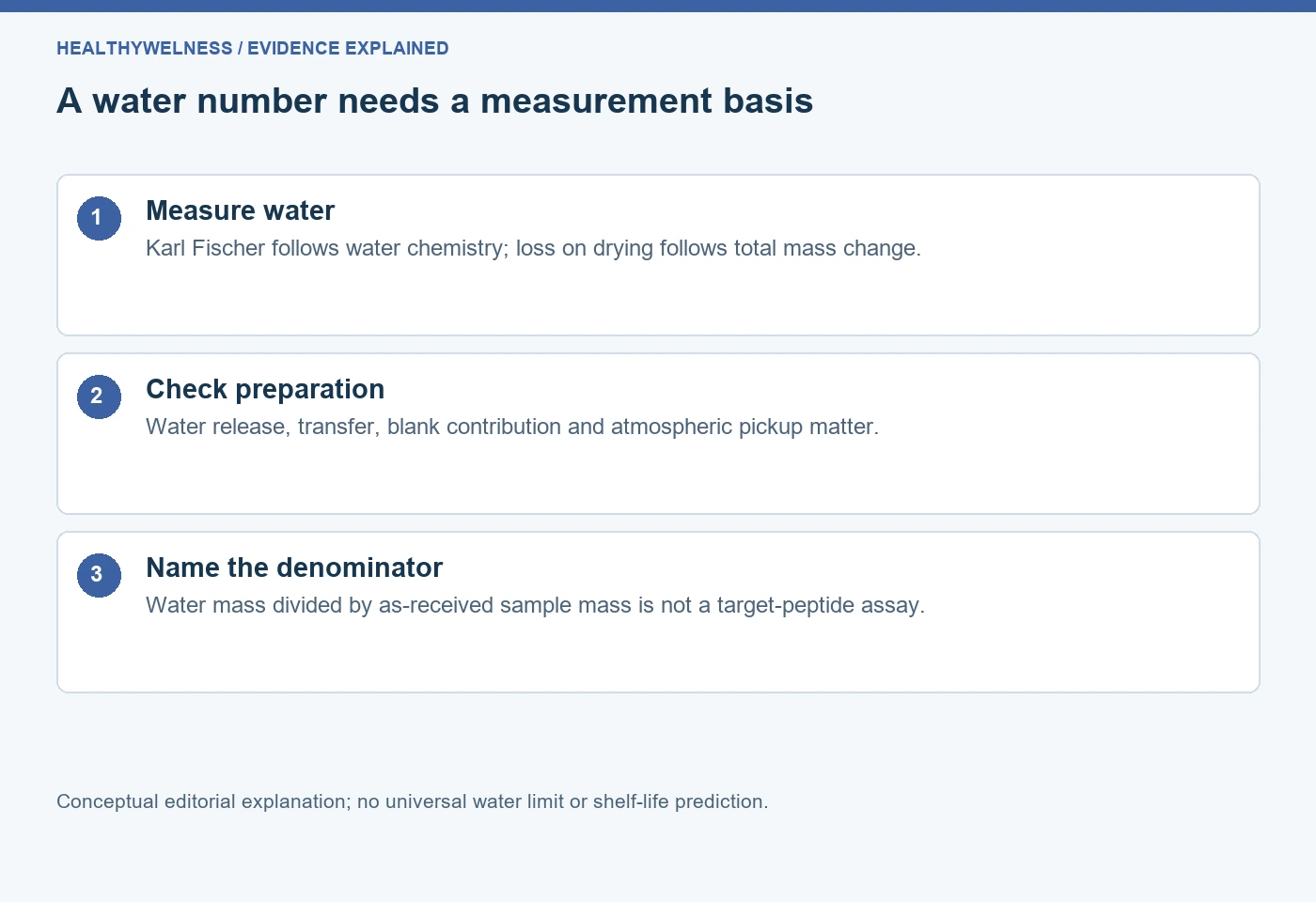
Karl Fischer titration measures water through a chemical reaction; loss on drying measures mass lost under a drying procedure. For a lyophilized peptide sample, the two percentages need not match. A useful water result identifies the sampled material, sample mass, preparation, blank correction and reporting basis, without converting residual water into a universal shelf-life prediction.
- Karl Fischer water content and loss on drying have different measurement definitions.
- Water percentage requires both a measured water amount and a defined sample-mass denominator.
- Incomplete water release, atmospheric pickup and reagent side reactions can affect a Karl Fischer result.
- The numbers below are invented analytical examples, not specifications for research peptides.
A water-specific reaction answers a narrower question than weighing
The word moisture can hide several different observations. A balance can show that a sample became lighter after heating. A Karl Fischer measurement instead connects reagent chemistry to water. These are different routes to a numerical result, so agreement must be demonstrated for a particular material rather than assumed from similar labels.
METTLER TOLEDO’s method comparison defines drying-oven and halogen-analyzer measurements through mass change. It notes that substances other than water can evaporate, while Karl Fischer is directed at water. The same comparison emphasizes that complete water extraction can be critical for titration. [1]
For a peptide powder containing an unspecified residual solvent, mass lost during drying could include solvent as well as water. A KF result is not a general residual-solvent screen. Conversely, a gravimetric method that leaves some water behind does not necessarily measure total water simply because its output is called moisture.
METTLER TOLEDO’s public M738 application summary describes coulometric KF for lyophilized pharmaceutical products and explains that iodine consumption is related to water, with iodine generated electrochemically. The publicly accessible summary supports the principle and example application. It does not supply a validated method or acceptance limit for every research peptide. [2]
| Result | Measured basis | Question left open |
|---|---|---|
| KF water amount | Water-specific reaction | Water percentage without sample mass |
| KF mass fraction | Water divided by sample mass | Target-peptide amount |
| Loss on drying | Mass change under conditions | Which lost components were water |
| Dry-basis assay | Analyte on a defined dry basis | As-received assay without conversion |
| Appearance | Observed physical form | Quantitative water content |
Direct introduction and oven transfer test different preparation steps
Putting a sample directly into a titration medium requires its water to become available to the reaction under the selected conditions. Oven-based KF instead releases water from the sample and transports it to the cell. Changing preparation changes the possible losses and interferences that must be assessed.
Metrohm’s oven guidance describes sealed sample vials, a dried carrier gas and transfer of released water into the titration cell. It identifies poor solubility, slow water release and side reactions as reasons to consider this preparation. It also warns that excessive temperature can decompose a sample and distort the measured water content. [3]
The oven is therefore a preparation option, not a promise that all water is measured without complications. A low result could be consistent with low water, incomplete release or incomplete transfer. A high result could reflect the original sample, background water or changes caused during analysis. The number alone cannot choose among these explanations.
This is why an oven temperature borrowed from an unrelated sample is weak evidence. A method needs to establish useful release behavior without introducing a misleading contribution. The article does not propose a universal temperature, extraction duration or solvent for peptide powders.
A hypothetical result shows why the blank matters
Invented calculation: assume a representative 20.00 mg portion of lyophilized material yields a total KF response equivalent to 0.460 mg water. Under the same measurement conditions, the relevant blank contributes 0.060 mg. Assume the procedure justifies subtracting that blank, with adequate water release and no material interference.
The blank-corrected sample water is 0.460 − 0.060 = 0.400 mg. Dividing by the original 20.00 mg portion gives 0.0200, or 2.00% water by mass on an as-received basis. The uncorrected calculation gives 2.30%. The discrepancy comes from background contribution, not a change in the original sample’s peptide sequence.
Metrohm’s oven guidance explicitly discusses moisture associated with sample vials and caps, blank determination and matched conditions for blanks and samples. Those details explain why a small absolute background can matter. Its instrument-check recommendations are guidance for that system, not universal product-release criteria. [3]
Now suppose a separately performed loss-on-drying test on comparable material gives 3.50%. It would be tempting to call the extra 1.50 percentage points residual solvent. That is only one hypothesis. Before subtraction has chemical meaning, the methods must have compatible samples and bases, adequate recovery and understood interferences. Two reported percentages do not identify the difference by themselves.
- Retain the measured total water equivalent and the blank separately.
- Record the actual sample mass used in the denominator.
- Keep the KF and drying results under their respective method names.
- Investigate disagreement before naming a particular lost component.
As-received and dry-basis percentages require different denominators
A 2.00% as-received water fraction means two mass units of water per 100 units of original sample. If water is the only component removed in the defined conversion, the non-water mass is 98 units. The same two units expressed relative to non-water mass would be 2/98 × 100, approximately 2.04%. The water amount has not changed; the denominator has.
A more useful research calculation concerns a separately measured analyte. Suppose an invented as-received target-peptide assay is 75.0% and the water fraction is 2.00%. If the intended dry basis excludes only that measured water, the corresponding calculation is 75.0/0.980 = approximately 76.5%. This is an explicit mathematical conversion, not a new assay.
That conversion assumes compatible samples, definitions and conditions. It does not make the remaining 98% all target peptide. Counterions, other peptides and any other non-water material remain in the denominator. Nor does 100% minus KF water establish peptide content.
Always preserve the originally reported basis. Replacing an as-received assay with a dry-basis number without labelling the change can create apparent disagreement between otherwise compatible documents. Extra decimal places cannot repair an undefined denominator.
Small samples make preparation history unusually important
Atmospheric exposure can change what is being measured between opening and analysis. METTLER TOLEDO’s M762 summary describes a closed-vial gas-phase-extraction approach for hygroscopic lyophilizates, combined with backweighing to obtain sample mass and scanning to select a suitable oven temperature. Only the public summary was read; the downloadable detailed application was not accessed. [4]
For an invented comparison, adding 0.050 mg water to a 5.00 mg original portion changes the water numerator by one percent of that original mass. The same addition is a much smaller fraction of a 100 mg portion. This arithmetic does not set an allowable exposure time. It shows why an undocumented transfer can become proportionally important with small fills.
A sealed-vial approach can address one handling pathway without proving that all vials are identical. A sample result belongs to the sampled material and sampling plan. Extending it across a batch requires evidence about representativeness, rather than the assumption that one attractive percentage characterizes every container.
Record the opening and transfer history that the procedure requires, the method of determining net sample mass and whether the measured portion is the same one used for another assay. A nominal label fill is not automatically an analytical weighing result.
Low water, poor release and side reactions must remain distinguishable
Metrohm’s technical FAQ identifies incomplete dissolution, slow water release, sample–reagent reactions and cell leaks among possible analytical problems. It discusses preparation choices rather than suggesting that the instrument name alone establishes accuracy. [5]
A check standard can help evaluate the measurement system. It does not automatically establish that water is fully released from a chemically different peptide matrix. Likewise, good repeatability can coexist with a consistent preparation bias. Three closely agreeing readings are evidence of agreement under those conditions, not proof that every relevant source of bias was removed.
A useful report names the KF mode, preparation and extraction conditions, blank treatment, sample amount, unit and basis, relevant checks and uncertainty or method limitations. If it reports only “moisture: pass,” the reader cannot reconstruct the water amount or compare it with a result obtained differently.
Residual water is one compositional measurement. It is not a standalone expiry model, a measure of intact target quantity or a complete investigation of degradation. This article deliberately sets no universal water specification for peptides and derives no storage duration from a percentage.
Questions about peptide water measurements
Is Karl Fischer the same as loss on drying?
No. KF measures water through a chemical reaction; loss on drying measures mass lost under the stated drying conditions and can include other volatile material.
Does 2% water mean 98% target peptide?
No. The non-water portion can include counterions, other peptides and additional components. Target amount needs its own defined assay.
Is an oven KF method automatically better than direct titration?
No. It can address certain preparation problems, but water release, transfer, blank contribution and thermal changes still need assessment for the material.
Can a check standard prove complete water extraction from a peptide?
Not by itself. A system check and recovery from a particular sample matrix answer related but different questions.
Can a KF percentage determine a peptide’s shelf life?
No. A water-content measurement does not independently establish chemical stability over time or define a universally acceptable storage period.
Read the result alongside its compositional context
See what lyophilization means, purity and content denominators and the separate storage discussion. Use the COA reading guide to check which measurements a document actually reports. No KF testing service or measurement of HealthyWelness products is asserted here.
The COA lookup can help locate available material documentation. Check whether water content and its method are actually reported rather than assuming a Karl Fischer result is included.
References and scope of source access
- METTLER TOLEDO. Loss on Drying: Thermogravimetric Method of Moisture Content Analysis. Method comparison and definition read.
- METTLER TOLEDO. Water Content in Lyophilized Vaccines with Karl Fischer Titration, M738. Public application summary read.
- Margreth M. Oven method for sample preparation in Karl Fischer titration. Metrohm. Preparation, temperature, blank and system-check sections read.
- METTLER TOLEDO. Water Content of Hygroscopic Lyophilized Drugs, M762. Public application summary read.
- Metrohm. FAQs: Karl Fischer Titration. Relevant sample handling, water release and troubleshooting sections read. All sources accessed 17 November 2026.
Cover and evidence map: original conceptual editorial schematics, not measured results, exact molecular structures, or photographs of HealthyWelness facilities.
Sources
- METTLER TOLEDO. Loss on Drying: Thermogravimetric Method of Moisture Content Analysis
- METTLER TOLEDO. Water Content in Lyophilized Vaccines with Karl Fischer Titration, M738
- Metrohm. Oven method for sample preparation in Karl Fischer titration
- METTLER TOLEDO. Water Content of Hygroscopic Lyophilized Drugs, M762
- Metrohm. FAQs: Karl Fischer Titration