Peptide Donnan Equilibrium: Unequal Ion Concentrations
Understand unequal ion partition in peptide research through retained charge, electrochemical equilibrium and ideal-model limits beyond membrane cutoff.

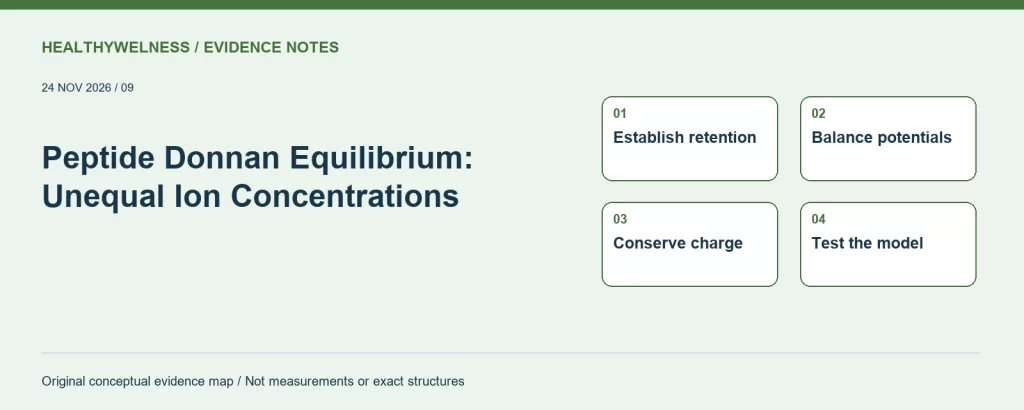
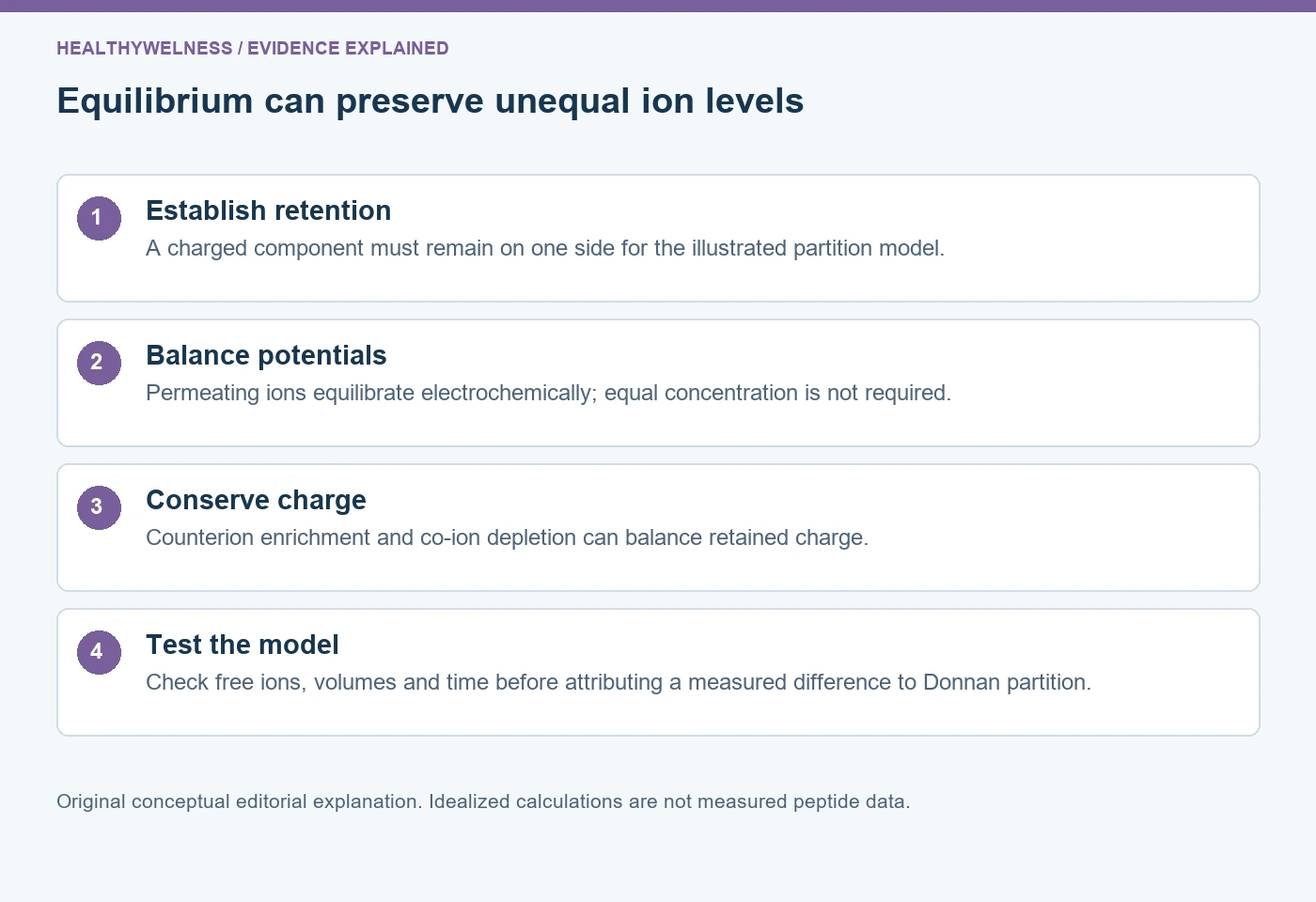
Diffusible ions can have unequal concentrations across a membrane at equilibrium when a charged component is retained on one side. This Donnan partition reflects electrochemical balance and electroneutrality, rather than a small ion failing to fit through a pore. Interpreting a peptide preparation requires evidence that the charged component is actually retained and that the observed state approaches equilibrium.
For laboratory research use only. The compounds discussed are not approved for human or veterinary use and are not drugs, foods or cosmetics. This article summarises published research and is not medical advice.
- Equilibrium requires equal electrochemical potentials for a permeating ion, rather than equal concentration considered alone.
- A retained charged component can produce enrichment of counterions and depletion of co-ions in a simple Donnan model.
- A molecular-weight cutoff does not specify the magnitude of Donnan partition or establish that equilibrium has been reached.
- The numerical examples below assume ideal monovalent ions, fixed final volume and a large external reservoir; they are not peptide measurements.
Separate an equilibrium distribution from incomplete exchange
A laboratory may observe that an ion remains more concentrated in a peptide-containing compartment than in the external solution after membrane exchange. One explanation is that exchange is incomplete. Another is that the final equilibrium distribution is unequal because the compartment contains retained charge. These explanations imply different next questions, so “some salt remained” is not a sufficient interpretation.
The existing dialysis and molecular-weight-cutoff guide addresses passage, retention and recovery. The narrower question here is what equilibrium itself permits. A freely permeating small ion need not end at the same concentration on both sides if its electrical contribution is balanced by a potential difference.
| Question | Relevant issue | Evidence needed |
|---|---|---|
| Can a species cross? | Permeability | Membrane and species behavior |
| Has exchange progressed? | Transport and time | Time-dependent observations |
| Where is equilibrium? | Electrochemical balance | Composition and charge model |
| Was target recovered? | Amount balance | Target-specific measurements |
These questions are related but cannot replace one another. A longer exchange may change a kinetically limited result. It cannot be assumed to remove an equilibrium partition imposed by the retained charge under unchanged conditions. Conversely, a concentration difference observed once is not proof of a Donnan mechanism.
Retained charge changes the condition for diffusible ions
Waniewski’s 2023 theoretical paper formulates membrane equilibrium using electrochemical potentials, electroneutrality and conservation. Its abstract and introduction also emphasize solvent, osmotic pressure, activities and nonideal behavior. This supports treating the familiar concentration-only Donnan calculation as a restricted model, rather than the full description of any research mixture. [1]
For a simplified teaching system, imagine a compartment containing a nonpermeating negatively charged component and monovalent permeating cations and anions. Bulk electroneutrality requires more cation charge than anion charge in that compartment to balance the retained negative charge. The surrounding reservoir has no retained charge and contains equal concentrations of the two simple ions.
The negative component need not be covalently attached to the membrane. In this model, it can move within its compartment while remaining unable to cross the boundary. That operational retention assumption matters for peptides: a sequence having charge does not establish that it remains inside a particular device. If it permeates, adsorbs, precipitates or changes charge, the stipulated model requires revision.
For ideal monovalent ions with pressure-related contributions neglected, equality of electrochemical potentials gives a reciprocal partition relationship. The inside-to-outside cation ratio is the inverse of the corresponding anion ratio. Multiplying the two concentrations on one side therefore gives the same product as on the other. Electroneutrality and this product relationship can be solved together.
An ideal reservoir calculation produces unequal concentrations
Invented example: take a large external reservoir containing 10.0 mM of a simple monovalent cation and 10.0 mM of its anion. Assume the reservoir composition remains unchanged. The inner compartment has a fixed final volume and retained negative charge equivalent to 20.0 mmol of elementary charges per litre. Assume ideal dilute behavior, no binding, no additional ions and equilibrium for both permeating ions.
Let x be the inner cation concentration and y the inner anion concentration, both in mM. Electroneutrality gives x − y = 20.0. The ideal Donnan product gives xy = 10.0 × 10.0 = 100. Substituting x = y + 20.0 produces y² + 20.0y − 100 = 0. The positive root is y = approximately 4.142 mM, and x is approximately 24.142 mM.
| Invented equilibrium | Cation | Anion | Charge difference |
|---|---|---|---|
| External reservoir | 10.000 mM | 10.000 mM | 0 mM |
| Inner compartment | 24.142 mM | 4.142 mM | 20.000 mM |
| Inside/outside ratio | 2.414 | 0.414 | Not a ratio |
The rounded products agree within rounding: 24.142 × 4.142 is approximately 100 mM². The cation is enriched and the anion depleted inside, although both are stipulated to permeate freely. There is no need to invoke an anion too large for the pore. Electrical and concentration contributions jointly determine the equilibrium.
The 20.0 mM retained-charge value is not automatically a peptide concentration. For example, a hypothetical retained species with two fixed negative charges per molecule at 10.0 mM would supply that charge concentration under the assumptions. A real peptide can have condition-dependent charge and additional associations. Sequence mass alone cannot supply this input.
Changing the reservoir changes the predicted partition
Keep the same invented 20.0 mM retained charge but increase both reservoir ion concentrations to 100.0 mM. The relationships become x − y = 20.0 and xy = 10,000. Solving gives x approximately 110.499 mM and y approximately 90.499 mM. The corresponding inside-to-outside ratios are approximately 1.105 and 0.905.
Under this restricted model, the relative departure from reservoir concentration is smaller at the higher salt concentration. The absolute cation–anion difference inside remains 20.0 mM because that was fixed by the retained charge. Relative partition and absolute charge balance should therefore not be confused. Changing the reservoir is also a chemical change to the sample environment, so a smaller calculated partition is not automatically a better research preparation.
Loeb’s original 1921 work examined gelatin chloride separated from an external aqueous phase by collodion membranes. Its publisher abstract reports that added neutral salt reduced the observed potential difference and discusses comparisons involving pH and ion valency. This is experimental evidence in a historical protein system, not a measured partition coefficient for an unnamed research peptide. [2]
For a finite external bath, the original reservoir concentration cannot simply be held constant in the calculation. Ion conservation across both compartments must also be satisfied. If water moves and changes compartment volumes, those final volumes enter the charge and mass balances. A fixed-volume, effectively infinite-reservoir example is useful precisely because its assumptions are visible.
Total analytical ion and freely partitioning ion may differ
A report may supply total chloride, total metal or another analytical concentration. The simple model instead uses the relevant freely permeating ionic species, with ideal concentrations standing in for activities. An ion associated with a retained component can contribute to a total assay while behaving differently from the freely permeating population.
Hitchcock’s 1954 original study of dilute protein–acid systems compared ion ratios derived from total chloride analysis with those derived from electromotive-force measurements. Its publisher abstract reports disagreement consistent with some chloride association with protein. The abstract supports this specific caution about interpreting total analytical quantities; the full experimental paper was not accessed here. [3]
Consequently, a mismatch between the simple prediction and a total-ion result can have several explanations. Nonideal activity, binding, additional ions, a changing retained charge, incomplete equilibration and a different final volume can all require attention. The measured difference should lead to a model check, rather than forcing every departure into one named mechanism.
- Identify which charged species are retained and which are permeating.
- Distinguish free-species measurements from total analytical concentrations.
- Record both compartments’ composition and final volumes.
- Preserve time dependence when claiming that equilibrium was approached.
- Check target amount and identity separately from small-ion exchange.
Use the model to sharpen a preparation comparison
Suppose two membrane preparations yield different internal ion readings. Before attributing the difference to pore size, compare the retained-charge concentration, reservoir composition, final volume and time history. A change in recovered peptide amount could itself alter retained charge per volume, linking apparent ion partition to target recovery. That is an inference to test, not evidence supplied by the calculation alone.
Similarly, a larger external bath changes the available material balance. It does not demonstrate that the peptide is retained, that its chemical state is preserved or that every relevant ion has the same permeability. A useful investigation chooses an observation that separates these alternatives instead of treating one conductivity value as a full reconstruction of composition.
Read ionic strength, conductivity and osmolality for the limits of those descriptors. The peptide concentration calculator checks nominal mass–volume arithmetic; it does not solve membrane electrochemical equilibrium. This article assigns no device setting, exchange duration or product-specific partition coefficient.
Questions about Donnan partition in peptide research
Does equilibrium mean equal salt concentration on both sides?
No. With retained charge, freely permeating ions can partition unequally while their electrochemical potentials satisfy equilibrium conditions.
Does every charged peptide create the illustrated Donnan distribution?
No. The model requires retention and specified charge and solution conditions. A peptide that crosses the membrane does not satisfy the example’s nonpermeating-component assumption.
Can a molecular-weight cutoff predict the partition ratio?
No. A cutoff concerns operational passage behavior. The equilibrium distribution also depends on charge, solution composition and the applicable thermodynamic model.
Will waiting longer necessarily remove an internal ion excess?
No. Extra time may address incomplete equilibration, but a genuine equilibrium partition can remain under unchanged boundary conditions.
Is total chloride always the free chloride concentration used in the simple model?
No. Association and analytical definitions can matter. Preserve whether a result measures total ion or the relevant freely permeating species.
References and limits of access
- Waniewski J. Osmotic and Gibbs–Donnan equilibrium for ions and neutral solutes. Scientific Reports. 2023;13:21066. PMID: 38030661. Abstract, introduction and bibliographic header read; later PMC access encountered a browser challenge. Full derivation was not read.
- Loeb J. Donnan equilibrium and the physical properties of proteins. I. Membrane potentials. Journal of General Physiology. 1921;3(5):667–690. Publisher abstract and bibliographic record read.
- Hitchcock DI. Membrane potentials in the Donnan equilibrium. II. Journal of General Physiology. 1954;37(6):717–727. Publisher abstract and bibliographic record read; full text not accessed.
Sources accessed 23 November 2026. The worked systems are original idealized calculations, not observations of HealthyWelness materials, membrane devices or laboratory facilities.
For laboratory research use only. The compounds discussed are not approved for human or veterinary use and are not drugs, foods or cosmetics. This article summarises published research and is not medical advice.
Cover and evidence map: original conceptual editorial schematics, not measured results, exact molecular structures, or photographs of HealthyWelness facilities.
Sources
- Waniewski J. Osmotic and Gibbs–Donnan equilibrium for ions and neutral solutes. Scientific Reports. 2023;13:21066. PMID: 38030661.
- Loeb J. Donnan equilibrium and the physical properties of proteins. I. Membrane potentials. Journal of General Physiology. 1921;3(5):667–690.
- Hitchcock DI. Membrane potentials in the Donnan equilibrium. II. Journal of General Physiology. 1954;37(6):717–727.