Peptide Dialysis MWCO: Retention and Recovery Explained
Understand what dialysis MWCO means for peptide research, why mass alone cannot predict retention, and how volume, time and recovery affect interpretation.

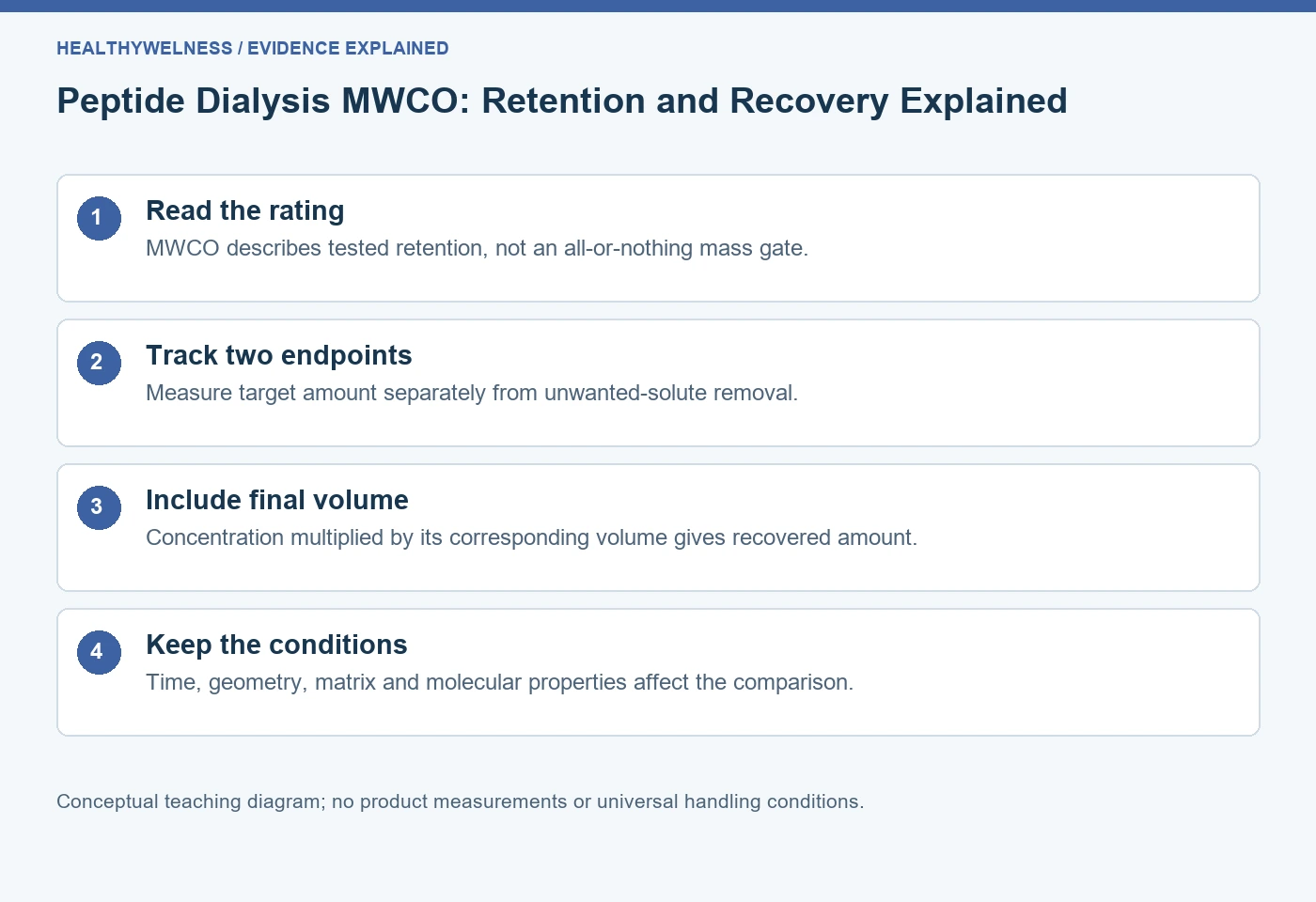
A dialysis membrane’s molecular weight cutoff is an operational retention rating, not a sharp molecular-mass gate. Peptide retention depends on the membrane, molecular properties and experimental conditions. Successful salt exchange does not prove peptide recovery, and a final concentration does not establish the amount retained unless the final sample volume is also known.
- MWCO describes a membrane’s tested separation behaviour rather than an exact universal pore diameter.
- Molecules near a membrane’s nominal cutoff can have restricted, condition-dependent passage.
- Target recovery and removal of small solutes require separate measurements.
- A peptide amount is concentration multiplied by the volume to which that concentration applies.
Translate a cutoff label into a measured claim
Laboratory dialysis places a sample and an external solution on opposite sides of a selectively permeable membrane. Solutes move according to their ability to cross the membrane and the concentration difference between the compartments. The external solution is often called the dialysate. The retained sample is the fraction of interest here; this article concerns research sample preparation only.
Repligen defines MWCO through retention of a reference solute during a specified 17-hour test, using a 90% retention criterion. That definition gives the rating an experimental meaning. It should not be interpreted as a mathematical step function in which every molecule below the label passes freely and every molecule above it remains completely retained. [3]
For a peptide workflow, start by writing the actual objective. “Exchange the surrounding salt while preserving the intact target” asks for two successful outcomes. “Separate a full-length peptide from a slightly smaller deletion product” asks a different and much harder separation question. A membrane suitable for the first task is not thereby suitable for the second.
| Quantity | What it describes | What it cannot establish alone |
|---|---|---|
| Nominal MWCO | Rated membrane behaviour | Actual target recovery |
| Retentate concentration | Target per liquid volume | Total target amount |
| Retentate target amount | Target remaining in that fraction | Why any target is missing |
| Residual small solute | Extent of exchange or removal | Intact peptide identity |
Why molecular weight does not predict a clean boundary
A membrane presents a distribution of transport pathways, and molecules do not all have the same shape or solution behaviour. Nominal molecular weight is useful for screening candidate membranes, but it leaves out hydration, molecular conformation, association and interactions with the membrane or surrounding solution. A mass label does not uniquely specify the effective size involved in transport.
Thermo Fisher’s original membrane-characterization application note tested several molecules across a series of membrane ratings. Its results show substantial retention of some molecules smaller than the nominal cutoff, illustrating why dialysis poorly separates closely sized molecules. The note also distinguishes globular reference molecules from more extended structures. Those observations concern the tested molecules and membrane formats, not a universal conversion from peptide mass to retention percentage. [1]
The correct inference is conditional: a cutoff comfortably below the target’s mass may be a useful candidate, but the actual target and matrix still need relevant evidence. For a short modified peptide, copying a rule derived from a globular protein can hide uncertainty about conformation and surface interaction. If the target associates into larger species, apparently good retention may describe an assembly rather than the intended monomer.
Retention and clearance can both be incomplete
The SnakeSkin tubing guide gives a useful counterexample to the binary-gate intuition: a 5 kDa peptide below a 10K rating may still fail to reach equilibrium even after a long interval. The guide distinguishes species much smaller than the membrane rating from molecules whose passage remains restricted. It is a product-specific explanation of transport limitations, not a measured prediction for every 5 kDa peptide. [2]
This matters when interpreting unwanted peptide removal. A contaminant being below MWCO does not establish that it was quantitatively cleared during the experiment. Equally, a target being above MWCO does not establish zero loss. State the tested interval and measured endpoints rather than replacing both with the label “dialysed.”
- Retention asks how much target stays in the intended sample fraction.
- Clearance asks how much unwanted solute leaves that fraction.
- Integrity asks whether recovered target retains the relevant chemical identity.
- Suitability asks whether the final preparation meets the particular research question.
These questions can disagree. Efficient small-ion removal with poor peptide recovery may be an unsuccessful preparation. High peptide recovery with substantial residual interfering solute may also be unsuccessful. A judgement needs both endpoints and their intended use.
Time, geometry and solution conditions change the comparison
Repligen lists concentration gradients, sample and dialysate volumes, membrane area and thickness, temperature, charge, agitation and time among factors affecting dialysis. Its guidance supplies starting considerations, while an actual method must remain compatible with the research material. Do not transplant a generic timing recommendation into a peptide-stability claim. [3]
Conceptually, a larger available membrane area can provide more opportunity for transport, but changing device size may also alter contact area for adsorption, handling losses and recovered volume. A comparison between two devices therefore evaluates the complete conditions used. It cannot automatically assign a difference solely to their MWCO values.
Similarly, extending time can improve movement of an unwanted solute while increasing the time available for target passage, surface association or chemical change. Lowering a cutoff can improve target retention while changing exchange speed. These are competing considerations to evaluate with measured endpoints, not a reason to declare one setting universally best.
Solution pH and composition belong in the record because they can affect the target and transport context. A charged peptide is not simply a neutral sphere with a mass label. Preserve buffer identity, concentration, salt, temperature and relevant modifications when comparing published recovery statements. If those details are missing, retain the uncertainty instead of supplying assumed conditions.
A hypothetical recovery calculation exposes a volume trap
Invented teaching example: an unnamed peptide begins at 1.00 mL and 100 µM, corresponding to 100 nmol. After a defined exchange experiment, a suitable target-specific assay measures 70 µM in a recovered volume of 1.20 mL. Assume the concentrations refer to intact target and that quantitative measurement is valid in both matrices.
The recovered target amount is 70 µmol/L × 0.00120 L = 0.084 µmol, or 84 nmol. Amount recovery is therefore 84/100 × 100 = 84%. Comparing concentrations alone would give 70/100 = 70%, which answers a different question. The increased volume makes a concentration ratio an incorrect substitute for amount recovery.
Suppose a separate, suitable measurement finds 6 nmol of target across the collected external fractions. Then 84 + 6 = 90 nmol is accounted for, leaving 10 nmol unresolved. The external target establishes that some target was present outside the retained fraction; it does not explain every missing nanomole. Wall association, uncollected solution, analytical bias or chemical change remain possible until evidence distinguishes them.
Now suppose the small-solute endpoint indicates 95% removal relative to its initial amount. That does not change the 84% peptide recovery into 95%. The two percentages have different numerators and denominators. All numbers in this example are invented arithmetic, not manufacturer results or acceptance criteria.
Design a pilot around the uncertainty that matters
For a valuable or poorly characterized research sample, a small comparison can be more informative than trusting a cutoff ratio. Define the target-specific amount at the initial and final stages, the actual recovered volume and the unwanted-solute endpoint. Where feasible, include information about target in external or device-associated fractions. Account for the analytical method’s suitability in the changed matrix.
A handling comparator without the membrane can help assess changes associated with time, temperature and transfers, although it does not recreate every device interaction. A device blank can identify relevant background. These comparisons address different alternatives; a clean blank does not establish target retention, and a stable no-membrane sample does not prove that missing target crossed the membrane.
Predefine what decision the pilot supports. A candidate method may be adequate for exchanging a small interfering ion yet unsuitable for quantitative concentration recovery. Avoid discovering an attractive percentage first and inventing the success criterion afterward. If separation of two similar peptides is the real requirement, evaluate a method with the necessary resolving mechanism rather than stretching a dialysis claim beyond the evidence.
Questions about MWCO and peptide sample recovery
Does a 3.5K membrane retain every peptide above 3.5 kDa?
No. The rating is an operational description, and actual retention depends on molecular properties, membrane characteristics and conditions. It is not a guarantee of complete recovery.
Will every smaller peptide leave the sample quickly?
No. Passage near a cutoff can be restricted. A molecule being smaller than the nominal rating does not establish rapid equilibration or complete removal.
Does successful desalting prove that the peptide stayed intact?
No. A small-solute measurement addresses exchange. Target-specific identity, amount and relevant integrity require appropriate evidence of their own.
Can I report recovery from a concentration ratio?
Only if the volume basis and other assumptions justify it. When starting and recovered volumes differ, calculate target amounts using each concentration and its corresponding volume.
Can dialysis reliably separate nearly equal peptide masses?
A nominal cutoff is not evidence of such resolution. Restricted passage and overlapping retention behaviour make close-size separation a distinct problem requiring relevant experimental demonstration.
Relate membrane choice to the wider analytical record
Continue with peptide solubility and stability, SEC recovery and aggregation evidence and matrix-dependent LC-MS response. The concentration calculator assists nominal mass–volume arithmetic; it does not measure membrane retention. HealthyWelness operates a commercial research-material catalog, and no product-specific dialysis performance is claimed here.
References
- Haney P, Herting K, Smith S. Separation Characteristics of Dialysis Membranes. Thermo Fisher Scientific. 2013.
- Thermo Fisher Scientific. SnakeSkin Dialysis Tubing User Guide. MAN0011339, revision B.0.
- Repligen. Frequently Asked Questions: Lab Dialysis.
Cover and evidence map: original conceptual editorial schematics, not measured results, exact molecular structures, or photographs of HealthyWelness facilities.