Peptide Radio-HPLC: Recovery, Decay and Molar Activity
Interpret peptide radio-HPLC through radioactive recovery, a common time reference, product-associated activity and the separate molar-amount denominator.

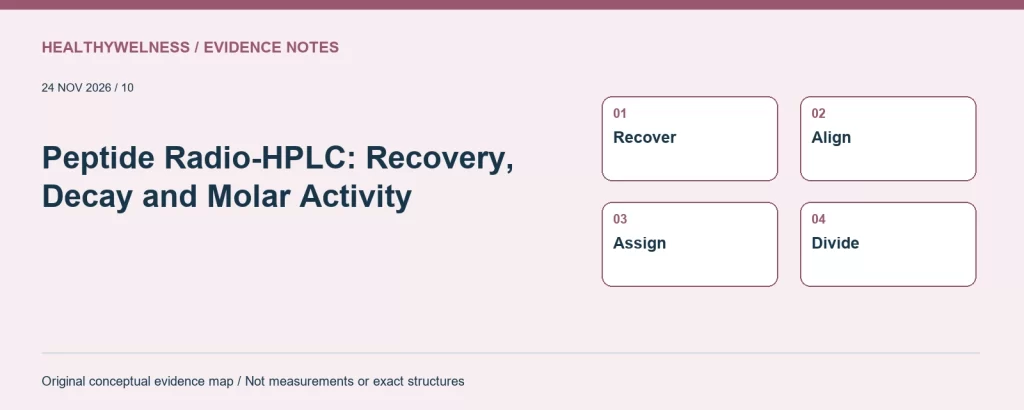
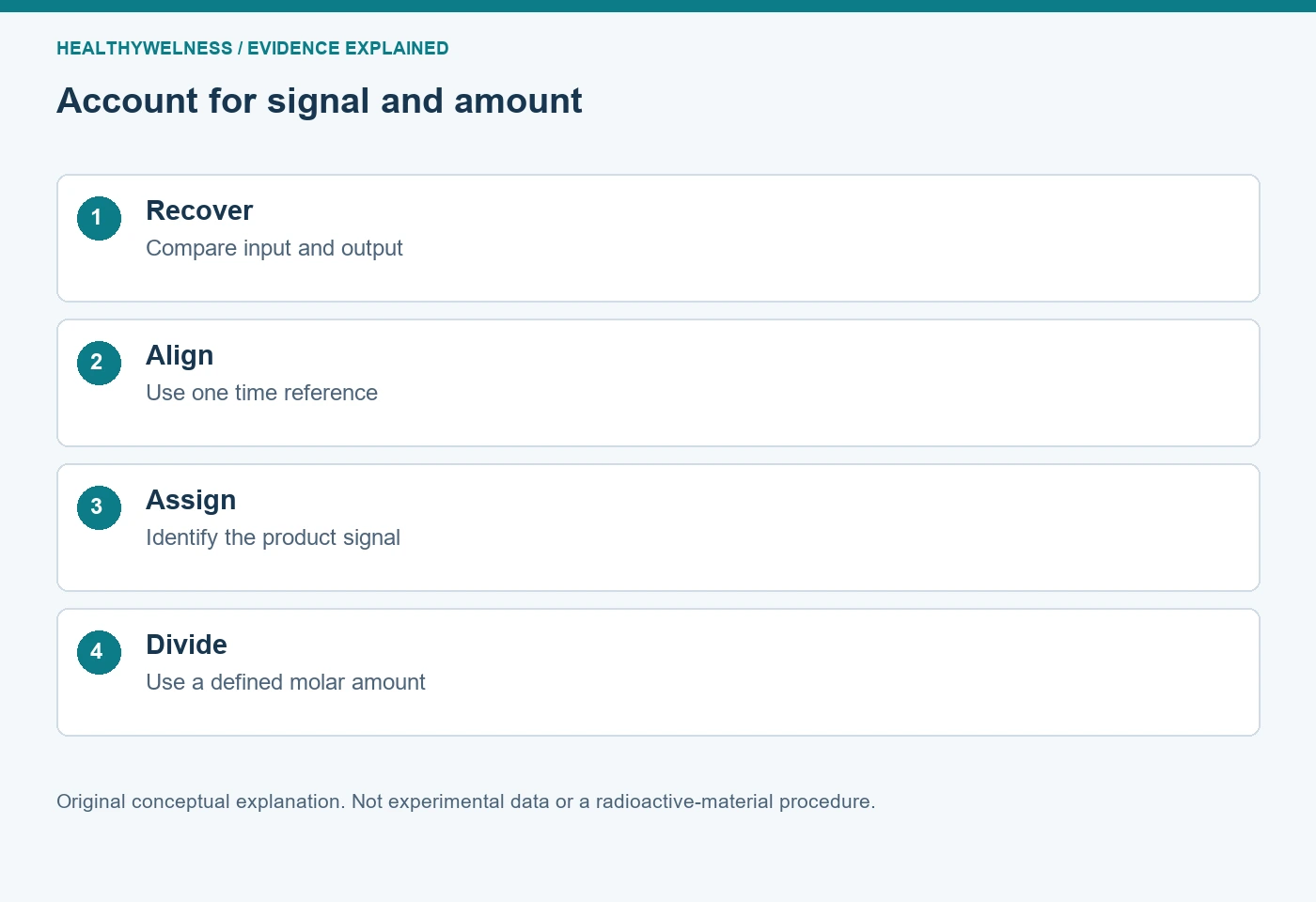
Peptide radio-HPLC assigns detected radioactivity to separated chemical forms; it does not directly measure total peptide amount. Interpret radiochemical purity alongside radioactive recovery, peak assignment and the time basis of the measurements. Molar activity additionally requires a defined molar amount. A high radioactive peak percentage can coexist with incomplete recovery or substantial non-radioactive material.
For laboratory research use only. The compounds discussed are not approved for human or veterinary use and are not drugs, foods or cosmetics. This article concerns analytical interpretation, not preparation or use of radiolabelled materials. Every numerical example below is hypothetical.
- Radiochemical purity and molar activity have different denominators and units.
- A percentage of recovered radioactive signal cannot account for material the measurement missed.
- Measurements made at different times need a common reference when radioactive decay affects their comparison.
- Peak assignment, radioactive recovery and chemical amount require their own evidence.
Identify which signal the report actually describes
A peptide chromatography report can contain an ultraviolet trace and a radioactivity trace. Similar-looking peaks on those traces do not make the detector outputs interchangeable. The useful first question is which trace supplied the stated result. An area percentage calculated from the radioactive channel describes the distribution of its included signal. It does not silently become an ultraviolet area percentage, a peptide mass fraction or a measured molar concentration.
The EANM analytical-method guideline describes radio-HPLC radiochemical purity as a desired-product fraction of detected radioactive peak areas, with decay correction. It emphasizes recovery and notes that radioactive species may be retained in the analytical system. It also requires accounting for transit delay when comparing serial physicochemical and radioactive detectors. These are method-specific analytical principles; citing the guideline does not certify a research material or supplier. Gillings et al., EANM analytical-method guideline, 2020.
Keep the familiar chromatography questions with the existing peptide chromatogram guide. The additional issue here is accounting for a radioactive signal that changes with time and may represent several chemical forms. A label can remain detectable even when the complete intended peptide structure is no longer present. Consequently, the word radioactive cannot substitute for the name of the analyte being quantified.
| Quantity | Question | Required context |
|---|---|---|
| Detected peak fraction | Where is the included signal? | Integration and peak assignment |
| Radioactive recovery | How much input activity was accounted for? | Comparable input and output measurements |
| Molar activity | How much product activity per defined mole? | Amount measurement and reference time |
| Structural identity | Which molecular form produces the assigned peak? | Method-supported identification |
A clean recovered trace can conceal missing radioactivity
Consider an invented accounting exercise. A sample contains 100 activity units at a chosen reference time. After the analytical separation, 80 comparable units are accounted for in the collected output. Of those 80, an assigned product peak accounts for 79.2 and other detected species account for 0.8. Stipulate accurate measurements and that all quantities have already been expressed at the same reference time.
The assigned peak fraction among recovered activity is 79.2/80 × 100 = 99.0%. Radioactive recovery is 80/100 × 100 = 80.0%. The assigned product accounts for 79.2% of the original activity under this constructed accounting system. These three correct calculations describe three different relationships. Reporting only 99.0% discards the information that 20 units remain unaccounted for.
The missing 20 units cannot be assigned to impurity by subtraction alone. They could include product, other forms or a measurement discrepancy. The invented numbers deliberately leave that composition unknown. Neither the optimistic assumption that all missing material is product nor the pessimistic assumption that it is all impurity has been established.
| Entry | Activity units | Interpretation |
|---|---|---|
| Input | 100.0 | Accounting denominator |
| Assigned product recovered | 79.2 | Identity assignment stipulated |
| Other activity recovered | 0.8 | Detected remainder |
| Unaccounted difference | 20.0 | Composition unresolved |
A useful review therefore retains the input-output comparison beside the chromatogram. If a laboratory investigates the discrepancy, the revised record should explain which part of the system or measurement was examined and what changed. Renormalizing the visible peaks cannot answer where the missing activity went. This is a mass-balance style question applied to radioactive activity, with additional requirements concerning decay and measurement comparability.
Time correction changes the accounting before interpretation
For a simple stipulated single radionuclide, let activity follow A(t) = A(0) × 2−t/T, where T is its half-life. This equation concerns nuclear decay. It contains no parameter describing peptide bond cleavage, chromatographic adsorption or oxidation. Correcting a measurement with this equation therefore addresses one specified source of time dependence.
Invent a radionuclide with T = 60 minutes solely to simplify arithmetic. A sample has total activity 120 MBq at time zero. Thirty minutes later, an otherwise identical retained sample would have 120 × 2−0.5 = 84.853 MBq under the stipulated model. Comparing that later number directly with 120 would suggest a 29.29% decrease, even though the example includes no chemical loss.
Now suppose output fractions contain a combined 76.368 MBq when measured at 30 minutes. Their time-zero equivalent is 76.368 × 20.5 = approximately 108 MBq. Relative to the 120 MBq input at time zero, recovery is therefore 90.0%. Dividing the uncorrected 76.368 by 120 would give 63.64%, blending radioactive decay with the stipulated output deficit.
This arithmetic does not authorize correcting every signal with one arbitrary half-life. A record must identify the radionuclide, measurement timestamps, reference timestamp and correction convention. If the sample contains relevant radionuclides with different decay behavior, a single shared factor may not represent the mixture. Equally, a correction already applied by the acquisition software should be recognized before a spreadsheet applies it again.
Collected fractions introduce a further bookkeeping detail: they may be measured at different times. A fraction counted later should not acquire an artificially smaller contribution merely because it waited longer. The review should make clear whether values are raw readings or values expressed at a shared reference. The calculation should remain reproducible from the recorded times and stated model.
Molar activity adds a chemical-amount denominator
The international consensus nomenclature summary distinguishes activity per mole from activity per mass, and calls for a stated measurement time. It also distinguishes apparent and effective quantities, so those qualifiers should not be dropped when quoting a result. A term on a report needs its definition as well as its numerical value. Coenen et al., international consensus nomenclature summary, 2019.
The EANM molar-activity guideline explicitly includes peptides. Its measurement discussion separates product-associated radioactivity from total formulation activity and requires a suitable chemical-amount measurement. It warns against extrapolating chemical amount beyond the method’s supported range. For concentrations below the amount method’s quantification limit, it describes reporting a corresponding lower bound rather than an unjustified exact molar activity. Luurtsema et al., EANM molar-activity guideline, 2021.
Continue with a separate invented example: at the stated reference time, a sample contains 120 MBq total activity, of which a justified 90% belongs to the named product. Product-associated activity is 108 MBq, or 0.108 GBq. Suppose an appropriate independent amount measurement gives 0.006 µmol for the defined product population in that same sample. Its calculated molar activity is 0.108/0.006 = 18 GBq/µmol.
Using total activity instead would give 20 GBq/µmol. That answer is 11.11% above 18 because 12 MBq was assigned to other forms. The error is not fixed by adding decimal places. It arose from pairing one analyte’s amount denominator with a broader activity numerator. This is why the definition of product must be consistent across both measurements.
Suppose an alternative preparation has the same 108 MBq product activity but a measured defined amount of 0.012 µmol. Its molar activity is 9 GBq/µmol. Its radiochemical peak fraction could still be 90%, because doubling non-radioactive counterpart material need not double radioactive signal. A radioactive percentage alone therefore cannot distinguish these constructed preparations.
Finally, replace the exact 0.006 µmol result with an amount known only to be below 0.010 µmol under a suitable method. For a positive denominator bounded above by 0.010, the ratio 0.108/n is at least 10.8 GBq/µmol. The bound is useful, but it does not recover the unknown value of n. A numerical result of 18 cannot be retained after the evidence supporting its denominator has been removed.
Keep identity and chemical stability outside the correction formula
A product-assigned peak needs a reason for its name. After adjusting for detector transit delay, an aligned radioactive response and reference response may support an assignment within a specified analytical method. That comparison should retain the actual reference and method context. It cannot be expanded into an unlimited claim that all coeluting molecular forms have been excluded.
Likewise, an unchanged decay-corrected total activity does not establish unchanged intact peptide. In a hypothetical closed vial, the label might move from intact target into a fragment while remaining inside the vial. Total activity could follow the expected decay equation throughout. The chemical distribution would change, and a measurement sensitive only to total activity would leave that change unresolved.
Conversely, a falling raw activity reading is not evidence by itself that the peptide degraded. The nuclear clock operates even in the absence of the proposed chemical reaction. A stability conclusion needs an analyte-sensitive comparison appropriate to the question. State whether the evidence tracks total activity, a chromatographic chemical form or a structurally characterized intact species.
For ordinary material documentation, the purity versus content guide explains why detector percentages and chemical amounts remain separate. The COA lookup provides access to available records; it does not imply that radio-HPLC, radioactive recovery or molar-activity testing has been performed on a listed product.
Questions about peptide radio-HPLC records
Does 99% radiochemical purity mean 99% of the powder is peptide?
No. It describes a radioactive signal fraction under a specified separation and calculation. Powder composition and defined peptide amount require their own measurements.
Can radioactive recovery be lower than the main peak percentage?
Yes. Recovery compares accounted output with input, while the peak fraction can use only recovered signal. The hypothetical example gives 80% recovery and a 99% assigned peak fraction simultaneously.
Does decay correction restore missing peptide?
No. It expresses activity at another reference time under a stated nuclear-decay model. It cannot reconstruct an unmeasured chemical form or determine the composition of missing material.
Can the radioactive trace provide molar activity by itself?
No. An activity-per-mole result also needs a supported amount denominator for the defined material. The numerator and denominator must refer to compatible samples and analyte definitions.
Does constant total radioactivity establish an intact peptide?
No. A label can remain detectable in a different chemical form. Chemical identity and stability require evidence capable of distinguishing the relevant forms.
Scope: analytical interpretation of published guidance, with original hypothetical accounting exercises. No batch measurements, radioactive-material preparation instructions or product-specific test claims are presented.
For laboratory research use only. Not for human or veterinary use.
Cover and evidence map: original conceptual editorial schematics, not measured results, exact molecular structures, or photographs of HealthyWelness facilities.
Sources
- Gillings N, et al. EANM guideline on the validation of analytical methods for radiopharmaceuticals. EJNMMI Radiopharmacy and Chemistry. 2020;5:7. Published 12 February 2020. Full-text radiochemical identity and radio-HPLC sections read.
- Coenen HH, et al. Open letter to journal editors on: International Consensus Radiochemistry Nomenclature Guidelines. EJNMMI Radiopharmacy and Chemistry. 2019;4:7. Published 16 April 2019. Full-text activity, molar/specific activity and qualifying terminology sections read.
- Luurtsema G, et al. EANM guideline for harmonisation on molar activity or specific activity of radiopharmaceuticals: impact on safety and imaging quality. EJNMMI Radiopharmacy and Chemistry. 2021;6:34. Published 9 October 2021. Full-text definitions and measurement sections read; clinical examples not used.