GLOW Blend vs GHK-Cu Alone: What the Other Two Add
GLOW is GHK-Cu 50 mg plus TB-500 10 mg and BPC-157 10 mg. What the extra components contribute, how the maths differs, and when the single peptide is better.

Cover illustration: AI-generated editorial artwork. Conceptual only; not an exact molecular structure, actual laboratory result or evidence of clinical effects.
GLOW and GHK-Cu are often compared as if they were two strengths of the same thing. They are not. GLOW contains the same 50 mg of GHK-Cu plus two unrelated peptides: TB-500 10 mg and BPC-157 10 mg. Choosing between them is really a choice between a defined single compound and a three-component mixture, and that choice has consequences for what any result can mean.
For laboratory research use only. The research materials supplied by HealthyWelness are not approved medicines, foods or cosmetics and are not for human or veterinary use. This article summarises published research and is not medical advice.
Key points
- GLOW = GHK-Cu 50 mg + TB-500 10 mg + BPC-157 10 mg (70 mg total).
- GHK-Cu vials contain 50 mg or 100 mg of the single compound.
- The three components are associated with different processes, not the same one.
- A blend makes attribution of any observed effect impossible.
- No peer-reviewed study has tested the combination.
Content compared
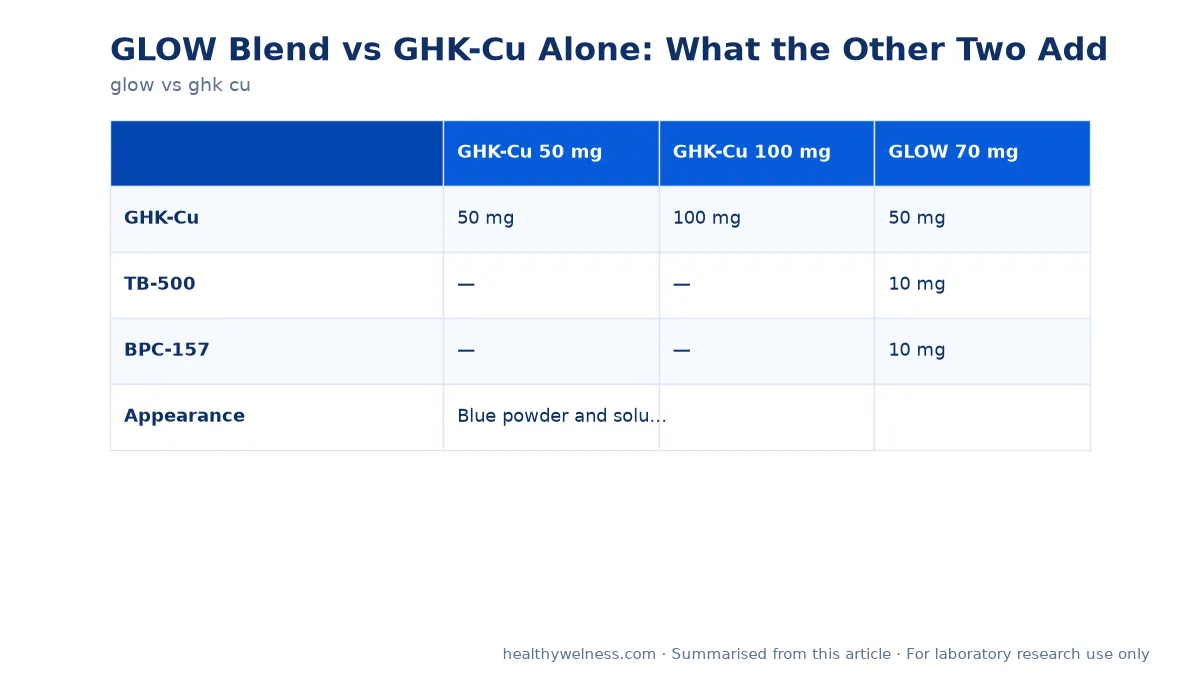
| GHK-Cu 50 mg | GHK-Cu 100 mg | GLOW 70 mg | |
|---|---|---|---|
| GHK-Cu | 50 mg | 100 mg | 50 mg |
| TB-500 | — | — | 10 mg |
| BPC-157 | — | — | 10 mg |
| Appearance | Blue powder and solution, from the copper complex | ||
Products: GHK-Cu and GLOW blend. Full profiles: GHK-Cu and GLOW blend.
What each component brings
| Component | Associated process (preclinical) | Key reference |
|---|---|---|
| GHK-Cu | Extracellular matrix synthesis and remodelling; MMP-2 with TIMP-1 and TIMP-2 in dermal fibroblasts | Siméon et al., 2000 |
| TB-500 | Actin-binding region of thymosin beta-4, linked to cell migration and angiogenesis | Sosne et al., 2010 |
| BPC-157 | Angiogenesis via VEGFR2–Akt–eNOS signalling | Hsieh et al., 2017 |
Two of the three are associated with angiogenesis-adjacent processes, which is presumably the thinking behind the combination. But “associated with related processes in separate studies” is a long way from “shown to work together”, and the literature contains no test of the mixture.
The attribution problem
This is the practical argument for using the single compound in research. Suppose a GLOW-treated culture shows increased collagen deposition. Four explanations are available:
- GHK-Cu did it.
- TB-500 did it.
- BPC-157 did it.
- Some interaction between them did it.
Nothing in the experiment distinguishes these. The same experiment run with GHK-Cu alone answers one clean question. If the aim is to study the blend as a product, that is a legitimate question too, but it should be framed that way rather than reported as a finding about copper peptides.
Does the copper stay with GHK?
A reasonable concern in any copper-containing blend. In GHK, copper is held by the N-terminal amine, a deprotonated backbone amide nitrogen and the histidine imidazole, and the complex exchanges copper rapidly (Hureau et al., 2011). Peptides that compete strongly for copper usually have a histidine near a free N-terminus. Neither TB-500 (N-terminus acetylated, no His) nor BPC-157 (no His) has that motif, so large-scale copper redistribution is not expected. It has not been measured in the blend, though, so this is reasoning from structure rather than data.
Practical differences
| Aspect | GHK-Cu alone | GLOW |
|---|---|---|
| Concentration maths | One calculation | Three separate calculations |
| Identity testing | One mass to confirm | Three masses (340, ~889, 1419.5 Da) |
| Ratio verification | Not applicable | Needed: 5:1:1 by weight |
| In-use stability | Set by GHK-Cu, which is robust at pH 4.5–7.4 | Set by the least stable of three |
| Experimental interpretation | Direct | Ambiguous |
The stability point is worth drawing out. GHK-Cu was stable in water and pH 4.5–7.4 buffers for at least two weeks at 60 °C in a stress study (Badenhorst et al., 2016), which is exceptional for a peptide. In a blend, that robustness does not protect the other two components, and the shortest-lived one determines how long the solution remains fully intact.
Choosing
- Mechanistic work on copper peptides: GHK-Cu alone, with a free-copper control and ideally a GHK-without-copper control.
- Evaluating the blend as a product: GLOW, with single-component arms for comparison if the budget allows.
- Need more GHK-Cu per vial: the 100 mg single-compound vial, not GLOW.
Handling for both is identical: see GHK-Cu handling and use the peptide reconstitution calculator one component at a time.
Open questions
- Does the blend produce effects that none of the three components produces alone?
- Is copper speciation altered by the presence of the other peptides at vial concentrations?
- Which component degrades first in a stored GLOW solution?
Related research
Frequently asked questions
What is the difference between GLOW and GHK-Cu?
GHK-Cu is a single copper tripeptide. GLOW is a 70 mg vial containing GHK-Cu 50 mg plus TB-500 10 mg and BPC-157 10 mg, so it adds two unrelated repair-research peptides to the same copper peptide.
Does GLOW contain less GHK-Cu than a GHK-Cu vial?
It depends which vial. A GLOW vial has 50 mg of GHK-Cu, the same as a 50 mg GHK-Cu vial, but a 100 mg GHK-Cu vial has twice as much.
Is GLOW stronger than GHK-Cu?
That question cannot be answered from published data. No peer-reviewed study has tested the blend, and the three components are associated with different processes rather than with the same one.
When is single-compound GHK-Cu the better choice?
Whenever an effect needs to be attributed to GHK-Cu specifically. A blend makes attribution impossible because any result could come from one of three peptides or from their interaction.
Is the blue colour the same?
Yes. GHK-Cu makes up five sevenths of the blend, so GLOW powder and solution are blue, and the other two components are colourless.
For laboratory research use only. The research materials supplied by HealthyWelness are not approved medicines, foods or cosmetics and are not for human or veterinary use. This article summarises published research and is not medical advice.
Sources
- Siméon A, et al. The tripeptide-copper complex glycyl-L-histidyl-L-lysine-Cu2+ stimulates matrix metalloproteinase-2 expression by fibroblast cultures. Life Sci. 2000. PMID: 11045606
- Pickart L, et al. Regenerative and Protective Actions of the GHK-Cu Peptide in the Light of the New Gene Data. Int J Mol Sci. 2018. PMID: 29986520
- Hureau C, et al. X-ray and solution structures of Cu(II) GHK and Cu(II) DAHK complexes: influence on their redox properties. Chemistry. 2011. PMID: 21780203
- Sosne G, et al. Biological activities of thymosin beta4 defined by active sites in short peptide sequences. FASEB J. 2010. PMID: 20179146
- Hsieh MJ, et al. Therapeutic potential of pro-angiogenic BPC157 is associated with VEGFR2 activation and up-regulation. J Mol Med (Berl). 2017. PMID: 27847966
- Badenhorst T, et al. Physicochemical characterization of native glycyl-l-histidyl-l-lysine tripeptide for wound healing and anti-aging: a preformulation study for dermal delivery. Pharm Dev Technol. 2016. PMID: 25384620