Tesamorelin vs HGH and IGF-1 LR3: Three Levels of the Axis
Tesamorelin stimulates the pituitary, HGH is the hormone itself, IGF-1 LR3 acts downstream. How the three differ in feedback, size and research use.


Cover illustration: AI-generated editorial artwork. Conceptual only; not an exact molecular structure, actual laboratory result or evidence of clinical effects.
Tesamorelin, growth hormone and IGF-1 LR3 are often compared as if they were alternatives. They are better understood as acting at three successive levels of the same axis: the hypothalamic signal, the pituitary hormone, and the downstream mediator. Where a compound sits in that chain determines what feedback still applies to it and what it can be used to study.
For laboratory research use only. The research materials supplied by HealthyWelness are not approved medicines, foods or cosmetics and are not for human or veterinary use. This article summarises published research and is not medical advice.
Key points
- Tesamorelin: GHRH analogue, acts on the pituitary, feedback intact.
- HGH (somatropin): the 191-residue hormone itself, ~22 kDa, bypasses the pituitary.
- IGF-1 LR3: modified IGF-1 acting at the IGF-1 receptor, downstream of GH.
- Only tesamorelin has a licensed indication among the three for the specific use studied here.
- Size differs by an order of magnitude across the group.
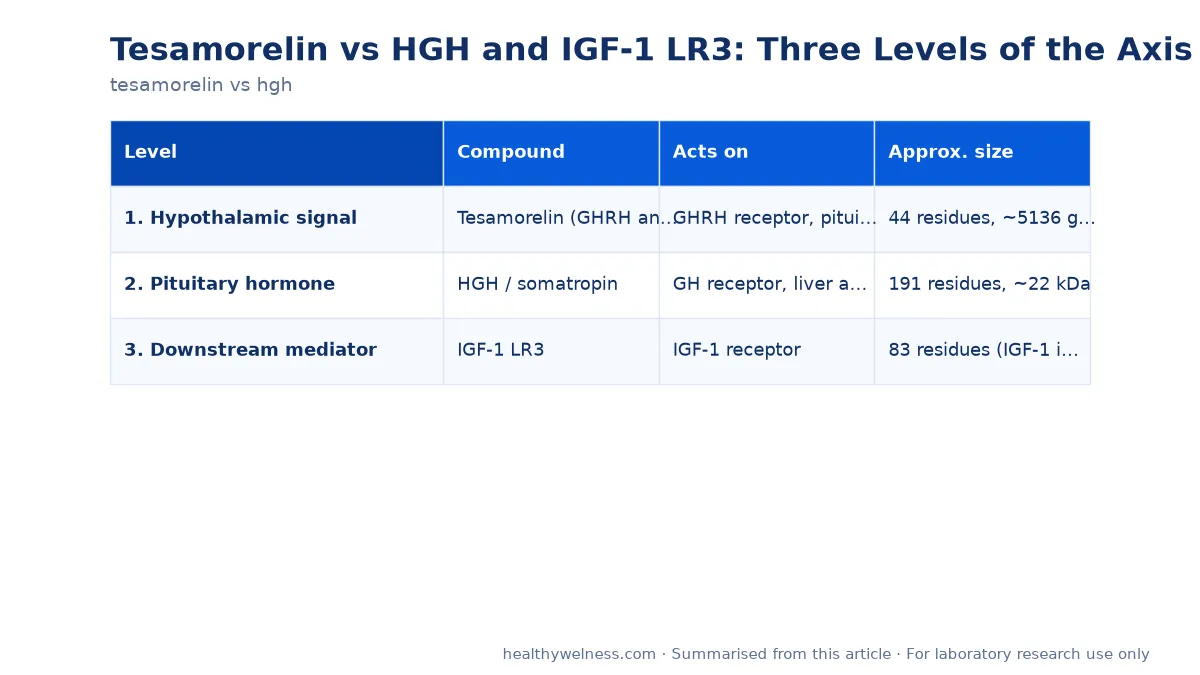
The axis, level by level
| Level | Compound | Acts on | Approx. size |
|---|---|---|---|
| 1. Hypothalamic signal | Tesamorelin (GHRH analogue) | GHRH receptor, pituitary somatotrophs | 44 residues, ~5136 g/mol |
| 2. Pituitary hormone | HGH / somatropin | GH receptor, liver and peripheral tissues | 191 residues, ~22 kDa |
| 3. Downstream mediator | IGF-1 LR3 | IGF-1 receptor | 83 residues (IGF-1 is 70) |
The GHRH receptor is a class B GPCR signalling through cAMP (Halmos et al., 2025), while the GH receptor is a cytokine-family receptor signalling through JAK2–STAT5, and the IGF-1 receptor is a tyrosine kinase related to the insulin receptor. Three different receptor classes, three different intracellular routes.
Feedback: the key practical difference
GH release is restrained by somatostatin and by IGF-1 feeding back on the hypothalamus and pituitary. A GHRH analogue pushes on one side of that balance while the brakes remain connected. Supplying GH or an IGF-1 analogue directly removes the pituitary from the loop entirely.
| Tesamorelin | HGH | IGF-1 LR3 | |
|---|---|---|---|
| Requires a functioning pituitary | Yes | No | No |
| Subject to somatostatin restraint | Yes | No | No |
| Preserves pulsatile pattern | Largely | No | Not applicable |
| IGF-1 as a readout | Downstream marker | Downstream marker | Is the agent itself |
This is why IGF-1 is a useful endpoint for tesamorelin and HGH studies but not a meaningful marker when an IGF-1 analogue is the agent being given.
What IGF-1 LR3 changes
Native IGF-1 circulates almost entirely bound to IGF-binding proteins, which regulate how much is available to the receptor. IGF-1 LR3 carries a 13-residue N-terminal extension and a substitution at position 3, modifications described as reducing binding-protein affinity so that more of the molecule remains free. In research it is used as a tool to probe IGF-1 receptor signalling without the confounding effect of binding-protein regulation. A 2026 review of peptides modulating the GH–IGF-1 axis covers this group and notes the gap between clinical evidence and the way these compounds are actually used outside research (Dominikowski et al., 2026).
Evidence compared
| Compound | Representative human data |
|---|---|
| Tesamorelin | 412-patient, 26-week phase 3: visceral fat −15.2% vs +5.0% placebo; IGF-I +81%; effect maintained to week 52 and reversed after stopping (Falutz et al., 2007; Dhillon, 2011) |
| HGH | Decades of use in defined deficiency states; pharmacology reviewed in Bidlingmaier et al., 2010 |
| IGF-1 LR3 | Research reagent; no comparable clinical program identified |
These are not interchangeable bodies of evidence. Tesamorelin’s data come from one defined population and endpoint; GH’s come from replacement in deficiency; IGF-1 LR3’s come from laboratory work.
Choosing for an experiment
- Studying pituitary responsiveness or GHRH-receptor signalling: tesamorelin (or another GHRH analogue).
- Studying GH receptor signalling directly: growth hormone.
- Studying IGF-1 receptor signalling without binding-protein interference: IGF-1 LR3.
- Interpreting IGF-1 measurements: remember IGF-1 integrates GH exposure over days, so it is a poor readout for short experiments.
Handling notes
Tesamorelin is a lyophilized peptide: store powder at −20 °C, solutions at 2–8 °C, protect from light because of Met27, and use the peptide reconstitution calculator for concentrations. Growth hormone and IGF-1 analogues are proteins rather than short peptides and are correspondingly more sensitive to agitation and freeze–thaw. Research-grade tesamorelin and IGF-1 LR3 are supplied for laboratory research use. Certificates are available for listed products — contact us for the latest report.
Open questions
- Does preserving pituitary feedback translate into a different long-term profile than direct GH administration?
- How much of tesamorelin’s effect on visceral fat is GH-mediated versus direct?
- What is the pharmacokinetic profile of IGF-1 LR3 relative to native IGF-1 in vivo?
Related research
Frequently asked questions
What is the difference between tesamorelin and HGH?
Tesamorelin is a GHRH analogue that stimulates the pituitary to release its own growth hormone. HGH (somatropin) is recombinant growth hormone itself, a 191-amino-acid protein given directly. Tesamorelin works upstream and leaves pituitary feedback intact; HGH bypasses it.
What is IGF-1 LR3?
A modified form of insulin-like growth factor 1 with an extended N-terminus and an amino acid substitution, designed to have reduced affinity for IGF-binding proteins. It acts downstream of growth hormone, at the IGF-1 receptor.
Which of the three acts fastest?
They act at different levels, so speed is not comparable in a simple way. A GHRH analogue needs a responsive pituitary; HGH raises circulating GH directly; IGF-1 analogues skip both steps and act at the IGF-1 receptor.
Why does feedback matter when comparing them?
GH secretion is regulated by somatostatin and by IGF-1 feedback. A GHRH analogue works within that system, so the pituitary can still restrain output. Giving GH or an IGF-1 analogue directly bypasses those controls.
Is tesamorelin a form of HGH?
No. Tesamorelin contains no growth hormone. It is a 44-residue GHRH analogue of about 5136 g/mol, whereas growth hormone is a 191-residue protein of about 22 kDa.
For laboratory research use only. The research materials supplied by HealthyWelness are not approved medicines, foods or cosmetics and are not for human or veterinary use. This article summarises published research and is not medical advice.
Sources
- Falutz J, et al. Metabolic effects of a growth hormone-releasing factor in patients with HIV. N Engl J Med. 2007. PMID: 18057338
- Dhillon S. Tesamorelin: a review of its use in the management of HIV-associated lipodystrophy. Drugs. 2011. PMID: 21668043
- Bidlingmaier M, et al. Growth hormone. Handb Exp Pharmacol. 2010. PMID: 20020365
- Halmos G, et al. Growth hormone-releasing hormone receptor (GHRH-R) and its signaling. Rev Endocr Metab Disord. 2025. PMID: 39934495
- Dominikowski A, et al. The emerging landscape of performance-enhancing peptides modulating GH-IGF1 axis: bridging the gap between clinical evidence and patient self-administration. Front Endocrinol (Lausanne). 2026. PMID: 42395176
- Memdouh S, et al. Advances in the detection of growth hormone releasing hormone synthetic analogs. Drug Test Anal. 2021. PMID: 34665524