Tesamorelin vs Retatrutide, Tirzepatide and MOTS-c
Tesamorelin works through the GH axis; incretin peptides through GIP, GLP-1 and glucagon receptors; MOTS-c through AMPK. Four different mechanisms compared.


Cover illustration: AI-generated editorial artwork. Conceptual only; not an exact molecular structure, actual laboratory result or evidence of clinical effects.
Tesamorelin is often compared with incretin peptides and with MOTS-c because all four appear in body-composition research. Mechanistically they have almost nothing in common. Tesamorelin acts on the pituitary; tirzepatide and retatrutide act on incretin and glucagon receptors; MOTS-c acts inside the cell on a metabolic enzyme pathway. Keeping those apart is the point of this comparison.
For laboratory research use only. The research materials supplied by HealthyWelness are not approved medicines, foods or cosmetics and are not for human or veterinary use. This article summarises published research and is not medical advice.
Key points
- Tesamorelin: GHRH receptor → growth hormone → IGF-1.
- Tirzepatide: GIP + GLP-1 receptors. Retatrutide adds the glucagon receptor.
- MOTS-c: mitochondria-encoded peptide; folate cycle inhibition and AMPK activation.
- Evidence volume runs incretins > tesamorelin > MOTS-c.
- No published study combines them.
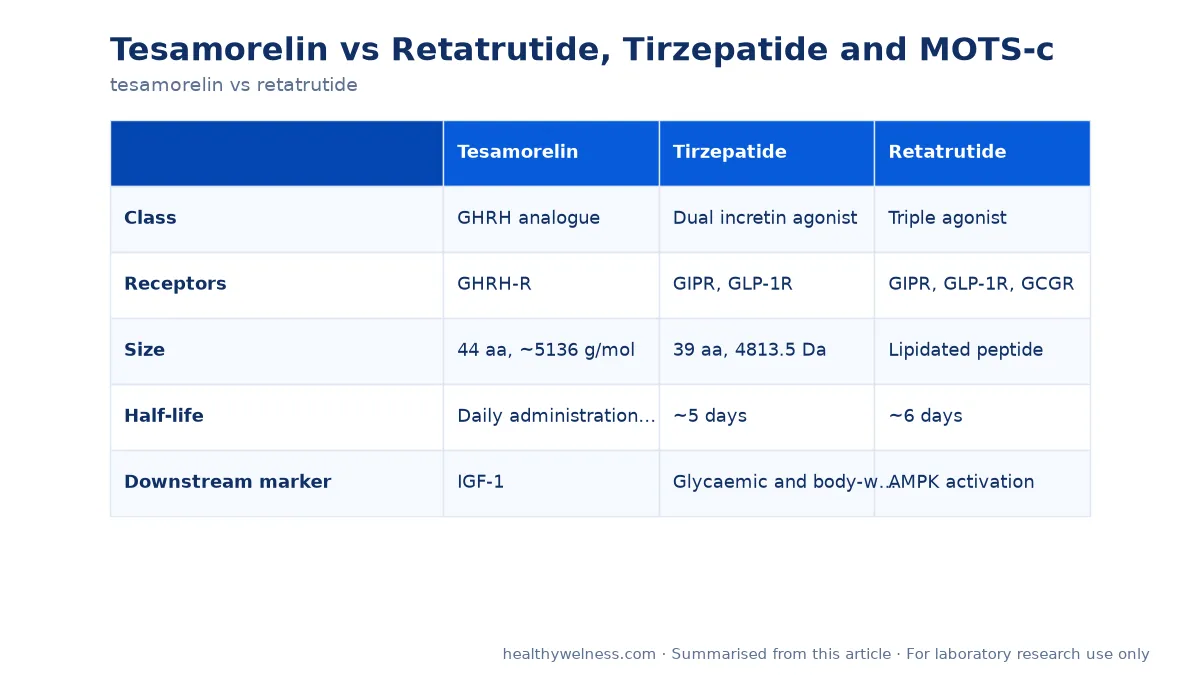
Four mechanisms, side by side
| Tesamorelin | Tirzepatide | Retatrutide | MOTS-c | |
|---|---|---|---|---|
| Class | GHRH analogue | Dual incretin agonist | Triple agonist | Mitochondria-encoded peptide |
| Receptors | GHRH-R | GIPR, GLP-1R | GIPR, GLP-1R, GCGR | No receptor identified |
| Size | 44 aa, ~5136 g/mol | 39 aa, 4813.5 Da | Lipidated peptide | 16 aa, ~2174.6 g/mol |
| Half-life | Daily administration in trials | ~5 days | ~6 days | Not published |
| Downstream marker | IGF-1 | Glycaemic and body-weight endpoints | AMPK activation | |
Profiles: tesamorelin, tirzepatide, retatrutide, MOTS-c.
Tesamorelin: upstream of a hormone
Tesamorelin does not act on fat tissue directly. It activates the GHRH receptor on pituitary somatotrophs, a cAMP-coupled GPCR (Halmos et al., 2025), and the resulting growth hormone acts on peripheral tissues. In its phase 3 trial, visceral adipose tissue fell 15.2% versus a 5.0% increase with placebo over 26 weeks, while IGF-I rose 81%, confirming that the GH axis was engaged (Falutz et al., 2007). Subcutaneous fat was not reduced to a clinically significant extent, and the visceral reduction reversed after stopping (Dhillon, 2011). The depot specificity is one of the more interesting features of the dataset.
Incretin peptides: receptor agonists with large trials
Tirzepatide and retatrutide act on receptors for gut and pancreatic hormones. In SURMOUNT-1, tirzepatide produced mean body-weight changes of −15.0% to −20.9% across dose groups over 72 weeks versus −3.1% with placebo (Jastreboff et al., 2022). Retatrutide’s phase 3 obesity trial reported −17.6% to −25.0% over 80 weeks versus −3.9% (Jastreboff et al., 2026). These are much larger trials with different populations and endpoints than the tesamorelin program, so the percentages are not comparable across studies.
MOTS-c: inside the cell
MOTS-c is encoded within the mitochondrial 12S rRNA gene rather than the nuclear genome. In the original description, its cellular actions inhibited the folate cycle and the de novo purine biosynthesis tethered to it, leading to AMPK activation, with skeletal muscle as the apparent primary target. In mice it prevented age-dependent and diet-induced insulin resistance (Lee et al., 2015). Later work reported enhanced physical performance in young, middle-aged and old mice, and showed that exercise induces endogenous MOTS-c in human muscle and circulation (Reynolds et al., 2021). There is no published human treatment trial.
What this means for study design
| If you want to study… | Use | Measure |
|---|---|---|
| Pituitary-mediated effects | Tesamorelin | GH and IGF-1, plus the tissue endpoint |
| Incretin receptor signalling | Tirzepatide or retatrutide | Receptor-level readouts; glycaemic endpoints |
| Energy expenditure versus intake | Retatrutide (adds glucagon receptor) | Expenditure as well as intake |
| Cellular energy sensing | MOTS-c | AMPK phosphorylation, purine pathway intermediates |
Because the pathways are independent, an experiment using more than one can separate contributions, provided each has its own control.
Handling differences
- Tesamorelin: 5.1 kDa peptide with Met27; protect from light and air.
- Tirzepatide and retatrutide: lipidated, prone to self-association; swirl gently, never shake, avoid freeze–thaw.
- MOTS-c: contains sulfur-containing residues; limit air exposure.
- All: powder at −20 °C, solutions at 2–8 °C. Use the peptide reconstitution calculator.
Research-grade tesamorelin is supplied in 5, 10 and 20 mg vials. Certificates are available for listed products — contact us for the latest report.
Open questions
- Why is tesamorelin’s effect on fat depot-specific, while incretin agonists reduce body weight more broadly?
- Does AMPK activation by MOTS-c overlap functionally with any part of the incretin response?
- Would combining mechanisms add anything, or simply add adverse effects? No data exist either way.
Related research
Frequently asked questions
What is the difference between tesamorelin and retatrutide?
They work through unrelated systems. Tesamorelin is a GHRH analogue acting on the pituitary GHRH receptor. Retatrutide is a triple agonist of the GIP, GLP-1 and glucagon receptors. Their only common ground is that both have been studied with body-composition endpoints.
Is tesamorelin an incretin peptide?
No. Tesamorelin has no activity at GLP-1 or GIP receptors. It is frequently confused with incretin peptides because catalogues list them together.
How does MOTS-c differ from both?
MOTS-c is a 16-residue peptide encoded in mitochondrial DNA. Its described mechanism is inhibition of the folate cycle and de novo purine synthesis, leading to AMPK activation, which is unrelated to either the GH axis or incretin receptors.
Which has the most human evidence?
The incretin peptides. Tirzepatide and retatrutide have large phase 3 trials. Tesamorelin has two 26-week phase 3 trials in one defined population. MOTS-c has no published human treatment trial.
Can these be used together in research?
They can be studied together because the pathways are independent, but no peer-reviewed study of such combinations was found.
For laboratory research use only. The research materials supplied by HealthyWelness are not approved medicines, foods or cosmetics and are not for human or veterinary use. This article summarises published research and is not medical advice.
Sources
- Falutz J, et al. Metabolic effects of a growth hormone-releasing factor in patients with HIV. N Engl J Med. 2007. PMID: 18057338
- Dhillon S. Tesamorelin: a review of its use in the management of HIV-associated lipodystrophy. Drugs. 2011. PMID: 21668043
- Jastreboff AM, et al. Tirzepatide Once Weekly for the Treatment of Obesity. N Engl J Med. 2022. PMID: 35658024
- Jastreboff AM, et al. Retatrutide, a Triple Hormone Receptor Agonist, for Treatment of Obesity. N Engl J Med. 2026. PMID: 42814954
- Lee C, et al. The mitochondrial-derived peptide MOTS-c promotes metabolic homeostasis and reduces obesity and insulin resistance. Cell Metab. 2015. PMID: 25738459
- Reynolds JC, et al. MOTS-c is an exercise-induced mitochondrial-encoded regulator of age-dependent physical decline and muscle homeostasis. Nat Commun. 2021. PMID: 33473109
- Halmos G, et al. Growth hormone-releasing hormone receptor (GHRH-R) and its signaling. Rev Endocr Metab Disord. 2025. PMID: 39934495