IGF-1 LR3 Reconstitution: It Is a Protein, Not a Peptide
IGF-1 LR3 is an 83-residue folded protein with three disulfide bridges. Why peptide reconstitution practice does not transfer, and what does.


Cover illustration: AI-generated editorial artwork. Conceptual only; not an exact molecular structure, actual laboratory result or evidence of clinical effects.
The most consequential thing to understand about IGF-1 LR3 is that it is not a peptide in the sense the rest of a research catalogue uses the word. It is an 83-residue recombinant protein with three disulfide bridges and a defined fold, carrying a 13-residue N-terminal extension and an arginine substitution at position 3. Peptide handling guidance does not transfer, and following it is how material gets wasted.
For laboratory research use only. The research materials supplied by HealthyWelness are not approved medicines, foods or cosmetics and are not for human or veterinary use. This article summarises published research and is not medical advice.
Peptide practice versus protein practice
| Step | Short peptide | IGF-1 LR3 |
|---|---|---|
| Diluent | Water or bacteriostatic water | Per certificate; commonly dilute acid, then buffer |
| Mixing | Swirl; vortex tolerated | Swirl only — never vortex |
| Carrier protein | Rarely needed | Standard for dilute working solutions |
| Freeze–thaw tolerance | Moderate | Low — aliquot on first use |
| Identity check | Intact mass by MS | SDS-PAGE plus activity; intact mass is less informative |
| Failure signature | Changed mass | Unchanged mass, lost activity |
That final row is the heart of the matter. A degraded short peptide usually shows it: a new peak, a changed mass. A denatured protein can have the correct mass, the correct chromatographic behaviour by some methods, and no activity at all. The failure is silent. A null result in an experiment using mishandled IGF-1 LR3 looks exactly like a negative finding.
What LR3 actually denotes
Two modifications relative to native IGF-1, and both exist for the same reason — to reduce binding by the IGF binding proteins:
- Long R3: a 13-residue N-terminal extension, and arginine in place of glutamate at position 3.
- The purpose: IGF binding proteins sequester native IGF-1 in circulation. Variants binding them less avidly show different availability.
The 1996 review by Ballard and colleagues on des(1-3)IGF-I is the right background reading even though it concerns a different variant, because it explains the same design logic: modify the N-terminal region, change binding protein interaction, change availability. The 2008 study by Hadsell and colleagues used long-R3-IGF-I in mice and is a representative example of the variant in use.
Why does this matter for handling? Because the binding protein interaction is a property of the folded protein. A partly denatured preparation does not simply have lower potency; its interaction with binding proteins in a serum-containing medium is unpredictable.
Reconstitution, step by step
- Centrifuge the vial briefly before opening if the lyophilized material may have been dislodged in transit. Powder in the cap is powder not in the solution.
- Use the diluent named on the certificate. This is not a step to improvise. Many recombinant IGF-1 preparations are specified for reconstitution in dilute acid because solubility is markedly better at low pH; neutral water may give incomplete dissolution.
- Add the diluent down the vial wall, slowly. Let it run over the cake rather than onto it.
- Swirl gently until clear. Minutes, not seconds, is normal. Do not shake, do not vortex, do not pipette up and down vigorously.
- Dilute into the buffered working solution with carrier protein if the final concentration is low. This dilution, not the stock, is where surface loss happens.
- Aliquot the stock into single-use volumes and freeze.
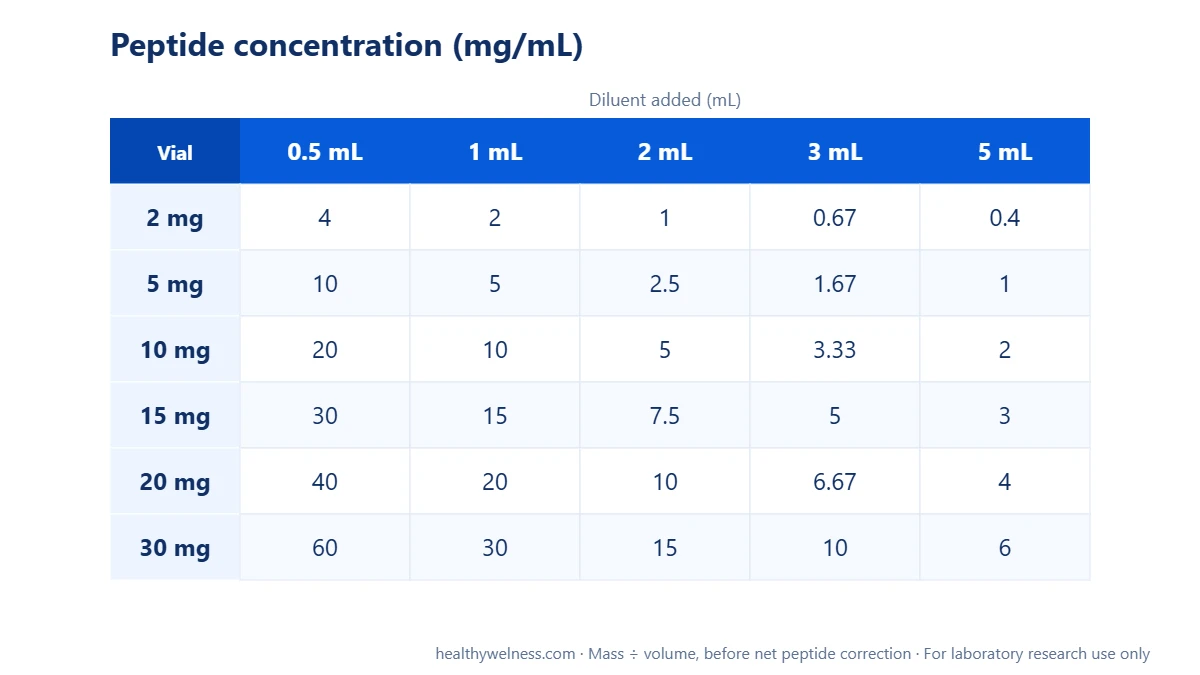
Our reconstitution calculator handles the volume arithmetic from net mass and target concentration; the diluent choice and the mixing technique are what the calculator cannot supply.
Why the solid state matters too
Lyophilized protein is not stable indefinitely regardless of temperature. The 1995 study by Bell and colleagues examined thermally induced denaturation of lyophilized bovine somatotropin and lysozyme and found it strongly affected by moisture content and excipients. The 2003 study by Chen and colleagues looked at how a single buffer component, histidine, influenced stability and physical properties of a protein in both aqueous and solid forms.
Both point the same way: residual moisture and formulation composition govern solid-state stability, not just temperature. Practically, that means resealing the vial properly with desiccant, letting it reach room temperature before opening so moisture does not condense into the powder, and not treating a lyophilized protein as indestructible because it is in a freezer.
Checks worth doing
- Inspect the reconstituted solution. Haze or visible particulates indicate aggregation. A clear solution is the minimum requirement, not a good sign.
- Run SDS-PAGE on a new lot where facilities allow. It shows aggregation and fragmentation that a mass measurement of the monomer will not.
- Keep a reference aliquot from a lot known to have performed well, to run alongside a new lot.
- Record the diluent and the number of freeze–thaw rounds for every aliquot. When a result is anomalous, this is the first thing worth checking. See how to read a certificate of analysis.
Our IGF-1 LR3 research material is supplied for laboratory research use. Certificates are available for listed products — contact us for the latest report.
Open questions
- How much activity is lost per freeze–thaw round under typical laboratory conditions?
- What proportion of variability between published IGF-1 LR3 experiments is attributable to handling?
- Does carrier protein choice affect measured potency in serum-free systems?
Related research
Frequently asked questions
Why is IGF-1 LR3 handled differently from a short peptide?
Because it is a folded protein, not a linear peptide. It is 83 residues long with three disulfide bridges, and its activity depends on a specific three-dimensional structure. Losing that structure destroys function without changing the mass or the appearance of the solution.
What diluent is appropriate?
The one named on the certificate for that lot. Recombinant IGF-1 preparations are commonly supplied for reconstitution in dilute acid rather than neutral water, because solubility is better at low pH, followed by dilution into a buffered working solution.
Why is carrier protein recommended?
At low concentrations a protein adsorbs to tube and pipette surfaces, and a meaningful fraction can simply be lost. A carrier protein saturates those surfaces. It is standard practice for working solutions in the nanogram per millilitre range.
Can it be vortexed?
No. Shear and foaming unfold proteins at the air-water interface, and unfolded protein aggregates irreversibly. Add the diluent gently down the vial wall and swirl until dissolved.
How many freeze-thaw rounds are acceptable?
As few as possible, which in practice means aliquoting on first reconstitution. Each freeze and thaw concentrates solutes at the ice interface and provides an opportunity for aggregation; the effect is greater for a disulfide-bridged protein than for a short peptide.
References
- Hadsell DL, et al. Enhancement of maternal lactation performance during prolonged lactation in the mouse by mouse GH and long-R3-IGF-I is linked to changes in mammary signaling and gene expression. J Endocrinol. 2008. PMID: 18577570 https://pubmed.ncbi.nlm.nih.gov/18577570/
- Ballard FJ, et al. Des(1-3)IGF-I: a truncated form of insulin-like growth factor-I. Int J Biochem Cell Biol. 1996. PMID: 8930132 https://pubmed.ncbi.nlm.nih.gov/8930132/
- Bell LN, et al. Thermally induced denaturation of lyophilized bovine somatotropin and lysozyme as impacted by moisture and excipients. J Pharm Sci. 1995. PMID: 7562408 https://pubmed.ncbi.nlm.nih.gov/7562408/
- Chen B, et al. Influence of histidine on the stability and physical properties of a fully human antibody in aqueous and solid forms. Pharm Res. 2003. PMID: 14725359 https://pubmed.ncbi.nlm.nih.gov/14725359/
For laboratory research use only. The research materials supplied by HealthyWelness are not approved medicines, foods or cosmetics and are not for human or veterinary use. This article summarises published research and is not medical advice.
Sources
- Hadsell DL, et al. Enhancement of maternal lactation performance during prolonged lactation in the mouse by mouse GH and long-R3-IGF-I is linked to changes in mammary signaling and gene expression. J Endocrinol. 2008. PMID: 18577570
- Ballard FJ, et al. Des(1-3)IGF-I: a truncated form of insulin-like growth factor-I. Int J Biochem Cell Biol. 1996. PMID: 8930132
- Bell LN, et al. Thermally induced denaturation of lyophilized bovine somatotropin and lysozyme as impacted by moisture and excipients. J Pharm Sci. 1995. PMID: 7562408
- Chen B, et al. Influence of histidine on the stability and physical properties of a fully human antibody in aqueous and solid forms. Pharm Res. 2003. PMID: 14725359