SLU-PP-332 Handling: Solubility, Purity and Storage
SLU-PP-332 is a small molecule, not a peptide, so it needs different handling. Co-solvents, precipitation checks and what its purity data should show.

Cover illustration: AI-generated editorial artwork. Conceptual only; not an exact molecular structure, actual laboratory result or evidence of clinical effects.
The most common mistake with SLU-PP-332 is treating it like a peptide, and it is an easy mistake to make, because it is sold alongside peptides and described in the same catalogues. It is a small molecule. Almost everything in standard peptide handling guidance — bacteriostatic water, aqueous reconstitution, peptide content figures — either does not apply or actively misleads.
For laboratory research use only. The research materials supplied by HealthyWelness are not approved medicines, foods or cosmetics and are not for human or veterinary use. This article summarises published research and is not medical advice.
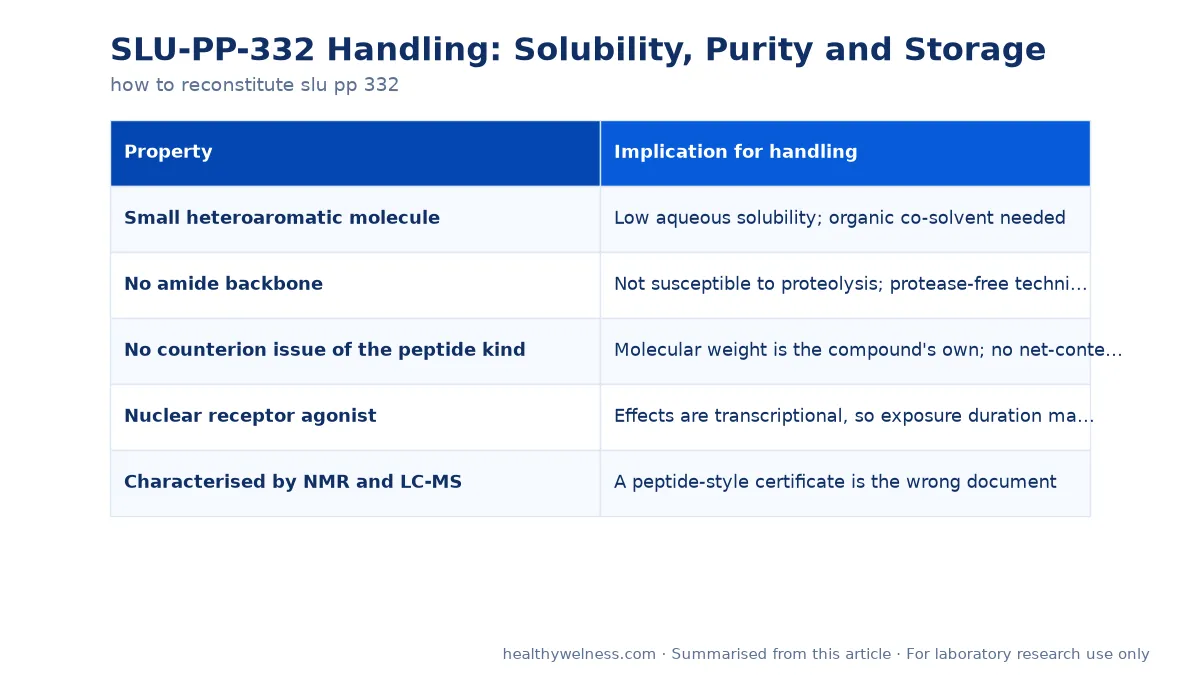
What it is, and what follows from that
| Property | Implication for handling |
|---|---|
| Small heteroaromatic molecule | Low aqueous solubility; organic co-solvent needed |
| No amide backbone | Not susceptible to proteolysis; protease-free technique irrelevant |
| No counterion issue of the peptide kind | Molecular weight is the compound’s own; no net-content correction |
| Nuclear receptor agonist | Effects are transcriptional, so exposure duration matters more than peak |
| Characterised by NMR and LC-MS | A peptide-style certificate is the wrong document |
Preparing a stock solution
The standard approach for a poorly water-soluble small molecule is a two-step one: a concentrated stock in an organic solvent, then dilution into the aqueous working medium.
- Let the vial reach room temperature before opening. A cold vial opened in humid air condenses water onto the solid, which for a hygroscopic compound is the start of a problem.
- Prepare the concentrated stock in an organic solvent at a concentration you have confirmed dissolves fully — clear, with no residual particulate against a dark background.
- Dilute into the assay medium last, with mixing, and keep the final co-solvent fraction as low as the assay permits.
- Prepare a vehicle control at the identical final co-solvent concentration. Organic solvents are not inert in cell systems; a vehicle control at a different concentration is not a control.
- Inspect the diluted solution. This is the step most often skipped and the one most likely to catch a failure.
The precipitation problem, in detail
When a concentrated organic stock meets an aqueous medium, the compound’s solubility drops abruptly. If the final concentration exceeds the aqueous solubility limit, it comes out of solution. Three features make this insidious:
- It can be partial. Some of the compound stays in solution, so the result is an unknown concentration rather than zero.
- It can be slow. A solution clear at the moment of preparation may develop haze over the hours of an incubation.
- It is concentration-dependent in the wrong direction for dose-response work. The highest concentrations in a series are the most likely to precipitate, which flattens the top of the curve and can look like a plateau in the response.
That last point deserves emphasis because it produces a plausible-looking artefact. A dose-response curve that plateaus because the compound stopped dissolving is indistinguishable, on the data alone, from one that plateaus because the target is saturated. The way to tell them apart is to inspect the wells and, where possible, to measure the compound concentration in the medium.
What the analytical data should contain
A certificate for a small molecule answers different questions from one for a peptide:
| Item | Expected for SLU-PP-332 | Peptide equivalent |
|---|---|---|
| Purity | HPLC or LC-MS area percentage | Same method, same caveats |
| Identity | Mass matching molecular formula; NMR ideal | Mass plus chromatographic retention |
| Content | Not applicable in the peptide sense | Peptide content, a distinct figure |
| Counterion | Only if supplied as a salt | Always relevant |
| Residual solvent | Relevant — from crystallisation | Less commonly reported |
| Water content | Relevant if hygroscopic | Routinely relevant |
The 2024 review by Kuril and colleagues in Analytical Biochemistry is written about peptides but its framework — what full characterisation actually requires, and why a single purity number is insufficient — transfers directly. The general principle in reading a certificate of analysis holds for small molecules too: the figure without the method cannot be interpreted.
One specific item is worth requesting for a compound like this: residual solvent. Small molecules are crystallised from organic solvents, and residual solvent is both a mass contribution and, in some cases, biologically active at the levels that remain.
Storage
- Solid: sealed, dry, dark, at −20 °C. Desiccant in the storage container is worthwhile.
- Organic stock: aliquot, seal tightly, freeze. Record the solvent and the date on every tube.
- Avoid repeated warming of a stock vial. Each opening admits atmospheric moisture into a hygroscopic organic solvent, and water content changes both solubility and the effective concentration.
- Do not store diluted aqueous working solutions. There is no advantage and a real risk of slow precipitation.
The general chemistry of degradation in solution — pH, oxidation, time — is covered well by the 2014 study by Li and colleagues in the International Journal of Pharmaceutics; the molecule there is a peptide, but the kinetic framework for thinking about chemical degradation in solution is the same.
Relating handling to the published work
The 2023 and 2024 papers by Billon and colleagues are the primary characterisations, and they matter for handling in one specific respect: the mechanism is transcriptional. ERR agonism acts through gene expression, so sustained exposure over hours is what the biology requires. A compound that precipitates two hours into a twenty-four-hour incubation has not delivered the exposure the experiment assumes.
Our SLU-PP-332 research material is supplied for laboratory research use. Certificates are available for listed products — contact us for the latest report. The reconstitution figures for the peptides in a comparison set can be worked out with our reconstitution calculator, but this compound’s stock concentration is set by its solubility in the chosen solvent rather than by a mass-and-volume calculation alone.
Open questions
- What is the measured aqueous solubility limit under common culture conditions?
- How stable is a frozen organic stock over months?
- How much do residual solvent levels vary between lots?
Related research
Frequently asked questions
Can SLU-PP-332 be dissolved in water?
Not usefully. It is a small heteroaromatic molecule rather than a peptide, and aqueous solubility is low. Published work and standard practice for compounds of this class use an organic co-solvent to prepare a concentrated stock, which is then diluted into the assay medium.
Is bacteriostatic water appropriate for it?
No. Bacteriostatic water is a diluent for peptides; it does not improve the solubility of a poorly water-soluble small molecule. Using it here produces a suspension rather than a solution.
How do I know whether it stayed in solution?
Look. Precipitation on dilution into aqueous medium is the most common failure with compounds of this type, and it is often visible as haze or particulates. A nominal concentration means nothing if the compound has come out of solution.
What should its purity data look like?
Small-molecule data, not peptide data: an HPLC or LC-MS purity figure, a mass consistent with the molecular formula, and ideally NMR confirming structure. A peptide-style certificate reporting peptide content would indicate the wrong analysis was applied.
How should it be stored?
Sealed, dry and protected from light at minus 20 degrees Celsius for the solid. Stock solutions in organic solvent are aliquoted and kept frozen, with the solvent choice recorded, since repeated warming and refreezing promotes both solvent water uptake and compound degradation.
References
- Billon C, et al. Synthetic ERRα/β/γ Agonist Induces an ERRα-Dependent Acute Aerobic Exercise Response and Enhances Exercise Capacity. ACS Chem Biol. 2023. PMID: 36988910 https://pubmed.ncbi.nlm.nih.gov/36988910/
- Billon C, et al. A Synthetic ERR Agonist Alleviates Metabolic Syndrome. J Pharmacol Exp Ther. 2024. PMID: 37739806 https://pubmed.ncbi.nlm.nih.gov/37739806/
- Kuril AK, et al. Analytical considerations for characterization of generic peptide product: A regulatory insight. Anal Biochem. 2024. PMID: 39089363 https://pubmed.ncbi.nlm.nih.gov/39089363/
- Li R, et al. Stability of an anti-stroke peptide: driving forces and kinetics in chemical degradation. Int J Pharm. 2014. PMID: 24929015 https://pubmed.ncbi.nlm.nih.gov/24929015/
For laboratory research use only. The research materials supplied by HealthyWelness are not approved medicines, foods or cosmetics and are not for human or veterinary use. This article summarises published research and is not medical advice.
Sources
- Billon C, et al. Synthetic ERRα/β/γ Agonist Induces an ERRα-Dependent Acute Aerobic Exercise Response and Enhances Exercise Capacity. ACS Chem Biol. 2023. PMID: 36988910
- Billon C, et al. A Synthetic ERR Agonist Alleviates Metabolic Syndrome. J Pharmacol Exp Ther. 2024. PMID: 37739806
- Kuril AK, et al. Analytical considerations for characterization of generic peptide product: A regulatory insight. Anal Biochem. 2024. PMID: 39089363
- Li R, et al. Stability of an anti-stroke peptide: driving forces and kinetics in chemical degradation. Int J Pharm. 2014. PMID: 24929015