5-Amino-1MQ: Salt Form, Purity and Lab Handling
5-Amino-1MQ is a quaternary ammonium cation supplied as a salt. Why the counterion is named on the label, and what its purity data should show.


Cover illustration: AI-generated editorial artwork. Conceptual only; not an exact molecular structure, actual laboratory result or evidence of clinical effects.
5-Amino-1MQ has a chemical feature that sets its entire handling profile: the molecule is a permanently charged cation. The quinolinium nitrogen bears a methyl group and a positive charge that no change in pH can remove. There is no neutral form. That single fact explains the counterion on the label, the solubility behaviour, and why the analytical data looks the way it does.
For laboratory research use only. The research materials supplied by HealthyWelness are not approved medicines, foods or cosmetics and are not for human or veterinary use. This article summarises published research and is not medical advice.
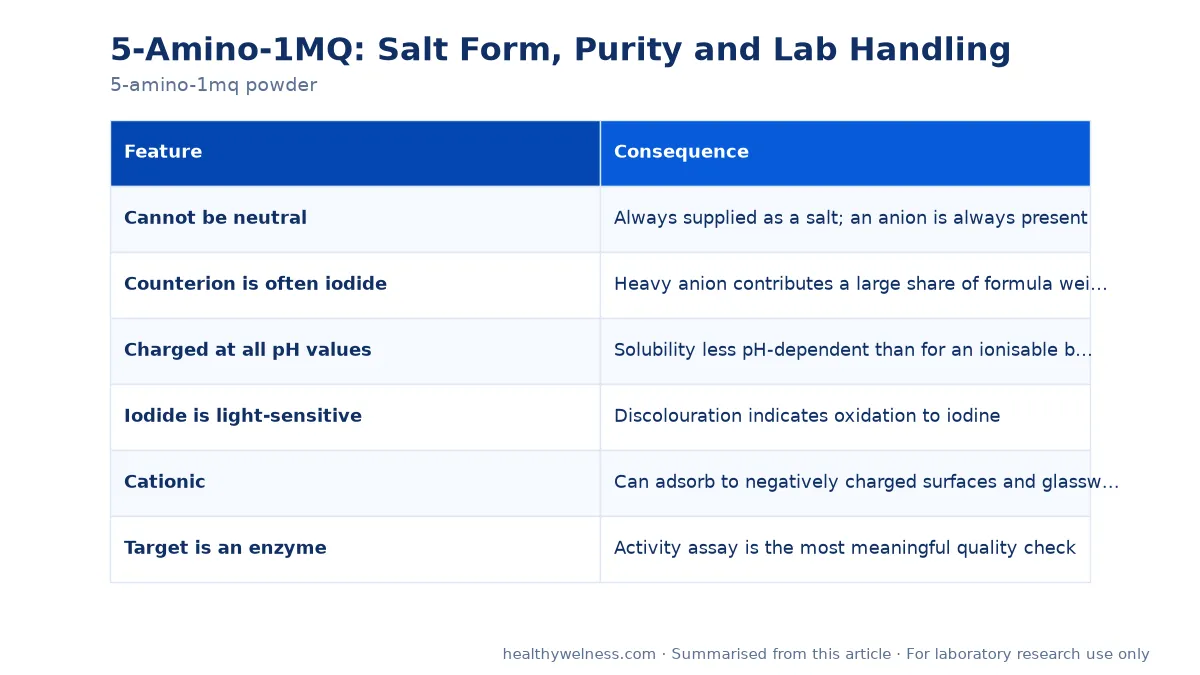
The consequences of a permanent charge
| Feature | Consequence |
|---|---|
| Cannot be neutral | Always supplied as a salt; an anion is always present |
| Counterion is often iodide | Heavy anion contributes a large share of formula weight |
| Charged at all pH values | Solubility less pH-dependent than for an ionisable base |
| Iodide is light-sensitive | Discolouration indicates oxidation to iodine |
| Cationic | Can adsorb to negatively charged surfaces and glassware |
| Target is an enzyme | Activity assay is the most meaningful quality check |
The counterion is not a footnote
With a quaternary ammonium compound, the anion is part of what is in the bottle by necessity rather than as a residue of purification. This differs from the peptide case, where a counterion is an artefact of ion exchange that can in principle be swapped.
The weight arithmetic is the practical point. Iodide has an atomic mass of about 127, which for a small cation can be a substantial fraction of the formula weight of the salt. Weighing out a quantity and calculating molarity from the cation’s mass alone overstates the concentration considerably. The molecular weight on the certificate — of the salt as supplied, not of the free cation — is the number to use.
If a lot is supplied with a different counterion, the molecular weight changes and so does every calculation derived from it. This is one of the few cases where the salt form on the label genuinely must be read rather than skimmed.
Light sensitivity, and what discolouration means
Iodide salts darken on exposure to light and air, because iodide oxidises to iodine. The visible result is yellowing or browning of material that should be white to off-white.
This is unusually convenient as quality indicators go: the failure mode is visible. Most degradation in research compounds is invisible and detectable only analytically. Here, a discoloured solid is direct evidence of oxidative change, and the sensible response is to discard the lot rather than to proceed and hope.
The corresponding storage practice is straightforward: amber vials or foil overwrap, desiccated, at −20 °C, with the container kept closed. Trace metal ions catalyse oxidation generally, a process documented in detail for histidine in model peptides by Khossravi and colleagues, and the principle — keep metals out of a system where oxidation is the failure route — applies here as well.
Preparing solutions
- Warm the sealed vial to room temperature before opening. Opening a cold vial admits moisture, and a hygroscopic salt takes it up.
- Dissolve in the diluent named on the certificate, at or below the stated solubility. A permanently charged cation is typically more water-tolerant than a neutral heteroaromatic, but this should be read from the certificate rather than assumed.
- Check for complete dissolution against a dark background. Undissolved material means the actual concentration is unknown.
- Note surface adsorption at low concentrations. Cationic compounds bind to negatively charged surfaces, so low-concentration working solutions can lose material to glass and plastic.
- Aliquot and freeze. Repeated warming of one tube is the common route to both water uptake and oxidative change.
Where a comparison set includes peptides, their concentration maths runs differently — net peptide content and counterion correction — and our reconstitution calculator handles that case. For this salt, the formula weight of the supplied form is the input that matters.
Quality checks for an enzyme inhibitor
This is where the compound class suggests a check that a certificate rarely provides. 5-Amino-1MQ inhibits nicotinamide N-methyltransferase. The 2018 study by Neelakantan and colleagues characterised selective, membrane-permeable NNMT inhibitors in a mouse model, and the 2025 Nature paper by Heide and colleagues on NNMT inhibition in cancer-associated fibroblasts indicates the field’s current direction.
For an inhibitor, the most informative quality measure is inhibition of the target enzyme, not a chromatographic percentage. A batch that is 98 per cent pure by area but has partly oxidised may show reduced inhibitory activity, and only an activity measurement reveals that. Where the laboratory has access to an NNMT activity assay, running a new lot alongside a retained reference lot is the single best quality practice available.
Failing that, the analytical minimum is:
| Check | Why |
|---|---|
| Purity with method stated | A percentage alone cannot be interpreted |
| Mass of the cation | Confirms identity of the active species |
| Counterion named | Required for correct molecular weight |
| Appearance described | Discolouration is meaningful for an iodide salt |
| Residual solvent | Crystallisation solvent contributes mass and can be active |
The framework in the 2024 review by Kuril and colleagues — that characterisation is a set of measurements rather than one number — applies to small molecules as readily as to peptides, and the same logic is set out in reading a certificate of analysis.
Our 5-Amino-1MQ research material is supplied for laboratory research use. Certificates are available for listed products — contact us for the latest report.
Open questions
- How much inhibitory activity is lost in a visibly discoloured lot?
- What is the measured stability of a frozen aqueous stock over months?
- How much material is lost to surface adsorption at low working concentrations?
Related research
Frequently asked questions
What kind of molecule is 5-Amino-1MQ?
A quaternary ammonium cation: 5-amino-1-methylquinolinium. Because the nitrogen carries a permanent positive charge, the compound cannot exist as a neutral species and is always supplied as a salt with an anion, commonly iodide.
Why does the counterion appear on the label?
Because it is unavoidable and because it contributes substantially to the formula weight. Iodide is heavy. A quantity stated as the salt is a different amount of cation than the same number stated for a lighter counterion, so the molecular weight used in calculations must match the salt supplied.
Is it water-soluble?
A permanently charged cation is generally more water-soluble than a neutral heteroaromatic compound, which distinguishes it from many small molecules in research catalogues. The solubility stated on the certificate for the specific salt is what should be relied on.
What should the purity data include?
A chromatographic purity figure with the method stated, a mass consistent with the cation, identification of the counterion, and ideally NMR. For an enzyme inhibitor, an activity measurement against the target enzyme is the most informative single check available.
How is it best stored?
Sealed, dry and dark at minus 20 degrees Celsius. Iodide salts are light-sensitive: iodide oxidises to iodine, which is visible as yellowing or browning of a white or off-white solid and is a reason to discard a discoloured lot.
References
- Neelakantan H, et al. Selective and membrane-permeable small molecule inhibitors of nicotinamide N-methyltransferase reverse high fat diet-induced obesity in mice. Biochem Pharmacol. 2018. PMID: 29155147 https://pubmed.ncbi.nlm.nih.gov/29155147/
- Heide J, et al. NNMT inhibition in cancer-associated fibroblasts restores antitumour immunity. Nature. 2025. PMID: 40702186 https://pubmed.ncbi.nlm.nih.gov/40702186/
- Khossravi M, et al. Chemical pathways of peptide degradation: IX. Metal-catalyzed oxidation of histidine in model peptides. Pharm Res. 1998. PMID: 9688066 https://pubmed.ncbi.nlm.nih.gov/9688066/
- Kuril AK, et al. Analytical considerations for characterization of generic peptide product: A regulatory insight. Anal Biochem. 2024. PMID: 39089363 https://pubmed.ncbi.nlm.nih.gov/39089363/
For laboratory research use only. The research materials supplied by HealthyWelness are not approved medicines, foods or cosmetics and are not for human or veterinary use. This article summarises published research and is not medical advice.
Sources
- Neelakantan H, et al. Selective and membrane-permeable small molecule inhibitors of nicotinamide N-methyltransferase reverse high fat diet-induced obesity in mice. Biochem Pharmacol. 2018. PMID: 29155147
- Heide J, et al. NNMT inhibition in cancer-associated fibroblasts restores antitumour immunity. Nature. 2025. PMID: 40702186
- Khossravi M, et al. Chemical pathways of peptide degradation: IX. Metal-catalyzed oxidation of histidine in model peptides. Pharm Res. 1998. PMID: 9688066
- Kuril AK, et al. Analytical considerations for characterization of generic peptide product: A regulatory insight. Anal Biochem. 2024. PMID: 39089363