Does NAD+ Need Refrigeration? Storage and Stability
NAD+ is hygroscopic and degrades in solution. Why the solid needs dry cold storage and why solutions should be prepared close to use.

Cover illustration: AI-generated editorial artwork. Conceptual only; not an exact molecular structure, actual laboratory result or evidence of clinical effects.
The question “does it need refrigeration” has a short answer and a more useful one. The short answer is that the solid should be kept cold. The more useful answer is that for NAD+, dryness is at least as important as temperature, and that solutions should not be stored at all regardless of what temperature is available.
For laboratory research use only. The research materials supplied by HealthyWelness are not approved medicines, foods or cosmetics and are not for human or veterinary use. This article summarises published research and is not medical advice.
Why dryness is the first variable
NAD+ is hygroscopic: the solid takes up water from the air. That matters for a reason that is easy to underestimate.
In a solid, water does two separate things. It acts as a solvent, providing the medium in which a degradation reaction can occur, and it acts as a plasticiser, lowering the glass transition and giving molecules enough mobility to meet and react. The 1999 study by Lai and colleagues separated these two effects experimentally for peptide deamidation in a polymer matrix, and the distinction generalises: a dry solid is stable not only because reactions need water but because reactions need movement.
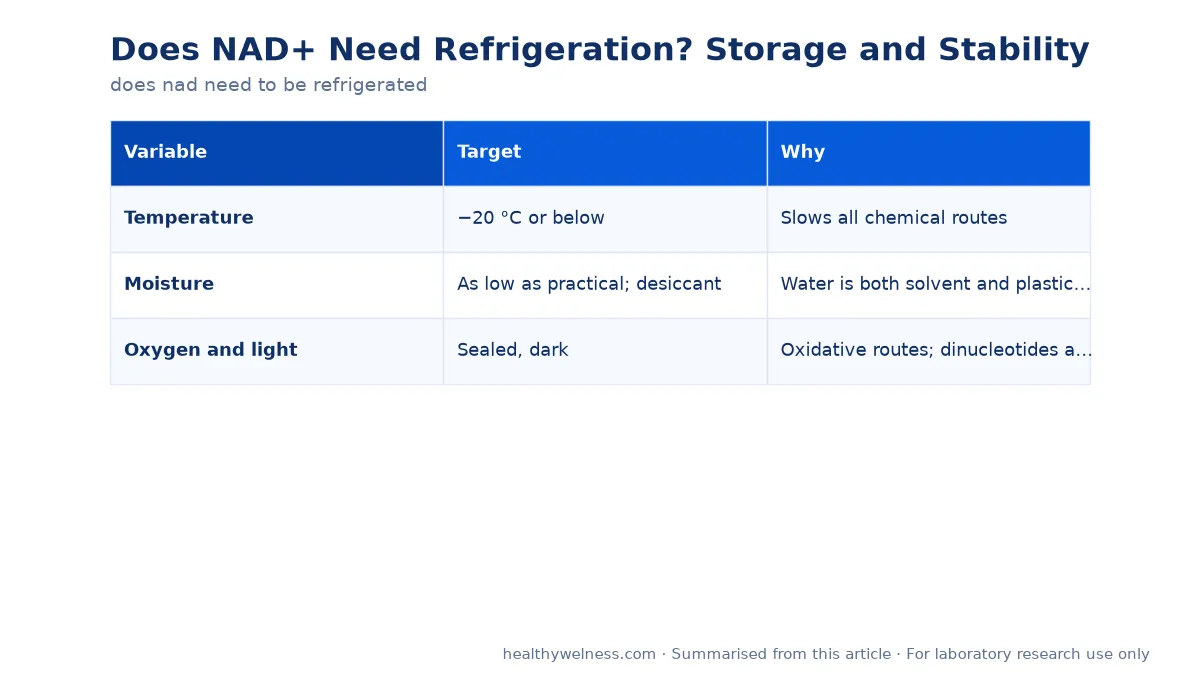
The 1992 study by Pikal and colleagues on freeze-dried formulations examined the effects of moisture and oxygen together, and found both to matter. The practical translation is a storage specification with three parts rather than one:
| Variable | Target | Why |
|---|---|---|
| Temperature | −20 °C or below | Slows all chemical routes |
| Moisture | As low as practical; desiccant | Water is both solvent and plasticiser |
| Oxygen and light | Sealed, dark | Oxidative routes; dinucleotides are not inert |
The mistake that undoes good storage
Opening a cold vial in a humid room. Cold glass and cold powder condense atmospheric moisture, and a hygroscopic solid takes it up immediately. The material then goes back into the freezer wetter than it came out, and the next retrieval repeats the process.
The fix is procedural and free: let the sealed vial reach room temperature before opening it, every time. For material retrieved frequently, weighing out single-use portions once and storing those separately removes the repeated exposure entirely.
Why solutions should not be stored
Both forms of the cofactor degrade in aqueous solution, and their sensitivities point in opposite directions: the reduced form is the more base-labile, the oxidised form the more acid-labile. There is consequently no buffer pH that is simultaneously optimal for both, which is an unusual and genuinely inconvenient situation.
The 1998 study by Gietz and colleagues on recombinant hirudin degradation kinetics is a good general illustration of how strongly pH governs degradation rate in solution. The molecule there is a peptide, but the lesson transfers: in solution, buffer choice is a stability variable with a large effect, and it has to be recorded as part of the method.
The conclusion for bench practice is simple. Prepare what the experiment needs, use it, and discard the remainder. A stored solution has an unknown concentration of the intended species, and that uncertainty propagates into every result derived from it.
A check that costs nothing
NADH absorbs strongly near 340 nm; NAD+ does not. This difference is the basis of most dehydrogenase assays, and it also gives a free quality check: an absorbance reading at 340 nm indicates whether a preparation is in the oxidised or reduced state.
Its limitation should be stated too. The reading distinguishes the two forms from each other; it does not reveal degradation products that are neither form. A preparation that has partly decomposed into something else will not announce itself this way. For that, a chromatographic method is needed.
The underlying chemistry of the two forms, and why the ratio rather than either concentration is the quantity of biological interest, is covered in NAD+ to NADH: reduction or oxidation.
Storage summary
| State | Condition | Notes |
|---|---|---|
| Sealed solid, long term | −20 °C, desiccated, dark | The default |
| Sealed solid, short term | Refrigerated, desiccated | Acceptable compromise; still keep dry |
| Opened solid | Reseal with desiccant; warm before each opening | Hygroscopic once exposed |
| Aqueous solution | Prepare close to use | Do not store; no pH suits both forms |
| Weighed single-use portions | −20 °C, sealed | Best practice for frequently used material |
Why the measurement context raises the stakes
There is a specific reason to be careful here rather than merely tidy. The 2018 study by Goodman and colleagues in the Journal of Biological Chemistry examined spatiotemporal compartmentalisation of hepatic NADH and NADPH metabolism — work that depends on resolving pools and ratios precisely.
In that kind of experiment, a reagent of uncertain composition is not a minor annoyance. If the material added to a system is partly degraded, the perturbation applied is not the one recorded, and no amount of analytical sophistication downstream recovers that information. Handling precision is a prerequisite for the measurement, not a separate concern.
Concentration maths should use the molecular weight of the exact salt form supplied, which our reconstitution calculator takes as an explicit input. Our NAD+ research material is supplied for laboratory research use. Certificates are available for listed products — contact us for the latest report.
Open questions
- How quickly does water uptake measurably affect solid-state stability under ordinary laboratory conditions?
- What is the practical shelf life of an aqueous solution at refrigerator temperature?
- Which degradation products are most common, and do any interfere with standard assays?
Related research
Frequently asked questions
Does NAD+ need to be refrigerated?
The solid should be stored cold and, more importantly, dry. For long-term storage minus 20 degrees Celsius with desiccant is standard; refrigeration is a compromise. Dryness matters at least as much as temperature, because the material is hygroscopic and water enables the degradation chemistry.
Why does dryness matter more than people expect?
Because in a solid, water acts as both a solvent for degradation reactions and a plasticiser that gives molecules the mobility to react. Work on peptide deamidation in polymer matrices demonstrated this distinction directly, and the principle applies to any hygroscopic solid.
How long do NAD+ solutions last?
Not long enough to be worth storing. Both the oxidised and reduced forms degrade in aqueous solution, and the two have opposite pH sensitivities, so there is no single buffer that protects both. Prepare solutions close to use rather than keeping them.
Is NADH stored the same way as NAD+?
The solids are stored similarly, but their solution sensitivities differ: the reduced form is the more base-labile and the oxidised form the more acid-labile. If both are in use, they need separate handling notes rather than a shared one.
Can degradation be detected easily?
Partly. NADH absorbs strongly near 340 nanometres and NAD+ does not, so an absorbance reading gives a quick indication of the redox state of a preparation. It will not reveal degradation products that are neither form.
References
- Lai MC, et al. Chemical stability of peptides in polymers. 2. Discriminating between solvent and plasticizing effects of water on peptide deamidation in poly(vinylpyrrolidone). J Pharm Sci. 1999. PMID: 10514359 https://pubmed.ncbi.nlm.nih.gov/10514359/
- Pikal MJ, et al. Formulation and stability of freeze-dried proteins: effects of moisture and oxygen on the stability of freeze-dried formulations of human growth hormone. Dev Biol Stand. 1992. PMID: 1592171 https://pubmed.ncbi.nlm.nih.gov/1592171/
- Gietz U, et al. Chemical degradation kinetics of recombinant hirudin (HV1) in aqueous solution: effect of pH. Pharm Res. 1998. PMID: 9755900 https://pubmed.ncbi.nlm.nih.gov/9755900/
- Goodman RP, et al. Spatiotemporal compartmentalization of hepatic NADH and NADPH metabolism. J Biol Chem. 2018. PMID: 29514978 https://pubmed.ncbi.nlm.nih.gov/29514978/
For laboratory research use only. The research materials supplied by HealthyWelness are not approved medicines, foods or cosmetics and are not for human or veterinary use. This article summarises published research and is not medical advice.
Sources
- Lai MC, et al. Chemical stability of peptides in polymers. 2. Discriminating between solvent and plasticizing effects of water on peptide deamidation in poly(vinylpyrrolidone). J Pharm Sci. 1999. PMID: 10514359
- Pikal MJ, et al. Formulation and stability of freeze-dried proteins: effects of moisture and oxygen on the stability of freeze-dried formulations of human growth hormone. Dev Biol Stand. 1992. PMID: 1592171
- Gietz U, et al. Chemical degradation kinetics of recombinant hirudin (HV1) in aqueous solution: effect of pH. Pharm Res. 1998. PMID: 9755900
- Goodman RP, et al. Spatiotemporal compartmentalization of hepatic NADH and NADPH metabolism. J Biol Chem. 2018. PMID: 29514978