Is NAD+ a Peptide or a Coenzyme?
NAD+ is a dinucleotide coenzyme, not a peptide. Why it appears in peptide catalogues anyway, and what that means for how it is handled.

Cover illustration: AI-generated editorial artwork. Conceptual only; not an exact molecular structure, actual laboratory result or evidence of clinical effects.
NAD+ is a coenzyme, specifically a dinucleotide. It is not a peptide, contains no amino acids, and has no peptide bonds. The question gets asked because NAD+ is routinely sold next to peptides, and the shelving implies a kinship that does not exist chemically. The distinction is worth drawing because it determines almost everything about how the material should be treated.
For laboratory research use only. The research materials supplied by HealthyWelness are not approved medicines, foods or cosmetics and are not for human or veterinary use. This article summarises published research and is not medical advice.
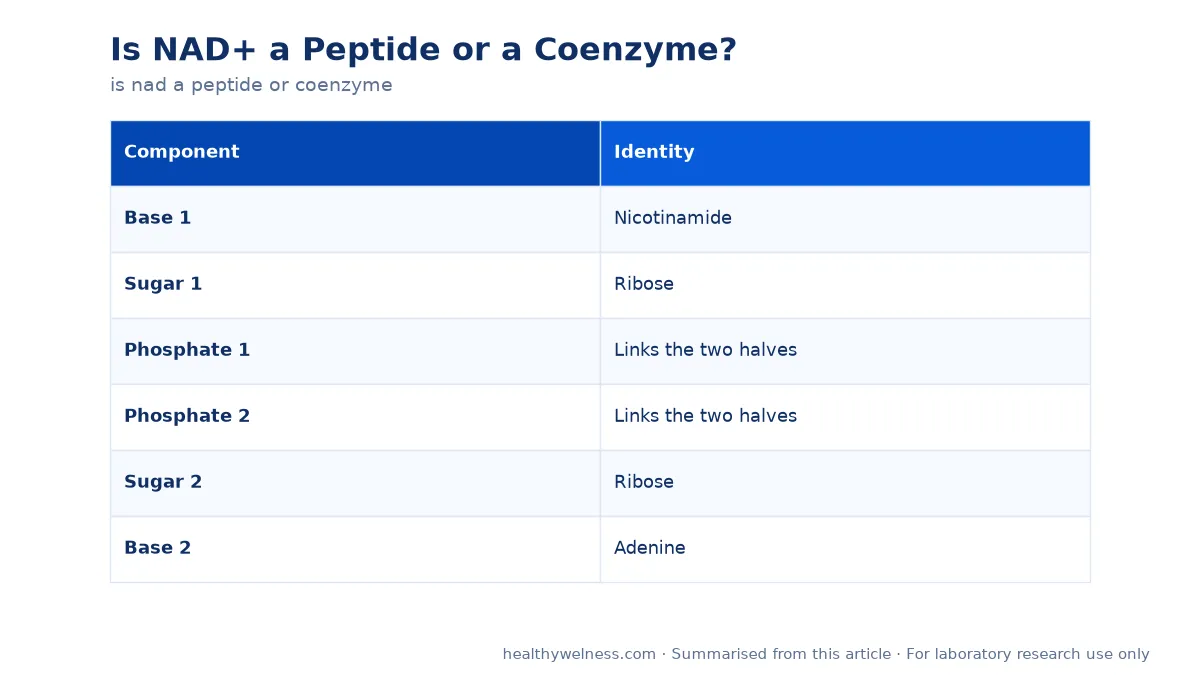
What NAD+ actually is, component by component
| Component | Identity |
|---|---|
| Base 1 | Nicotinamide |
| Sugar 1 | Ribose |
| Phosphate 1 | Links the two halves |
| Phosphate 2 | Links the two halves |
| Sugar 2 | Ribose |
| Base 2 | Adenine |
| Amino acids | None |
| Peptide bonds | None |
Read that list and the name decodes itself. Nicotinamide adenine dinucleotide: the two bases are nicotinamide and adenine, and there are two nucleotides joined through their phosphates. The name is a complete structural description, which is unusual and convenient.
A peptide, by contrast, is a chain of amino acids joined by amide bonds between a carboxyl group and an amino group. NAD+ has neither building block nor bond type in common with that description. The two classes share only the property of being biological molecules of moderate size.
What “coenzyme” means
A coenzyme is a non-protein organic molecule that an enzyme needs in order to catalyse its reaction, and which is chemically altered in the process. NAD+ satisfies this precisely: dehydrogenase enzymes cannot operate without it, and it is reduced to NADH as the substrate is oxidised.
The alteration is the point. A cofactor that merely sat in the active site unchanged would be a structural component; NAD+ carries the electrons away, which makes it a participant. The 2015 review by Bilan and colleagues on the main cellular redox couples places NAD+/NADH in that broader context, alongside the other couples a cell maintains.
This also explains why the ratio of the two forms, rather than either concentration, is the biologically meaningful quantity — a point developed in NAD+ to NADH: reduction or oxidation. The 2019 review by Berthiaume and colleagues is an example of research framed that way, examining mitochondrial NAD+/NADH state rather than NAD+ levels alone.
Why the catalogue places it with peptides
Research catalogues are organised by research area, not by chemical class. The compounds grouped under a metabolic heading share a subject matter: mitochondrial function, energy metabolism, ageing research. Some are peptides, some are small molecules, and one is a coenzyme.
This is a reasonable merchandising decision and a poor guide to handling. The same confusion arises elsewhere in the same category — SLU-PP-332 and 5-Amino-1MQ are small molecules rather than peptides, as set out in the comparison of metabolic research compounds. The lesson generalises: the section of the catalogue tells you what a compound is studied for, not what it is.
What follows for handling
| Concern | Peptide | NAD+ |
|---|---|---|
| Proteolysis | Principal biological degradation route | Not applicable — no peptide bonds |
| Folding | Relevant for longer peptides and proteins | Not applicable |
| Disulfide chemistry | Relevant where cysteines are present | Not applicable |
| Main chemical routes | Oxidation, deamidation | Hydrolysis, oxidation of the nucleotide |
| pH sensitivity | Sequence-dependent | Marked, and opposite for the two forms |
| Peptide content figure | Essential for concentration maths | Not applicable; use the salt’s formula weight |
| Identity confirmation | HPLC plus peptide MS | Small-molecule methods |
| Spectrophotometric handle | UV at 214 or 280 nm | Reduced form absorbs near 340 nm |
Three rows are worth expanding. There is no peptide content figure for NAD+, because the concept does not apply; the quantity needed for a molar calculation is the formula weight of the exact salt supplied. The pH sensitivity is unusual in that the oxidised and reduced forms are labile in opposite directions, so no single buffer protects both. And the 340 nm absorbance is a free diagnostic that peptides have no equivalent of.
Our reconstitution calculator takes molecular weight as an explicit input rather than inferring it from a sequence, which is what makes it usable for a non-peptide. Storage practice is covered in does NAD+ need refrigeration.
A related distinction: NAD+ versus its precursors
Precursors such as nicotinamide riboside are a third chemical category again — nucleosides rather than dinucleotides, lacking the phosphates and the adenosine half entirely. The 2016 study by Trammell and colleagues on oral bioavailability is the standard reference there, and the chemistry behind why a precursor is used at all is covered in NAD+ compared with nicotinamide riboside.
The compartmentalisation work by Goodman and colleagues adds a further layer: NADP, which carries an additional phosphate, is handled by different enzymes and maintained at a different ratio. Four related molecules, four sets of properties, one catalogue heading.
Our NAD+ research material is supplied for laboratory research use. Certificates are available for listed products — contact us for the latest report.
Open questions
- How much experimental error in this area traces to handling a coenzyme as if it were a peptide?
- Which analytical method best distinguishes intact NAD+ from its common degradation products?
- Does salt form affect solid-state stability measurably?
Related research
Frequently asked questions
Is NAD+ a peptide?
No. NAD+ is a dinucleotide: two nucleotides joined by their phosphate groups. It contains no amino acids and no peptide bonds. It is a coenzyme, and it belongs to an entirely different chemical class from the peptides it is often listed beside.
What is NAD+ made of?
A nicotinamide base attached to a ribose with a phosphate, joined through that phosphate to a second nucleotide built from adenine and its own ribose. The result is a molecule with two sugars, two phosphates and two nitrogenous bases.
Why does it appear in peptide catalogues then?
Because research catalogues are organised by what customers research rather than by chemical class. Metabolic research reagents are grouped together, so a coenzyme sits alongside peptides. It is a merchandising convention, not a chemical claim.
Does the distinction change how it is handled?
Yes, in several ways. There is no fold to lose, no disulfide to scramble and no proteolysis to worry about. The degradation routes are hydrolysis and oxidation of a nucleotide, and the identity confirmation methods are those used for small molecules rather than for peptides.
What is a coenzyme, precisely?
A non-protein organic molecule that an enzyme requires in order to catalyse its reaction, and which is chemically changed during the reaction. NAD+ fits this definition: dehydrogenases cannot function without it, and it is reduced to NADH in the process.
References
- Bilan DS, et al. Main Cellular Redox Couples. Bioorg Khim. 2015. PMID: 26615634 https://pubmed.ncbi.nlm.nih.gov/26615634/
- Goodman RP, et al. Spatiotemporal compartmentalization of hepatic NADH and NADPH metabolism. J Biol Chem. 2018. PMID: 29514978 https://pubmed.ncbi.nlm.nih.gov/29514978/
- Trammell SA, et al. Nicotinamide riboside is uniquely and orally bioavailable in mice and humans. Nat Commun. 2016. PMID: 27721479 https://pubmed.ncbi.nlm.nih.gov/27721479/
- Berthiaume JM, et al. Mitochondrial NAD(+)/NADH Redox State and Diabetic Cardiomyopathy. Antioxid Redox Signal. 2019. PMID: 29073779 https://pubmed.ncbi.nlm.nih.gov/29073779/
For laboratory research use only. The research materials supplied by HealthyWelness are not approved medicines, foods or cosmetics and are not for human or veterinary use. This article summarises published research and is not medical advice.
Sources
- Bilan DS, et al. Main Cellular Redox Couples. Bioorg Khim. 2015. PMID: 26615634
- Goodman RP, et al. Spatiotemporal compartmentalization of hepatic NADH and NADPH metabolism. J Biol Chem. 2018. PMID: 29514978
- Trammell SA, et al. Nicotinamide riboside is uniquely and orally bioavailable in mice and humans. Nat Commun. 2016. PMID: 27721479
- Berthiaume JM, et al. Mitochondrial NAD(+)/NADH Redox State and Diabetic Cardiomyopathy. Antioxid Redox Signal. 2019. PMID: 29073779