How Does SLU-PP-332 Work? ERR Agonism Explained
SLU-PP-332 activates the estrogen-related receptors, nuclear receptors that act on gene transcription. Why that makes the timescale hours, not minutes.


Cover illustration: AI-generated editorial artwork. Conceptual only; not an exact molecular structure, actual laboratory result or evidence of clinical effects.
SLU-PP-332 is a small molecule that activates the estrogen-related receptors ERR-alpha, ERR-beta and ERR-gamma, which are nuclear receptors acting on gene transcription. That makes its effects transcriptional and slow: hours, not the seconds or minutes of a cell-surface receptor. It is not a peptide.
For laboratory research use only. The research materials supplied by HealthyWelness are not approved medicines, foods or cosmetics and are not for human or veterinary use. This article summarises published research and is not medical advice.
- SLU-PP-332 is a pan-agonist at ERR-alpha, ERR-beta and ERR-gamma, a family of nuclear receptors.
- It is a small molecule containing no amino acids and no peptide bonds, despite appearing in peptide catalogues.
- Its original characterisation reported an ERR-alpha-dependent acute aerobic exercise response in mice (Billon et al., ACS Chem Biol 2023, PMID 36988910).
- Nuclear receptor agonism acts through gene transcription, so readouts taken minutes after exposure will show nothing.
- A 2026 paper characterised in vitro metabolism and analytical detection for SLU-PP-332 and SLU-PP-915 together (Möller et al., PMID 41588687).
What are the estrogen-related receptors?
A family of three nuclear receptors — ERR-alpha, ERR-beta and ERR-gamma — named for sequence similarity to estrogen receptors. The name causes confusion, so it is worth stating the correction directly: they are not estrogen receptors, and estrogen is not their ligand. They are described as orphan receptors, and their documented roles concern gene programmes for mitochondrial and oxidative metabolism.
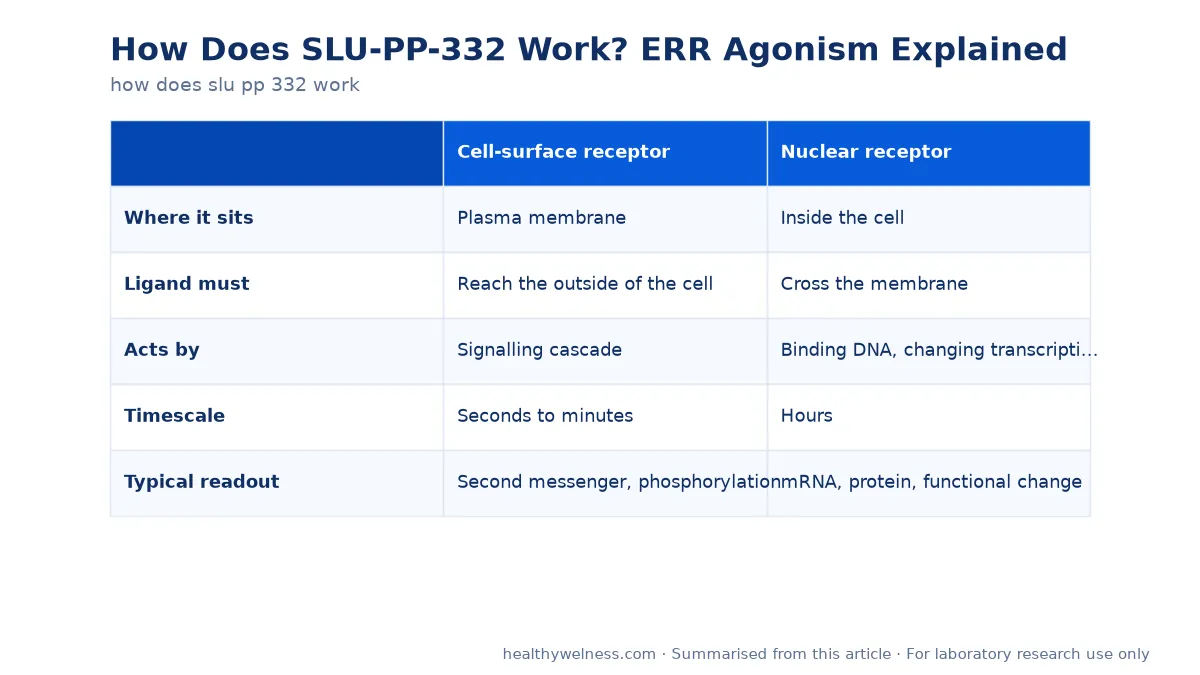
Nuclear receptors differ from cell-surface receptors in a way that governs every experiment with them:
| Cell-surface receptor | Nuclear receptor | |
|---|---|---|
| Where it sits | Plasma membrane | Inside the cell |
| Ligand must | Reach the outside of the cell | Cross the membrane |
| Acts by | Signalling cascade | Binding DNA, changing transcription |
| Timescale | Seconds to minutes | Hours |
| Typical readout | Second messenger, phosphorylation | mRNA, protein, functional change |
The crossing requirement explains why a small molecule rather than a peptide was the right tool here. A charged, flexible peptide crosses membranes poorly; a compact lipophilic molecule does it readily.
What does “pan-agonist” mean, and why does it matter?
That the compound activates all three receptors of the family rather than selecting one.
That is a deliberate design, and like every multi-target design it is an interpretive constraint as well as a feature. An effect observed with SLU-PP-332 is an effect of pan-ERR agonism, and attributing it to ERR-alpha specifically requires either a selective tool or a genetic approach. The 2023 study by Billon and colleagues addressed this by showing the acute response was ERR-alpha-dependent, which is the kind of evidence that makes an attribution rather than an assumption.
The 2024 follow-up in the Journal of Pharmacology and Experimental Therapeutics extended the work to a metabolic syndrome model, and the programme later produced a successor compound, SLU-PP-915, described by Hampton and colleagues in 2023 and reported as orally active in 2026. The two compounds are compared in SLU-PP-915 compared with SLU-PP-332.
Why does “exercise mimetic” need reading carefully?
Because it is a description of a transcriptional signature, not a claim about outcomes.
The phrase comes from the finding that the compound induced an acute aerobic exercise response in mice — that is, a pattern of gene expression resembling the pattern exercise produces, in that model, measured that way. It does not say that the compound substitutes for exercise, and the primary literature does not claim that it does.
For a laboratory the useful translation is: if you want to see what this compound does, measure transcription. A functional readout taken without a transcriptional one leaves you unable to say whether the mechanism engaged at all.
What does the timescale mean for experimental design?
- Short incubations will show nothing, and that nothing is a design error rather than a result. Transcriptional changes take hours; functional consequences take longer still.
- Exposure must be maintained across that window. A compound that precipitates two hours into a twenty-four-hour incubation has not delivered the exposure the protocol assumes.
- Vehicle controls must run the same duration. Organic co-solvents have their own effects over hours that they do not have over minutes.
- Time-course sampling is worth the extra wells. A single endpoint cannot distinguish a slow effect from an absent one.
How is a non-peptide handled differently?
This is where the peptide-or-small-molecule question stops being semantic.
| Step | Short peptide | SLU-PP-332 |
|---|---|---|
| Diluent | Water or bacteriostatic water | Organic co-solvent for the stock |
| Vehicle control | Aqueous | Co-solvent-matched |
| Characteristic failure | Aggregation, proteolysis | Precipitation on dilution |
| Concentration from | Net peptide content | Formula weight and solubility limit |
| Identity data | HPLC plus peptide MS | NMR, LC-MS, residual solvent |
| Peptide content figure | Essential | Does not apply |
Precipitation deserves the emphasis it gets here because it is both common and invisible in the data. It can be partial, leaving an unknown concentration rather than zero; it can be slow, developing over an incubation; and it affects the highest concentrations in a series preferentially, which flattens the top of a response curve in a way that is indistinguishable from receptor saturation on the numbers alone. Inspecting the wells is the cheap way to tell them apart.
Full handling detail is in handling SLU-PP-332, and the compound background in what SLU-PP-332 is.
Our SLU-PP-332 research material is supplied for laboratory research use. Certificates are available for listed products — contact us for the latest report. Concentration here is set by formula weight and solubility rather than by the net-content arithmetic our reconstitution calculator performs for peptides.
What a nuclear receptor agonist cannot be used to test
Knowing the mechanism also tells you which experiments will not work, and that is worth stating because the failures are quiet rather than obvious.
- Acute signalling assays. A second-messenger or phosphorylation readout taken minutes after exposure measures nothing for a transcriptional agonist. The result looks like inactivity and is actually a mismatch of timescales.
- Short-exposure dose-response curves. If the incubation is shorter than the time transcription needs, the curve reports the incubation, not the compound.
- Systems without the receptors. A cell type not expressing ERR-alpha, ERR-beta or ERR-gamma cannot respond. Confirming receptor expression before interpreting a null is the first control, not an afterthought.
- Comparisons against cell-surface agonists at matched timepoints. A GPCR agonist and a nuclear receptor agonist peak at different times; a single shared endpoint flatters one and penalises the other.
The constructive version of all four is the same: measure transcription, over hours, in a system whose receptor expression you have checked. Everything else in the design follows from that.
Why the detection literature is worth reading
The 2026 paper by Möller and colleagues was written for anti-doping purposes, and that framing makes it the most rigorous published source on what this compound actually is. Detection work has to identify a molecule and its metabolites unambiguously, in a real matrix, with no room for a convenient assumption — which is a higher bar than a pharmacology paper needs to clear.
For a laboratory it offers two things no other paper in this series does: a description of how the compound is transformed in vitro, and a set of analytical signatures for confirming that what is in a vial is what the label says. Where a compound has no clean published half-life, metabolism data is the next best basis for planning an exposure window.
Scope note
This material is supplied for laboratory research use only. It is not a medicine, not a supplement, and not for human or veterinary use. The published work described above is in cells and animal models.
Open questions
- Which of the three ERR subtypes contributes most to the reported effects?
- What is the measured aqueous solubility limit under common culture conditions?
- Does a published pharmacokinetic study giving a half-life figure exist for either compound in this series?
Related research
Frequently asked questions
How does SLU-PP-332 work?
It activates the estrogen-related receptors ERR-alpha, ERR-beta and ERR-gamma. These are nuclear receptors, so the compound acts on gene transcription rather than on an acute signalling event, and its effects appear over hours rather than minutes.
Is SLU-PP-332 a peptide or a small molecule?
A small molecule. It contains no amino acids and no peptide bonds, despite being listed alongside peptides in research catalogues. That determines its diluent, its storage and how its identity is confirmed.
What are estrogen-related receptors?
A family of nuclear receptors named for their sequence similarity to estrogen receptors. Despite the name they are not estrogen receptors and are described as orphan receptors, with roles in mitochondrial and oxidative metabolism gene programmes.
Why is SLU-PP-332 called an exercise mimetic?
Because its original characterisation reported an ERR-alpha-dependent acute aerobic exercise response and enhanced exercise capacity in mice. The phrase describes a transcriptional signature observed in animal models, not an outcome claim.
Is there a published half-life for SLU-PP-332?
Not a clean figure that we can find. The most relevant published work is a 2026 study of in vitro metabolism and analytical characterisation covering both SLU-PP-332 and its successor SLU-PP-915.
For laboratory research use only. The research materials supplied by HealthyWelness are not approved medicines, foods or cosmetics and are not for human or veterinary use. This article summarises published research and is not medical advice.
Sources
- Billon C, et al. Synthetic ERRα/β/γ Agonist Induces an ERRα-Dependent Acute Aerobic Exercise Response and Enhances Exercise Capacity. ACS Chem Biol. 2023. PMID: 36988910
- Billon C, et al. A Synthetic ERR Agonist Alleviates Metabolic Syndrome. J Pharmacol Exp Ther. 2024. PMID: 37739806
- Möller T, et al. In Vitro Metabolism and Analytical Characterization of SLU-PP-332 and SLU-PP-915: Novel Pan-ERR Agonists With Doping Potential. Rapid Commun Mass Spectrom. 2026. PMID: 41588687
- Hampton CS, et al. Development and pharmacological evaluation of a new chemical series of potent pan-ERR agonists, identification of SLU-PP-915. Eur J Med Chem. 2023. PMID: 37421886
- Billon C, et al. An orally active estrogen receptor-related receptor agonist, SLU-PP-915, enhances aerobic exercise capacity. J Pharmacol Exp Ther. 2026. PMID: 41421047