What Is Mazdutide? An Oxyntomodulin-Based Dual Agonist
Mazdutide (IBI362, LY3305677) is a GLP-1 and glucagon receptor dual agonist built on an oxyntomodulin scaffold. Its trials and lab handling.


Cover illustration: AI-generated editorial artwork. Conceptual only; not an exact molecular structure, actual laboratory result or evidence of clinical effects.
Mazdutide is an engineered peptide that activates both the GLP-1 receptor and the glucagon receptor, built on the scaffold of the natural dual-acting gut hormone oxyntomodulin. It carries three names in the literature — mazdutide, IBI362 and LY3305677 — and it received a first regulatory approval in 2025.
For laboratory research use only. The research materials supplied by HealthyWelness are not approved medicines, foods or cosmetics and are not for human or veterinary use. This article summarises published research and is not medical advice.
- Mazdutide is a dual agonist at the GLP-1 receptor (GLP-1R) and the glucagon receptor (GCGR).
- Its development codes are IBI362 (Innovent) and LY3305677 (Lilly); all three names appear in the primary literature.
- A multiple-ascending-dose phase 1b trial in Chinese adults was published in EClinicalMedicine in 2022 (Ji et al., PMID 36247927).
- A once-weekly trial in Chinese adults appeared in the New England Journal of Medicine in 2025 (Ji et al., PMID 40421736).
- Mazdutide: First Approval was published in Drugs in 2025 (Shirley, PMID 41028652), marking its first regulatory clearance.
What is the oxyntomodulin scaffold, and why does it matter?
Most multi-receptor agonists are assembled: a designer takes one hormone’s backbone and engineers in affinity for a second receptor. Mazdutide starts from a different place. Oxyntomodulin is a naturally occurring gut peptide that already activates both the GLP-1 and glucagon receptors. Dual activity is its native property, not an addition.
That provenance has a practical implication worth stating plainly: the receptor balance in an oxyntomodulin-derived molecule is inherited from a hormone that evolution tuned, then adjusted, rather than built from scratch. It does not make the compound better or worse. It does mean the design question was “how do we keep this molecule around longer” rather than “how do we add a second receptor”.
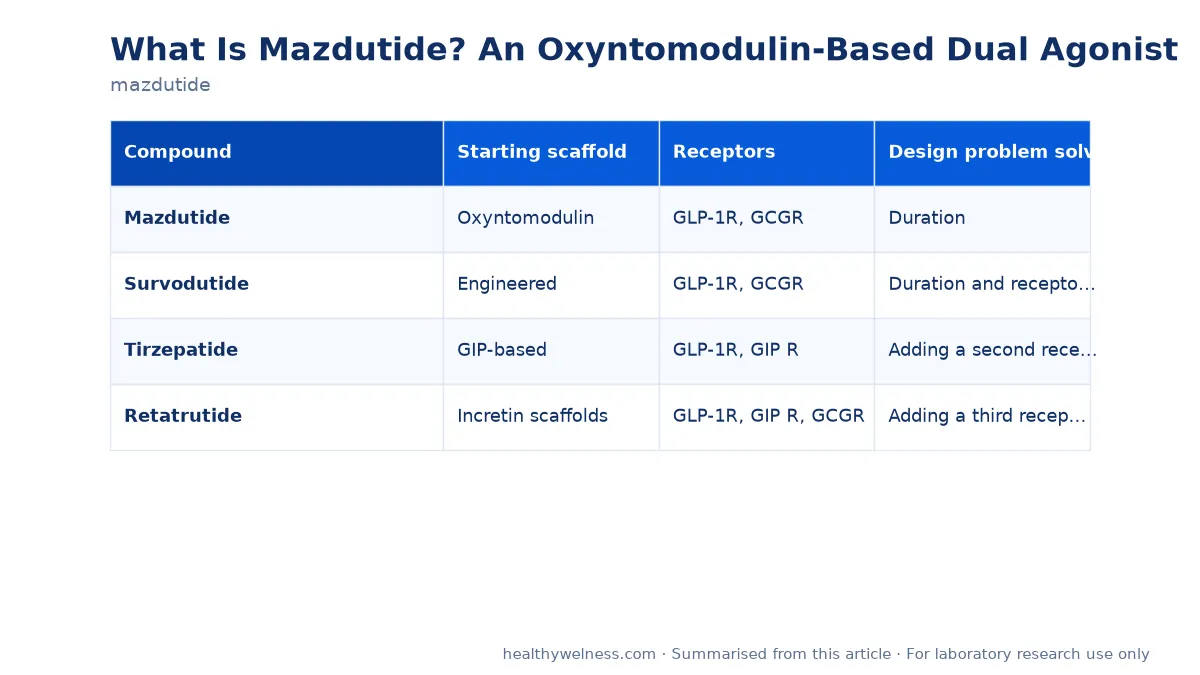
| Compound | Starting scaffold | Receptors | Design problem solved |
|---|---|---|---|
| Mazdutide | Oxyntomodulin | GLP-1R, GCGR | Duration |
| Survodutide | Engineered | GLP-1R, GCGR | Duration and receptor balance |
| Tirzepatide | GIP-based | GLP-1R, GIP R | Adding a second receptor |
| Retatrutide | Incretin scaffolds | GLP-1R, GIP R, GCGR | Adding a third receptor |
What does the published trial record cover?
Mazdutide’s literature has a feature that distinguishes it from the rest of this class: its main trials were conducted in Chinese adults, and it reached approval on that basis.
| Study | Year | Journal | Design |
|---|---|---|---|
| Ji et al. | 2022 | EClinicalMedicine | Randomised, placebo-controlled, multiple-ascending-dose phase 1b |
| Ji et al. | 2025 | N Engl J Med | Once-weekly treatment in adults with obesity or overweight |
| Shirley | 2025 | Drugs | First approval review |
| Zhang et al. | 2025 | EBioMedicine | Multi-omics, diabetes-associated cognitive dysfunction |
The 2025 EBioMedicine study by Dong and colleagues is the one most likely to interest a laboratory rather than a clinic. It is a mechanistic multi-omics study in a model of diabetes-associated cognitive dysfunction — which is to say it asks what dual GLP-1R and GCGR agonism does at the level of transcripts and proteins, in a tissue not usually associated with this compound class.
That kind of paper is more directly useful for experimental design than a clinical endpoint trial, because it names measurable readouts. A clinical trial tells you that something changed; a multi-omics study tells you which molecules to measure if you want to see it happen in a dish.
What does a second receptor add, mechanistically?
Dual agonism is often described as though it were simply more of the same effect. It is not. The two receptors sit on different tissues and feed different processes, which is why combining them produces something neither does alone.
- The GLP-1 receptor is the better-known of the pair in this field, and it is the target of the single-receptor agonists against which dual agonists are compared.
- The glucagon receptor is expressed on hepatocytes, and glucagon signalling acts directly on liver metabolism. That is a different organ from the one GLP-1 signalling is usually discussed in.
- Both are class B G protein-coupled receptors, which bind long peptide ligands in two parts: the extracellular domain grips the ligand’s C-terminal region while the N-terminal region reaches into the receptor core.
The shared architecture is what makes a single peptide capable of engaging both. A molecule whose C-terminal region can be gripped by either receptor’s extracellular domain, and whose N-terminus can activate either core, is a plausible dual agonist — and oxyntomodulin is exactly such a molecule in nature.
For experimental design the consequence is the one that applies to every multi-receptor agent: an effect observed with mazdutide is an effect of dual agonism, and attributing it to either receptor requires a selective comparator in the same system. A GLP-1-only agonist is the obvious control, and the comparison with survodutide, which shares the same receptor pair, controls for something different again.
Why is the dosing interval not a half-life?
A frequent assumption is that once-weekly dosing means a half-life of about a week. It does not follow, and the distinction matters for planning exposure in an experiment.
- A dosing interval is chosen, from pharmacokinetics plus the exposure range the programme is targeting. A half-life is measured.
- Intervals are often shorter than, or similar to, the half-life so that concentrations accumulate to a steady state rather than falling away between doses.
- We could not find a published half-life figure for mazdutide in the indexed abstracts, so this article does not give one. Where a verified figure exists, as it does for tirzepatide, a decay curve can be plotted from it — see orforglipron compared with tirzepatide.
Stating the absence is more useful than estimating. An experiment planned around an invented number is planned around nothing.
How is mazdutide handled in the laboratory?
As a long engineered peptide. The practical steps are the same as for the rest of this class, and the reasons are chemical rather than conventional:
- Sealed, dry, dark, −20 °C for the lyophilized powder; warm the vial to room temperature before opening so moisture does not condense into it.
- Diluent down the vial wall, then swirl. No vortexing: hydrophobic modifications make these peptides surface-active, and foaming drives aggregation at the air–liquid interface.
- Inspect for haze before use. Aggregated material is no longer at the nominal concentration, and nothing in a plate reading announces that.
- Aliquot immediately and date each tube. One warming round per aliquot is the whole point.
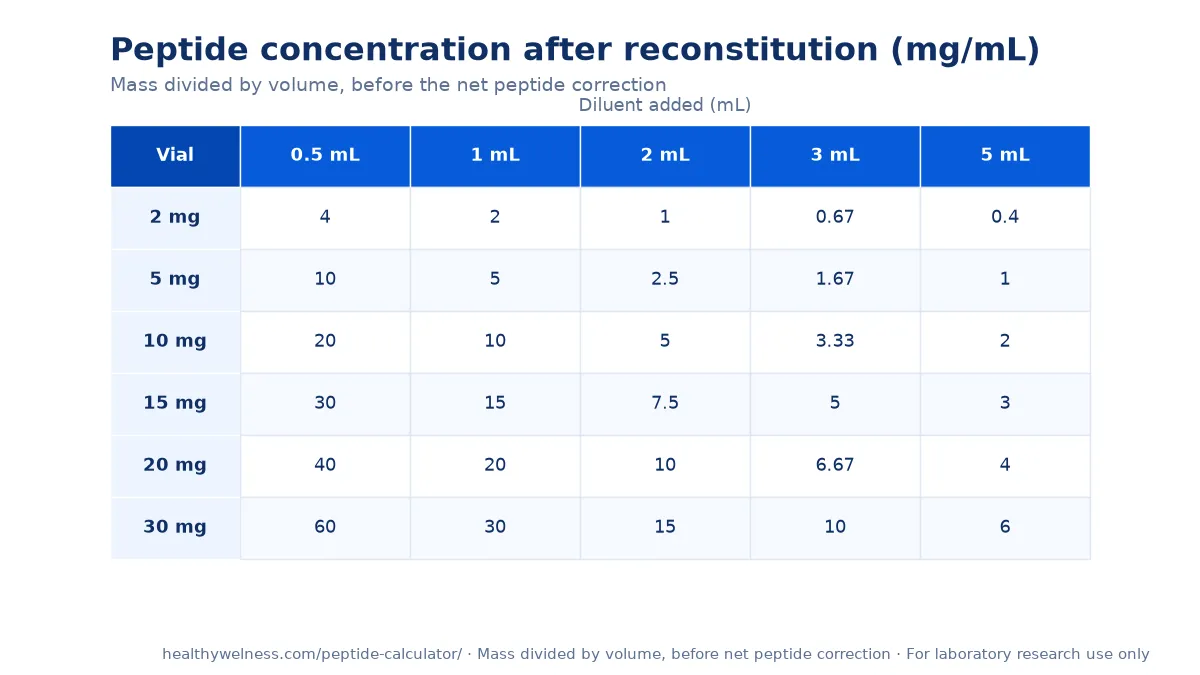
- Molarity from net peptide content. The chart above shows the gross mass-over-volume arithmetic; our reconstitution calculator applies the net correction that makes it correct.
One analytical point is specific to a molecule with three names: confirm that the stated sequence and observed mass match what the paper you are relying on describes. Development codes are more reliable identifiers than trade names, and IBI362 or LY3305677 in a report is stronger evidence of identity than the word mazdutide alone. The wider framework is in how to read a certificate of analysis.
Our mazdutide research material is supplied for laboratory research use. Certificates are available for listed products — contact us for the latest report.
Scope note
This material is supplied for laboratory research use only. It is not a medicine, not a supplement, and not for human or veterinary use. The clinical trials cited are referenced as published literature about a molecule, and an approval in one jurisdiction says nothing about the status of research material.
Open questions
- Is there a published pharmacokinetic study giving a half-life figure for mazdutide?
- Do mazdutide and survodutide differ in the balance between GLP-1 and glucagon receptor activity?
- How far do findings from trials in one population generalise to others?
Related research
- What is survodutide?
- Mazdutide, survodutide and tirzepatide compared
- Orforglipron compared with retatrutide
Frequently asked questions
What is mazdutide?
Mazdutide, also known as IBI362 and LY3305677, is an engineered peptide that activates both the GLP-1 receptor and the glucagon receptor. It is described in the literature as an oxyntomodulin analogue, and it received its first regulatory approval in 2025.
Why does mazdutide have three names?
IBI362 is the Innovent development code, LY3305677 is the Lilly code from the molecule’s origin, and mazdutide is the international non-proprietary name. All three appear in the primary literature and refer to the same compound.
What is oxyntomodulin and why does it matter here?
Oxyntomodulin is a naturally occurring gut peptide that activates both the GLP-1 and glucagon receptors. Mazdutide is built on that scaffold, so its dual activity derives from a natural dual-acting hormone rather than from combining two separate designs.
How does mazdutide compare with survodutide?
They engage the same receptor pair, GLP-1 and glucagon. The clearest difference is where they were developed and tested: mazdutide’s main trials are in Chinese adults, and it reached approval in 2025, which survodutide had not at the time of the trials cited here.
Is there a published half-life for mazdutide?
Not one we can find in the indexed abstracts. The published trials describe once-weekly subcutaneous dosing, which implies a long circulating duration, but a numerical half-life is a separate measurement and should not be inferred from a dosing interval.
References
- Ji L, et al. Safety and efficacy of a GLP-1 and glucagon receptor dual agonist mazdutide (IBI362) 9 mg and 10 mg in Chinese adults with overweight or obesity: A randomised, placebo-controlled, multiple-ascending-dose phase 1b trial. EClinicalMedicine. 2022. PMID: 36247927 https://pubmed.ncbi.nlm.nih.gov/36247927/
- Ji L, et al. Once-Weekly Mazdutide in Chinese Adults with Obesity or Overweight. N Engl J Med. 2025. PMID: 40421736 https://pubmed.ncbi.nlm.nih.gov/40421736/
- Shirley M. Mazdutide: First Approval. Drugs. 2025. PMID: 41028652 https://pubmed.ncbi.nlm.nih.gov/41028652/
- Dong W, et al. Mazdutide, a dual agonist targeting GLP-1R and GCGR, mitigates diabetes-associated cognitive dysfunction: mechanistic insights from multi-omics analysis. EBioMedicine. 2025. PMID: 40479843 https://pubmed.ncbi.nlm.nih.gov/40479843/
- le Roux CW, et al. Glucagon and GLP-1 receptor dual agonist survodutide for obesity: a randomised, double-blind, placebo-controlled, dose-finding phase 2 trial. Lancet Diabetes Endocrinol. 2024. PMID: 38330987 https://pubmed.ncbi.nlm.nih.gov/38330987/
For laboratory research use only. The research materials supplied by HealthyWelness are not approved medicines, foods or cosmetics and are not for human or veterinary use. This article summarises published research and is not medical advice.
Sources
- Ji L, et al. Safety and efficacy of a GLP-1 and glucagon receptor dual agonist mazdutide (IBI362) 9 mg and 10 mg in Chinese adults with overweight or obesity: A randomised, placebo-controlled, multiple-ascending-dose phase 1b trial. EClinicalMedicine. 2022. PMID: 36247927
- Ji L, et al. Once-Weekly Mazdutide in Chinese Adults with Obesity or Overweight. N Engl J Med. 2025. PMID: 40421736
- Shirley M. Mazdutide: First Approval. Drugs. 2025. PMID: 41028652
- Dong W, et al. Mazdutide, a dual agonist targeting GLP-1R and GCGR, mitigates diabetes-associated cognitive dysfunction: mechanistic insights from multi-omics analysis. EBioMedicine. 2025. PMID: 40479843
- le Roux CW, et al. Glucagon and GLP-1 receptor dual agonist survodutide for obesity: a randomised, double-blind, placebo-controlled, dose-finding phase 2 trial. Lancet Diabetes Endocrinol. 2024. PMID: 38330987