AOD-9604 Compared: Tesamorelin, Incretins, Secretagogues
AOD-9604 is an hGH fragment studied for lipolysis. How it differs from tesamorelin, sermorelin, CJC-1295, ipamorelin, MOTS-c and incretins.

Cover illustration: AI-generated editorial artwork. Conceptual only; not an exact molecular structure, actual laboratory result or evidence of clinical effects.
AOD-9604 turns up in comparisons with almost every metabolic and GH-axis peptide, which says more about catalogue adjacency than about pharmacology. It is a 16-residue fragment of growth hormone’s C-terminal region, studied in rodent adipose tissue. None of the compounds it is compared with works the same way. This article sets out the differences in one place.
For laboratory research use only. The research materials supplied by HealthyWelness are not approved medicines, foods or cosmetics and are not for human or veterinary use. This article summarises published research and is not medical advice.
Key points
- AOD-9604 = hGH(177-191) plus an N-terminal tyrosine; ~1815 g/mol.
- It does not stimulate GH release; it is a piece of the hormone.
- Rodent studies reported increased lipolysis without impaired insulin sensitivity.
- GHRH analogues and secretagogues act upstream; incretins act on entirely different receptors.
- No head-to-head study compares AOD-9604 with any of them.
Where each compound acts
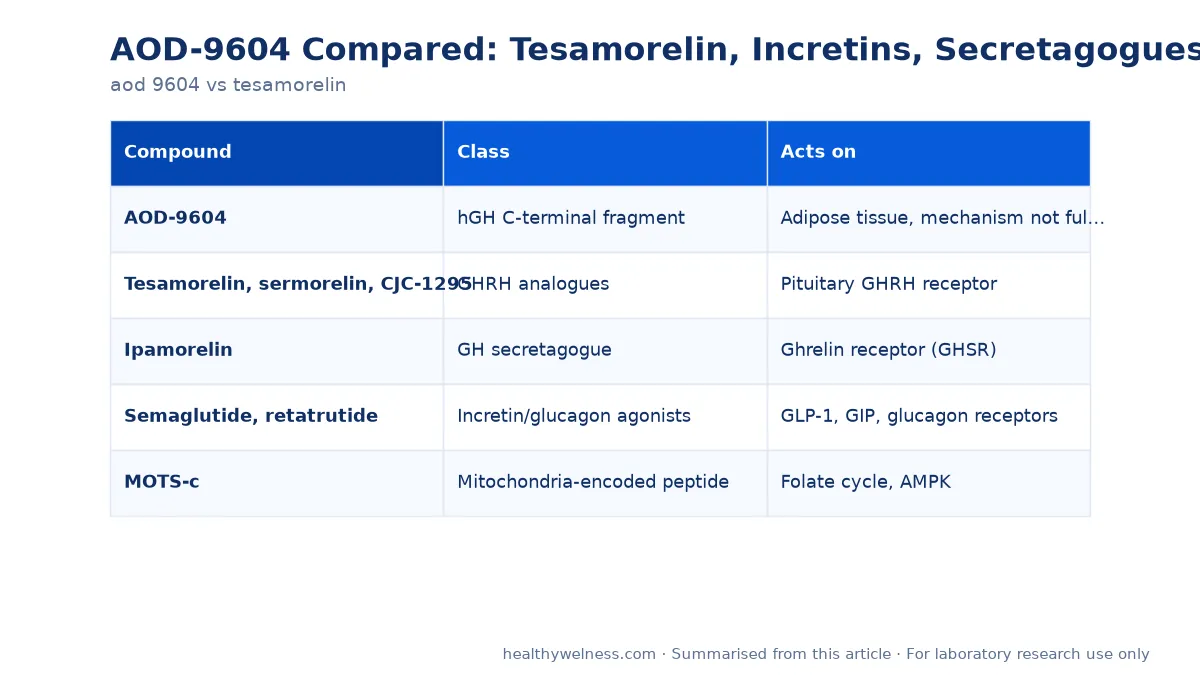
| Compound | Class | Acts on |
|---|---|---|
| AOD-9604 | hGH C-terminal fragment | Adipose tissue, mechanism not fully defined |
| Tesamorelin, sermorelin, CJC-1295 | GHRH analogues | Pituitary GHRH receptor |
| Ipamorelin | GH secretagogue | Ghrelin receptor (GHSR) |
| Semaglutide, retatrutide | Incretin/glucagon agonists | GLP-1, GIP, glucagon receptors |
| MOTS-c | Mitochondria-encoded peptide | Folate cycle, AMPK |
Only the middle two rows belong to the same system as AOD-9604, and even there the relationship is indirect: they raise growth hormone, while AOD-9604 reproduces part of it.
AOD-9604 vs the GHRH analogues
This is the comparison that comes up most. Tesamorelin acts on the pituitary; its phase 3 trial measured a 15.2% reduction in visceral adipose tissue against a 5.0% increase with placebo, alongside an 81% rise in IGF-I that confirmed the GH axis was engaged (Falutz et al., 2007). AOD-9604 was designed for the opposite property: to act on fat without the growth-promoting and glucose-related effects of whole growth hormone. In obese Zucker rats, 19 days of oral AOD-9604 roughly halved body-weight gain and increased adipose lipolytic activity, and euglycaemic clamp studies showed no impairment of insulin sensitivity, in contrast to chronic intact hGH (Ng et al., 2000).
| AOD-9604 | Tesamorelin | |
|---|---|---|
| Size | 16 aa, ~1815 g/mol | 44 aa, ~5136 g/mol |
| Requires a functioning pituitary | No | Yes |
| Raises IGF-1 | Not the intended effect | Yes, markedly |
| Human evidence | Limited peer-reviewed reports | Phase 3, licensed indication |
AOD-9604 vs secretagogues
Ipamorelin and the GHRPs act on the ghrelin receptor to trigger GH release; ipamorelin was notable for doing so without raising ACTH or cortisol in swine (Raun et al., 1998). AOD-9604 does not act on this receptor and does not trigger release of anything. The only thing the two classes share is an association with growth hormone biology, at opposite ends of it.
AOD-9604 vs incretin peptides
Semaglutide and retatrutide are lipidated peptides engineered for weekly exposure through albumin binding (Lau et al., 2015). Their targets, GLP-1, GIP and glucagon receptors, have no relationship to growth hormone. The comparison exists only because both appear in metabolic research. The evidence bases are also very different in scale: large phase 3 programmes on one side, rodent studies from around 2000 on the other.
AOD-9604 vs MOTS-c
Both are short peptides studied in metabolic models, and both were proposed to act on energy metabolism without classical hormone-receptor agonism. MOTS-c is encoded in mitochondrial DNA, and its described actions inhibit the folate cycle and de novo purine synthesis, leading to AMPK activation, with skeletal muscle as the apparent primary target (Lee et al., 2015). AOD-9604’s rodent work centred on adipose tissue and the beta-3 adrenergic receptor, where chronic treatment raised beta-3 receptor RNA but the acute lipolytic effect persisted in beta-3 knockout mice, indicating the effect is not directly mediated by that receptor (Heffernan et al., 2001).
What is shared: an unresolved mechanism
AOD-9604’s binding partner has not been identified in the published literature. The fragment is not thought to act through the growth hormone receptor in the classical sense, and beta-3 adrenergic involvement appears indirect. That leaves its mechanism less well defined than any of the comparators here, all of which have named receptors. For study design, this means AOD-9604 experiments cannot use receptor antagonists as controls the way GHRH or incretin experiments can.
Handling
AOD-9604 contains two cysteines forming an intramolecular disulfide. Avoid reducing agents such as DTT or TCEP unless reduction is intended, and avoid strongly basic solutions. Confirm identity by MS, remembering that the oxidised (disulfide) form is 2 Da lighter than the reduced form. An anti-doping study validated a urine method with a 50 pg/mL detection limit and identified six potential metabolites, among them a stable fragment (Cox et al., 2015), so the peptide is well characterised analytically. Storage and preparation: reconstituting AOD-9604. Our AOD-9604 research peptide comes in 5 mg and 10 mg vials. Concentrations: peptide reconstitution calculator.
Open questions
- What receptor or binding partner mediates AOD-9604’s effects?
- Do the rodent findings on lipolysis and insulin sensitivity hold in other species?
- Why did clinical development not progress beyond early trials?
Related research
- What is AOD-9604?
- Tesamorelin vs retatrutide, tirzepatide and MOTS-c
- AOD-9604 reconstitution and half-life
Frequently asked questions
What is the difference between AOD-9604 and tesamorelin?
AOD-9604 is a 16-residue fragment of growth hormone’s C-terminal region, studied for effects on adipose tissue directly. Tesamorelin is a 44-residue GHRH analogue that acts on the pituitary to raise the body’s own growth hormone. One mimics part of the hormone, the other triggers its release.
Does AOD-9604 raise IGF-1 like growth hormone does?
The rationale for the fragment was to separate lipolytic activity from growth-promoting effects. In obese Zucker rats, chronic AOD-9604 did not impair insulin sensitivity, in contrast to intact growth hormone.
How does AOD-9604 differ from semaglutide or retatrutide?
Completely. Incretin peptides act on GIP, GLP-1 and glucagon receptors to influence intake and glycaemia. AOD-9604 has no activity at those receptors and was studied in adipose tissue models.
Is AOD-9604 comparable to ipamorelin or CJC-1295?
Only in that all are studied around the GH axis. Ipamorelin and CJC-1295 cause the pituitary to release growth hormone; AOD-9604 is a fragment of the hormone itself and does not stimulate its release.
How does it compare with MOTS-c?
Both are short peptides studied in metabolic models, but MOTS-c is encoded in mitochondrial DNA and acts through folate-cycle inhibition and AMPK activation, which is unrelated to the GH axis.
For laboratory research use only. The research materials supplied by HealthyWelness are not approved medicines, foods or cosmetics and are not for human or veterinary use. This article summarises published research and is not medical advice.
Sources
- Heffernan MA, et al. Effects of oral administration of a synthetic fragment of human growth hormone on lipid metabolism. Am J Physiol Endocrinol Metab. 2000. PMID: 10950816
- Heffernan M, et al. The effects of human GH and its lipolytic fragment (AOD9604) on lipid metabolism following chronic treatment in obese mice and beta(3)-AR knock-out mice. Endocrinology. 2001. PMID: 11713213
- Ng FM, et al. Metabolic studies of a synthetic lipolytic domain (AOD9604) of human growth hormone. Horm Res. 2000. PMID: 11146367
- Falutz J, et al. Metabolic effects of a growth hormone-releasing factor in patients with HIV. N Engl J Med. 2007. PMID: 18057338
- Raun K, et al. Ipamorelin, the first selective growth hormone secretagogue. Eur J Endocrinol. 1998. PMID: 9849822
- Lee C, et al. The mitochondrial-derived peptide MOTS-c promotes metabolic homeostasis and reduces obesity and insulin resistance. Cell Metab. 2015. PMID: 25738459
- Lau J, et al. Discovery of the Once-Weekly Glucagon-Like Peptide-1 (GLP-1) Analogue Semaglutide. J Med Chem. 2015. PMID: 26308095
- Cox HD, et al. Detection and in vitro metabolism of AOD9604. Drug Test Anal. 2015. PMID: 25208511