AOD-9604 Reconstitution and Half-Life: What Is Known
How to reconstitute 5 mg and 10 mg AOD-9604 vials, why its disulfide bond changes handling, and what the published metabolite work says about its half-life.

Cover illustration: AI-generated editorial artwork. Conceptual only; not an exact molecular structure, actual laboratory result or evidence of clinical effects.
AOD-9604 is reconstituted like other lyophilized peptides, with one structural feature that changes the rules: an intramolecular disulfide bond between its two cysteines. Keeping that bond intact is the main handling requirement. Its half-life, by contrast, is one of the better-documented unknowns in this catalogue.
For laboratory research use only. The research materials supplied by HealthyWelness are not approved medicines, foods or cosmetics and are not for human or veterinary use. This article summarises published research and is not medical advice.
Key points
- 16 residues, C78H123N23O23S2, 1815.1 g/mol.
- Disulfide bond between the two cysteines must be preserved.
- Avoid reducing agents and strongly basic conditions.
- Oxidised form is 2 Da lighter than reduced; MS distinguishes them.
- No published half-life; metabolite data exist instead.
Step by step
- Let the sealed vial warm to room temperature, 15–30 minutes.
- Swab the stoppers of the peptide and solvent vials; let them dry.
- Draw the planned volume of solvent.
- Run it slowly down the inside wall of the vial.
- Swirl gently until clear. Do not shake.
- Label with peptide, lot, solvent, volume, concentration and date; refrigerate.
Bacteriostatic water suits vials that will be sampled repeatedly; sterile water suits a single preparation or frozen aliquots. The general method is in how to reconstitute peptides.
Concentration tables
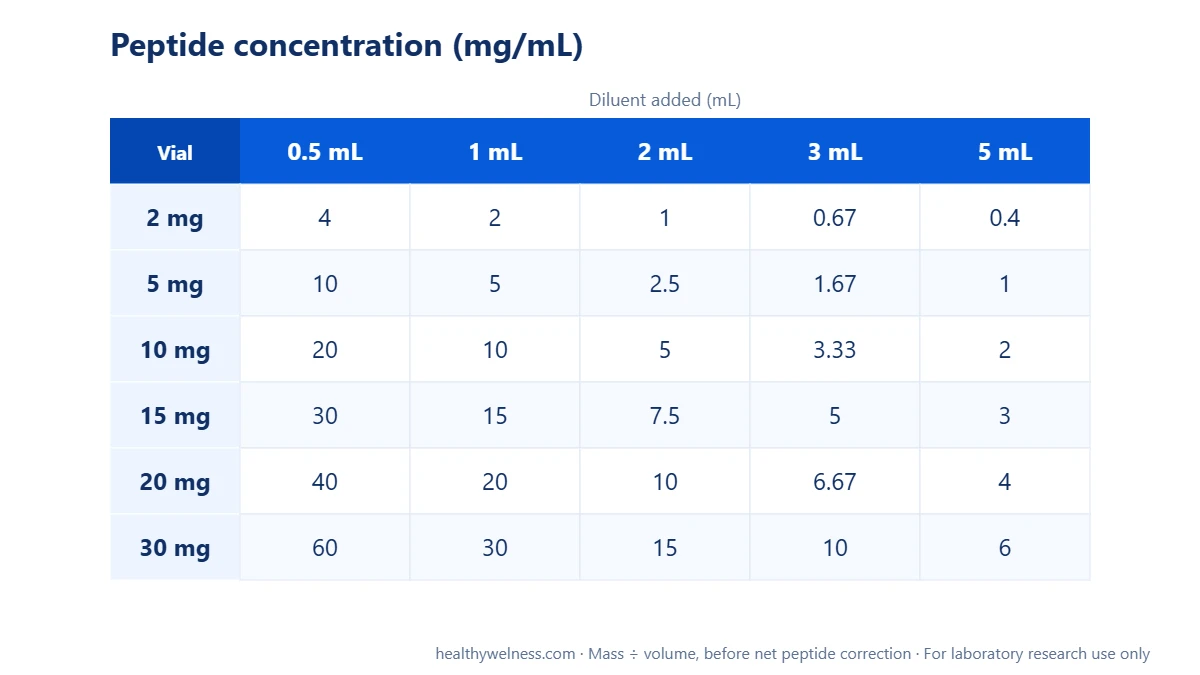
| Vial | 1 mL | 2 mL | 3 mL |
|---|---|---|---|
| 5 mg | 5 mg/mL | 2.5 mg/mL | 1.67 mg/mL |
| 10 mg | 10 mg/mL | 5 mg/mL | 3.33 mg/mL |
| mg/mL | Molar (at 1815.1 g/mol) |
|---|---|
| 1 | 551 µM |
| 2.5 | 1.38 mM |
| 5 | 2.75 mM |
| 10 | 5.51 mM |
Use the peptide reconstitution calculator for other combinations.
The disulfide bond
AOD-9604 corresponds to hGH(177-191) with an added N-terminal tyrosine. Its sequence contains two cysteines that form a loop, reproducing the C-terminal loop of growth hormone. That loop is structural, so breaking it changes the molecule rather than merely damaging it.
| Avoid | Why |
|---|---|
| DTT, TCEP, 2-mercaptoethanol | Reduce the disulfide, opening the loop |
| Strongly basic buffers | Promote thiol–disulfide exchange and scrambling |
| Free thiols in the medium (e.g. cysteine, glutathione at high concentration) | Can exchange with the peptide’s disulfide |
| Prolonged air exposure of a reduced sample | Can form intermolecular rather than intramolecular bonds |
Disulfide scrambling and thiol oxidation are standard categories in peptide and protein degradation (Manning et al., 2010; Reubsaet et al., 1998). The practical check is mass: the intact disulfide form is 2 Da lighter than the reduced form, and dimers would appear at roughly twice the mass.
What is known about half-life
We found no peer-reviewed study reporting a plasma half-life for AOD-9604. What exists is metabolite work from anti-doping research. Cox and colleagues validated a solid-phase extraction method for urine with a limit of detection of 50 pg/mL, precision under 20%, recovery of 62% and good linearity. They identified six potential metabolites after incubation in serum and urine, and quantification in serum identified a single metabolite, CRSVEGSCG, that is significantly more stable than the other metabolites or the parent compound. Screening for both the parent and that stable metabolite was proposed to extend the detection window (Cox et al., 2015).
| What the study establishes | What it does not |
|---|---|
| Metabolites form in serum and urine | How fast the parent peptide clears |
| One metabolite outlasts the parent | Whether that metabolite is active |
| Detection is feasible at 50 pg/mL | Exposure or distribution |
The observation that a metabolite is more stable than the parent is a useful warning: a long detection window does not mean a long half-life. The two are frequently conflated in online summaries.
A note on route
Unusually for a peptide, AOD-9604 was studied orally in rodents. In obese Zucker rats, an oral dose given daily for 19 days reduced body-weight gain by over 50% compared with control and increased adipose lipolytic activity (Ng et al., 2000). The authors raised the possibility of an orally usable agent. For laboratory work this matters mainly as context: results from oral rodent studies cannot be assumed to transfer to in vitro exposure at a given concentration.
Storage
- Powder: −20 °C, sealed, protected from light; warm before opening.
- Solution: 2–8 °C, dark, upright.
- Avoid repeated freeze–thaw, a recognised aggregation stress (Jain et al., 2021). Aliquot in sterile water if freezing is needed.
- Date the vial; no published in-use stability data exist.
Our AOD-9604 research peptide is supplied in 5 mg and 10 mg vials. Certificates are available for listed products — contact us for the latest report. General guidance: storing reconstituted peptides.
Open questions
- What is AOD-9604’s plasma half-life in any species?
- Is the stable metabolite CRSVEGSCG biologically active?
- How quickly does the disulfide scramble in unbuffered aqueous solution at 2–8 °C?
Related research
Frequently asked questions
How do you reconstitute AOD-9604 5 mg?
Warm the vial to room temperature, add a measured volume of bacteriostatic or sterile water slowly down the wall, and swirl gently. 1 mL gives 5 mg/mL; 2 mL gives 2.5 mg/mL.
What is the half-life of AOD-9604?
No peer-reviewed pharmacokinetic study reporting a half-life was found. An anti-doping study identified six metabolites and noted that one of them, the fragment CRSVEGSCG, is considerably more stable than the parent peptide.
Does AOD-9604 need special handling?
Yes, one thing: it contains two cysteines joined by a disulfide bond. Avoid reducing agents such as DTT and TCEP, and avoid strongly basic solutions, which promote disulfide scrambling.
How do I check AOD-9604 by mass spectrometry?
The oxidised form with the disulfide intact is 2 Da lighter than the fully reduced form. Seeing the reduced mass suggests the disulfide has been broken.
Can AOD-9604 be frozen in solution?
If necessary, reconstitute in sterile water, split into single-use aliquots and freeze once. Repeated freeze–thaw stresses any peptide and is best avoided.
For laboratory research use only. The research materials supplied by HealthyWelness are not approved medicines, foods or cosmetics and are not for human or veterinary use. This article summarises published research and is not medical advice.
Sources
- Cox HD, et al. Detection and in vitro metabolism of AOD9604. Drug Test Anal. 2015. PMID: 25208511
- Ng FM, et al. Metabolic studies of a synthetic lipolytic domain (AOD9604) of human growth hormone. Horm Res. 2000. PMID: 11146367
- Reubsaet JL, et al. Analytical techniques used to study the degradation of proteins and peptides: chemical instability. J Pharm Biomed Anal. 1998. PMID: 9884187
- Manning MC, et al. Stability of protein pharmaceuticals: an update. Pharm Res. 2010. PMID: 20143256
- Jain K, et al. Freeze-thaw characterization process to minimize aggregation and enable drug product manufacturing of protein based therapeutics. Sci Rep. 2021. PMID: 34059716
- PubChem Compound Summary for CID 71300630, AOD-9604. National Center for Biotechnology Information.