Cagrilintide With Retatrutide or Tirzepatide
Cagrilintide acts on amylin and calcitonin receptors, not incretin receptors. Why it is paired with GLP-1 agonists, what CagriSema showed, and blend handling.

Cover illustration: AI-generated editorial artwork. Conceptual only; not an exact molecular structure, actual laboratory result or evidence of clinical effects.
Cagrilintide is frequently listed next to retatrutide and tirzepatide, but it belongs to a different receptor family. It is an amylin analogue acting on amylin and calcitonin receptors, while the others are incretin and glucagon receptor agonists. That is precisely why they are studied together: the pathways are complementary, not overlapping.
For laboratory research use only. The research materials supplied by HealthyWelness are not approved medicines, foods or cosmetics and are not for human or veterinary use. This article summarises published research and is not medical advice.
Key points
- Cagrilintide: amylin analogue, non-selective amylin/calcitonin receptor agonist, ~4409 g/mol.
- Tirzepatide: GIP + GLP-1. Retatrutide: GIP + GLP-1 + glucagon.
- The documented combination is cagrilintide + semaglutide (CagriSema).
- No published trial pairs cagrilintide with retatrutide or tirzepatide.
- All are lipidated peptides of similar size, which complicates analysis of blends.
Receptor comparison
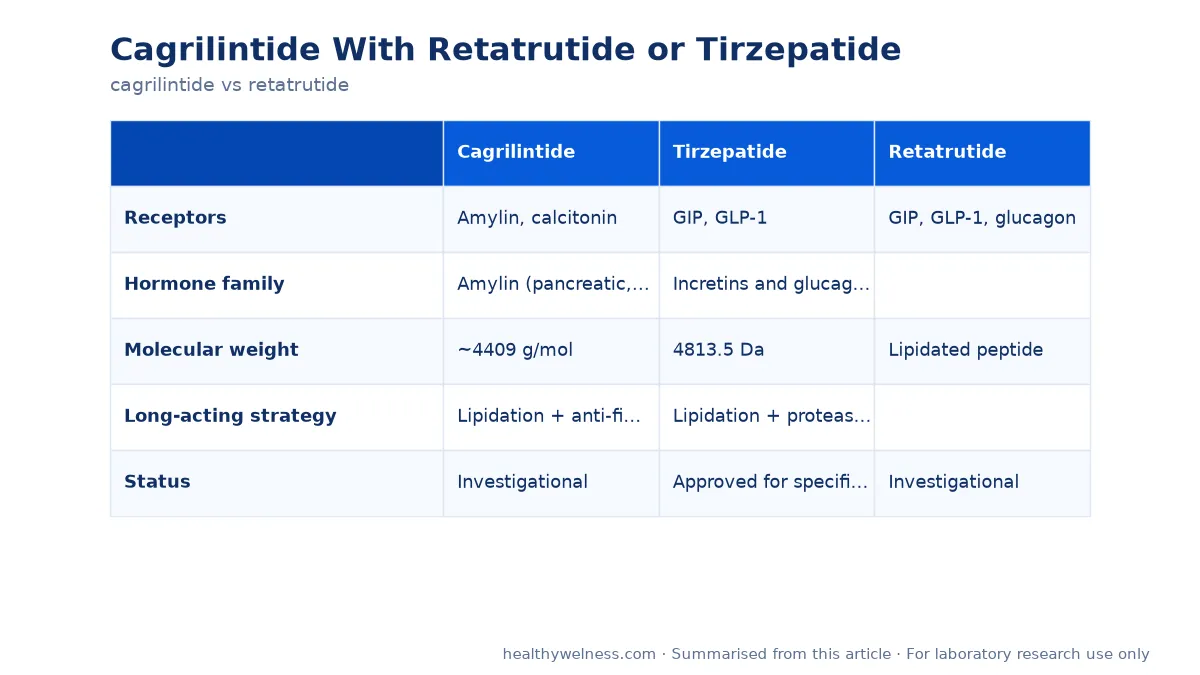
| Cagrilintide | Tirzepatide | Retatrutide | |
|---|---|---|---|
| Receptors | Amylin, calcitonin | GIP, GLP-1 | GIP, GLP-1, glucagon |
| Hormone family | Amylin (pancreatic, co-secreted with insulin) | Incretins and glucagon | |
| Molecular weight | ~4409 g/mol | 4813.5 Da | Lipidated peptide |
| Long-acting strategy | Lipidation + anti-fibrillation changes | Lipidation + protease-resistant residues | |
| Status | Investigational | Approved for specific indications | Investigational |
Research material: cagrilintide, retatrutide, tirzepatide. Profiles: cagrilintide and retatrutide.
Why amylin analogues are hard to make
Native amylin has a strong tendency to form amyloid fibrils, which made it a difficult starting point for drug design. The first analogue, pramlintide, needed three daily injections because of its short half-life. Cagrilintide was developed through structure–activity work aimed at a stable, lipidated, long-acting molecule (Kruse et al., 2021). The engineering problem was therefore different from that faced by incretin designers, who were mainly fighting enzymatic cleavage rather than aggregation.
What the trials show, separately
| Trial | Compound | Duration | Mean body-weight change | Comparator |
|---|---|---|---|---|
| Phase 2 dose-finding (Lau et al., 2021) | Cagrilintide | 26 weeks | −6.0% to −10.8% across doses | −3.0% placebo; −9.0% liraglutide |
| SURMOUNT-1 (Jastreboff et al., 2022) | Tirzepatide | 72 weeks | −15.0% to −20.9% | −3.1% placebo |
| Phase 3 obesity (Jastreboff et al., 2026) | Retatrutide | 80 weeks | −17.6% to −25.0% | −3.9% placebo |
The cagrilintide trial was shorter and used an active comparator, so the smaller numbers do not mean the compound is weaker in a like-for-like sense. Notably, the highest cagrilintide dose exceeded daily liraglutide 3.0 mg in that trial (−10.8% vs −9.0%, p=0.03).
The combination evidence
The published combination work pairs cagrilintide with semaglutide. A phase 2 trial in type 2 diabetes tested once-weekly cagrilintide 2.4 mg co-administered with once-weekly semaglutide 2.4 mg against comparators (Frias et al., 2023). This is the basis for the “CagriSema” name. Pairings with retatrutide or tirzepatide are available as research material but, as far as we found, have not been reported in peer-reviewed trials. Anyone studying such a combination is therefore working ahead of the literature rather than reproducing it.
Handling blends of similar-sized lipidated peptides
Cagrilintide and tirzepatide differ by only about 400 Da and are both lipidated, so a blend of the two is harder to verify than, say, ipamorelin plus tesamorelin. Points to check:
- High-resolution MS is needed to resolve the two intact masses confidently.
- HPLC retention may be similar because both carry fatty acid chains; a gradient optimised for one may not separate the other.
- Aggregation: lipidated peptides can self-associate, and antimicrobial preservatives have been shown to promote aggregation of an acylated peptide (Li et al., 2022). Check clarity carefully after reconstitution.
- Amylin lineage: cagrilintide’s parent hormone is amyloidogenic, so any haze or gel formation deserves particular attention.
Store powder at −20 °C and solutions at 2–8 °C; avoid freeze–thaw. Calculate each component separately with the peptide reconstitution calculator.
Amylin as a target in its own right
Amylin is secreted from pancreatic beta cells together with insulin, and it acts on receptors formed when the calcitonin receptor associates with receptor activity-modifying proteins. That is why an amylin analogue inevitably has some calcitonin receptor activity, and why cagrilintide is described as a non-selective amylin and calcitonin receptor agonist rather than a clean single-target molecule. For researchers this has a practical consequence: an effect seen with cagrilintide cannot automatically be assigned to amylin receptors without a calcitonin receptor control.
Open questions
- Does adding amylin receptor agonism to a triple agonist add anything beyond what three receptors already provide?
- How does cagrilintide’s calcitonin receptor activity contribute, relative to amylin receptor activity?
- Is cagrilintide physically stable when stored alongside another lipidated peptide in the same solution?
Related research
Frequently asked questions
What is the difference between cagrilintide and retatrutide?
Different receptor families. Cagrilintide is a long-acting amylin analogue acting on amylin and calcitonin receptors. Retatrutide is a triple agonist of the GIP, GLP-1 and glucagon receptors. They are complementary rather than alternatives.
Why combine cagrilintide with an incretin peptide?
Amylin and GLP-1 influence satiety through partly different pathways, so combining them is studied as a way to engage both. The best-documented pairing is cagrilintide with semaglutide, known as CagriSema.
Has cagrilintide been combined with retatrutide in published trials?
Not that we found. The published combination work pairs cagrilintide with semaglutide. Combinations with retatrutide or tirzepatide appear in research catalogues rather than in the trial literature.
Can cagrilintide and tirzepatide be mixed in one vial?
They are supplied as separate products and sometimes as premixed blends. Both are lipidated peptides of similar size, which makes analytical separation harder than for mismatched pairs, so the certificate of analysis should report each component.
Which is larger, cagrilintide or tirzepatide?
They are close: cagrilintide is about 4409 g/mol and tirzepatide 4813.5 Da.
For laboratory research use only. The research materials supplied by HealthyWelness are not approved medicines, foods or cosmetics and are not for human or veterinary use. This article summarises published research and is not medical advice.
Sources
- Kruse T, et al. Development of Cagrilintide, a Long-Acting Amylin Analogue. J Med Chem. 2021. PMID: 34288673
- Lau DCW, et al. Once-weekly cagrilintide for weight management in people with overweight and obesity: a multicentre, randomised, double-blind, placebo-controlled and active-controlled, dose-finding phase 2 trial. Lancet. 2021. PMID: 34798060
- Frias JP, et al. Efficacy and safety of co-administered once-weekly cagrilintide 2·4 mg with once-weekly semaglutide 2·4 mg in type 2 diabetes: a multicentre, randomised, double-blind, active-controlled, phase 2 trial. Lancet. 2023. PMID: 37364590
- Jastreboff AM, et al. Retatrutide, a Triple Hormone Receptor Agonist, for Treatment of Obesity. N Engl J Med. 2026. PMID: 42814954
- Jastreboff AM, et al. Tirzepatide Once Weekly for the Treatment of Obesity. N Engl J Med. 2022. PMID: 35658024
- Li M, et al. Molecular Mechanism of Antimicrobial Excipient-Induced Aggregation in Parenteral Formulations of Peptide Therapeutics. Mol Pharm. 2022. PMID: 35917158