Eloralintide vs Incretin Peptides: A Different Receptor
Eloralintide is an amylin receptor agonist, not an incretin analogue. Why that makes comparisons with retatrutide and tirzepatide awkward.


Cover illustration: AI-generated editorial artwork. Conceptual only; not an exact molecular structure, actual laboratory result or evidence of clinical effects.
Eloralintide is compared with retatrutide and tirzepatide because all three appear in the same field at the same time. Mechanistically the comparison is off-axis: eloralintide acts at amylin receptors and the other two act at incretin and glucagon receptors. Those are different receptor families with different architecture. The closer comparison is with cagrilintide.
For laboratory research use only. The research materials supplied by HealthyWelness are not approved medicines, foods or cosmetics and are not for human or veterinary use. This article summarises published research and is not medical advice.
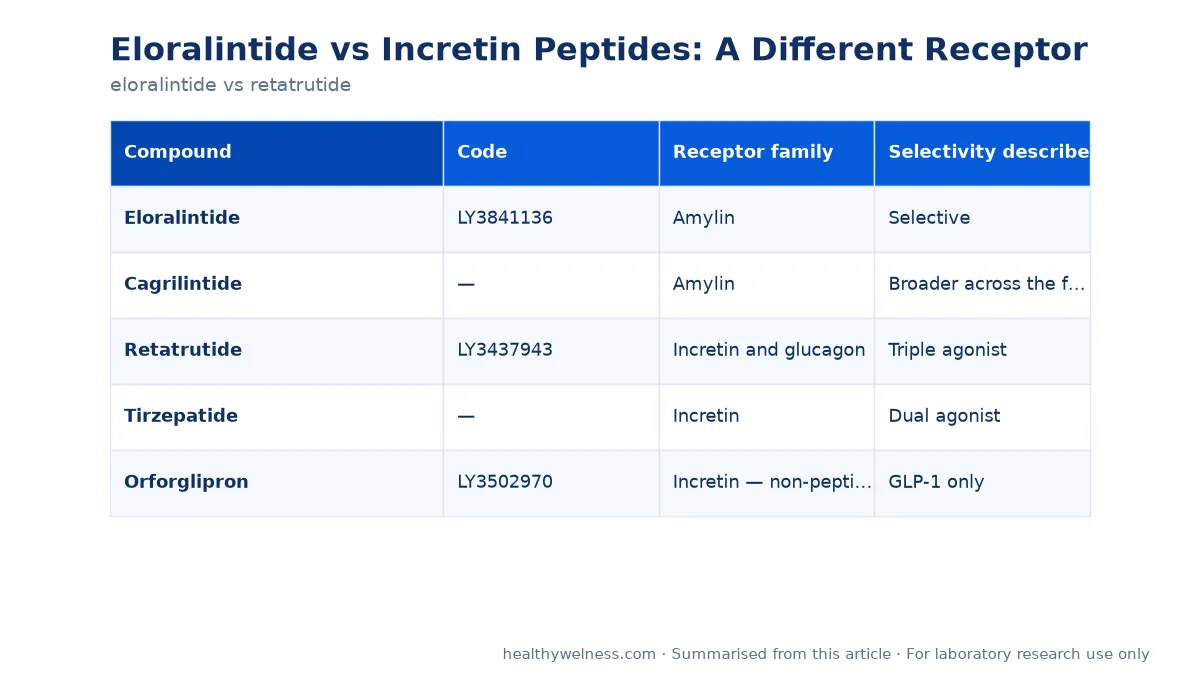
Which receptor family each one engages
| Compound | Code | Receptor family | Selectivity described as |
|---|---|---|---|
| Eloralintide | LY3841136 | Amylin | Selective |
| Cagrilintide | — | Amylin | Broader across the family |
| Retatrutide | LY3437943 | Incretin and glucagon | Triple agonist |
| Tirzepatide | — | Incretin | Dual agonist |
| Orforglipron | LY3502970 | Incretin — non-peptide | GLP-1 only |
The development codes are worth keeping in view. They appear in the primary literature, they do not change when a compound is renamed, and they are often the quickest way to confirm which molecule a paper is about.
Why amylin receptors are structurally different
This is the part that makes the comparison genuinely interesting rather than merely contrastive. Amylin receptors are not standalone receptors in the way the GLP-1 receptor is. They are formed when the calcitonin receptor associates with receptor activity-modifying proteins, and the identity of the accessory protein determines which amylin receptor subtype results.
Two consequences follow:
- Selectivity claims mean something different here. For an incretin agonist, selectivity is about which of several distinct receptors is engaged. For an amylin agonist it is about which accessory-protein combination the compound prefers — a subtler distinction, and harder to establish.
- A cell system must express the accessory protein, not only the calcitonin receptor, for the amylin receptor to exist at all. An experiment that omits this measures nothing.
The 2026 review by Bailey and colleagues in Peptides covers long-acting amylin-related peptides as a class and is the right orientation before reading any single compound’s papers.
The evidence base, which is unusually fresh
Eloralintide’s literature appeared quickly and in a coherent sequence, which is rare for a compound appearing in research catalogues:
| Paper | Year | What it covers |
|---|---|---|
| Briere, Mol Metab | 2025 | Discovery through clinical proof of concept |
| Bhattachar, Diabetes Obes Metab | 2026 | Phase 1 proof of concept |
| Billings, Lancet | 2025 | 48-week randomised phase 2 trial |
| Bailey, Peptides | 2026 | Class review of long-acting amylin peptides |
A discovery-to-proof-of-concept paper alongside a randomised phase 2 trial is a strong position for a molecule this new. For comparison, retatrutide’s trial evidence is aggregated in the 2025 systematic review and meta-analysis by Abdrabou Abouelmagd and colleagues.
What a comparison can and cannot establish
Because the receptor families differ, any comparison between eloralintide and an incretin agonist rests on a shared functional endpoint rather than on shared pharmacology.
- It cannot be a potency comparison. Potency is defined against a receptor, and the receptors differ.
- It can ask whether distinct interventions converge on a common measured endpoint, which is a legitimate question.
- Combination claims have no basis here. Any experiment combining an amylin agonist with an incretin agonist is exploratory unless a specific published study supports it.
- Molar equivalence is required, since the peptides differ substantially in molecular weight.
The amylin-versus-incretin framing within our own catalogue is covered in cagrilintide and the incretin peptides.
A note on the “GLP-3” label
Searches sometimes ask whether retatrutide is “GLP-3R”. It is not: there is no GLP-3 receptor. Retatrutide is an agonist at three receptors — GLP-1, GIP and glucagon — and the label appears to be a compression of “three receptors” into a receptor name that does not exist. The primary literature uses either the compound name or LY3437943, and either is unambiguous. See what retatrutide is.
Handling
All the peptides here are long engineered molecules carrying modifications intended to extend circulation, which makes them more hydrophobic than a plain peptide and more prone to aggregation under shear.
- Reconstitute gently down the vial wall and swirl; do not vortex.
- Aliquot on first reconstitution; store sealed, dry and dark at −20 °C before that.
- Compute molarity from net peptide content rather than vial weight — our reconstitution calculator takes both figures.
- Ask for the chromatogram: at this length, deletion impurities from synthesis are a real possibility and are the ones most likely to co-elute. See how to read a certificate of analysis.
Our retatrutide research material is supplied for laboratory research use. Certificates are available for listed products — contact us for the latest report.
Scope note
This material is supplied for laboratory research use only. It is not a medicine, not a supplement, and not for human or veterinary use. The clinical trials cited are referenced as published literature about these molecules.
Open questions
- How is amylin receptor subtype selectivity established experimentally?
- Do amylin and incretin agonists converge on shared downstream signatures?
- Which accessory-protein combinations are present in common cell models?
Related research
Frequently asked questions
What is eloralintide?
A selective amylin receptor agonist, development code LY3841136. It is described in a 2025 Molecular Metabolism paper covering discovery through clinical proof of concept, and in phase 1 and phase 2 reports published in 2025 and 2026.
Is it an incretin analogue like retatrutide?
No, and this is the central point. Retatrutide and tirzepatide act at incretin and glucagon receptors. Eloralintide acts at amylin receptors, which are a different receptor family built from calcitonin receptors with accessory proteins.
How does it compare with cagrilintide?
Both target amylin receptors, which makes that the more natural comparison. Published descriptions emphasise selectivity for eloralintide, where cagrilintide is generally described as acting more broadly across the receptor family.
What do the LY numbers mean?
They are Eli Lilly development codes: LY3841136 is eloralintide, LY3437943 is retatrutide and LY3502970 is orforglipron. The codes appear in the primary literature and are often the most reliable way to identify which molecule a paper concerns.
Is retatrutide the same as GLP-3R?
No. Retatrutide is a triple agonist at the GLP-1, GIP and glucagon receptors. There is no receptor called GLP-3, and the label appears to be a misreading of the three-receptor description.
For laboratory research use only. The research materials supplied by HealthyWelness are not approved medicines, foods or cosmetics and are not for human or veterinary use. This article summarises published research and is not medical advice.
Sources
- Briere DA, et al. Eloralintide (LY3841136), a novel amylin receptor agonist for the treatment of obesity: From discovery to clinical proof of concept. Mol Metab. 2025. PMID: 41109426
- Billings LK, et al. Eloralintide, a selective amylin receptor agonist for the treatment of obesity: a 48-week phase 2, multicentre, double-blind, randomised, placebo-controlled trial. Lancet. 2025. PMID: 41207310
- Bhattachar S, et al. Eloralintide, a selective, long-acting amylin receptor agonist for treatment of obesity: Phase 1 proof of concept. Diabetes Obes Metab. 2026. PMID: 41559929
- Bailey CJ, et al. Long-acting amylin-related peptides as therapies for obesity and type 2 diabetes. Peptides. 2026. PMID: 41747885
- Abdrabou Abouelmagd A, et al. Efficacy and safety of retatrutide, a novel GLP-1, GIP, and glucagon receptor agonist for obesity treatment: a systematic review and meta-analysis of randomized controlled trials. Proc (Bayl Univ Med Cent). 2025. PMID: 40291085