Epithalon vs Thymalin: Tetrapeptide or Preparation
Epithalon is a defined four-residue peptide; thymalin is a thymic peptide preparation. Same research tradition, very different levels of definition.

Cover illustration: AI-generated editorial artwork. Conceptual only; not an exact molecular structure, actual laboratory result or evidence of clinical effects.
These two come from the same research programme and sit at opposite ends of one axis: how precisely the thing in the vial is defined. Epithalon is a four-residue peptide with one sequence. Thymalin is a tissue-derived preparation understood through its fragments. That difference governs what each can be used for.
For laboratory research use only. The research materials supplied by HealthyWelness are not approved medicines, foods or cosmetics and are not for human or veterinary use. This article summarises published research and is not medical advice.
- Epithalon is a tetrapeptide — four amino acid residues with a single defined sequence.
- Thymalin is a thymic peptide preparation, characterised in recent work through constituent dipeptides such as KE and EW.
- A 2003 study reported that epithalon induced telomerase activity and telomere elongation in human somatic cells (Khavinson et al., PMID 12937682).
- A 2020 study examined thymalin and differentiation of human haematopoietic stem cells (Khavinson et al., PMID 33237528).
- Both compounds come from the Russian bioregulator research tradition and appear in overlapping journals.
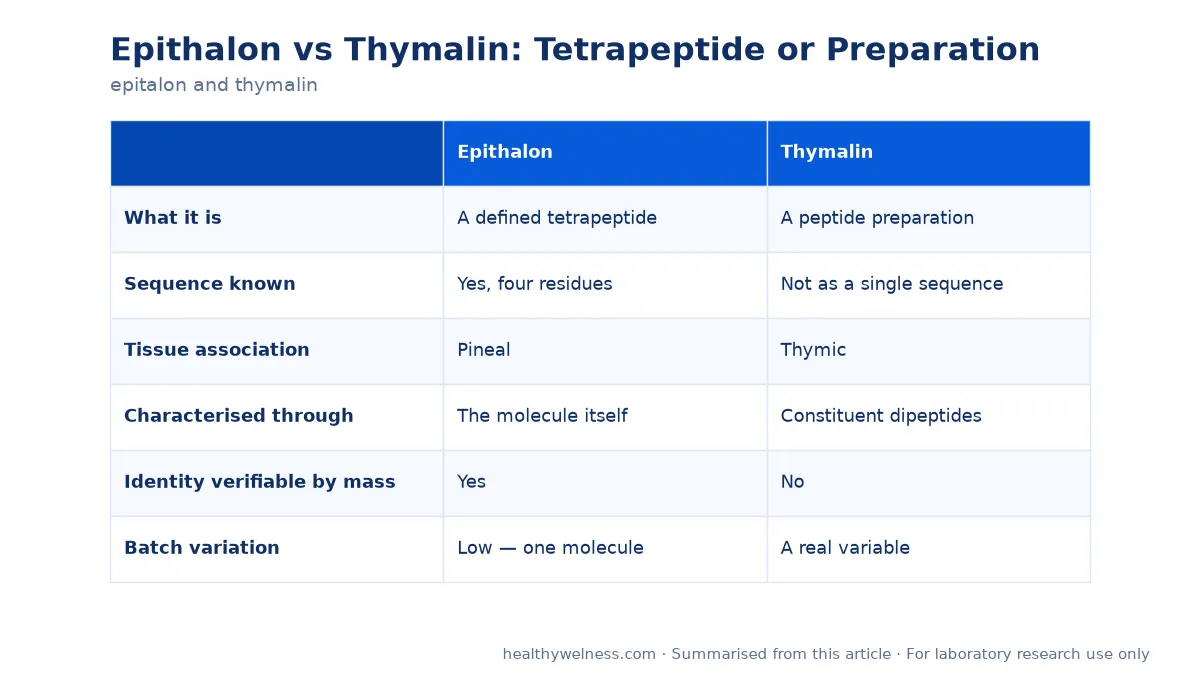
Side by side
| Epithalon | Thymalin | |
|---|---|---|
| What it is | A defined tetrapeptide | A peptide preparation |
| Sequence known | Yes, four residues | Not as a single sequence |
| Tissue association | Pineal | Thymic |
| Characterised through | The molecule itself | Constituent dipeptides |
| Identity verifiable by mass | Yes | No |
| Batch variation | Low — one molecule | A real variable |
| Reported mechanism | Telomerase activity in somatic cells | Fragment-level gene expression effects |
Why does definition level change what you can conclude?
Because it changes what the control group is controlling for.
With a defined tetrapeptide, a scrambled-sequence peptide of identical amino acid composition isolates the contribution of the sequence. If the scramble is inactive and the correct sequence is active, the sequence matters. That is a clean experiment, and a four-residue peptide makes it cheap to run.
With a preparation, there is no single sequence to scramble. The sensible controls are different:
- Batch-to-batch comparison against a retained sample that performed as expected.
- Testing the constituent fragments individually, which is precisely what the 2023 study by Linkova and colleagues did with the KE and EW dipeptides.
- Reporting composition where the supplier provides it, since composition is a variable rather than a constant.
Neither approach is invalid. They answer different questions, and conflating them is where most confusion about this compound family comes from. The wider family is covered in Russian bioregulator peptides.
What does the epithalon literature actually report?
The foundation is a pair of studies from the early 2000s in Bulletin of Experimental Biology and Medicine. The 2003 paper reported that epithalon induced telomerase activity and telomere elongation in human somatic cells; the 2004 paper described cells overcoming the division limit.
Two observations about that evidence base, both worth making plainly:
- These are cell-level findings in human cells, which is more directly relevant than a rodent behavioural readout would be.
- They come from one research group. Independent replication of the telomerase result is the obvious question, and it is one we have not been able to answer from the indexed literature.
The 2025 review by Araj and colleagues in the International Journal of Molecular Sciences is the most recent survey, and its title describes the compound as having “promising properties” — the language of an open case rather than a closed one. The compound background is in what epithalon is.
What does the thymalin literature report?
The 2020 study by Khavinson and colleagues examined effects on differentiation of human haematopoietic stem cells. The 2023 study by Linkova and colleagues is the more informative one for understanding what thymalin is, because it works at the level of constituent dipeptides and asks what they do to gene expression and protein synthesis.
That design is an admission and a method at the same time: if the preparation is understood by studying its fragments, then the preparation is not a single defined entity. Recognising that is the first step to designing a sound experiment with it. A separate and frequently confused compound, thymulin, is covered in thymalin compared with thymulin.
How should each be verified before use?
| Check | Epithalon | Thymalin |
|---|---|---|
| Stated sequence | Four residues, checkable | Not a single sequence |
| Observed mass | Close to definitive at this length | Not interpretable as one value |
| Chromatogram | Shows co-present species | Shows the composition profile |
| Counterion named | Needed for molecular weight | Needed if quantifying |
| Retained reference batch | Useful | Essential |
For a four-residue peptide the number of possible same-mass alternatives is small, so computing the expected mass and comparing it against the reported value is a two-minute check worth doing — though it confirms composition rather than identity, since same-composition alternatives share a mass. The framework is in how to read a certificate of analysis.
Handling
- Store both sealed, dry and dark at −20 °C; warm the vial to room temperature before opening so moisture does not condense into a hygroscopic powder.
- Reconstitute gently and aliquot on first use. See storing reconstituted peptides.
- Compute molarity from net peptide content where a defined sequence exists. For a tetrapeptide the counterion is a proportionally large share of vial weight, so the correction is substantial rather than cosmetic; our reconstitution calculator applies it.
- Keep a retained aliquot of any batch that performed as expected, particularly for the preparation, so a new batch has something to be compared against.
Our epithalon research material is supplied for laboratory research use. Certificates are available for listed products — contact us for the latest report.
Why the Russian bioregulator literature needs a different reading
Both compounds come from a research programme that developed largely apart from the Western peptide literature, and that history shapes how the evidence should be weighed — not dismissed, but read with its context in view.
- Authorship is concentrated. A large share of the primary work on both compounds comes from one group. Twenty papers from one laboratory are not twenty independent confirmations, and the question that matters for a claim’s strength is how many separate groups have tested it.
- Some of the work is in journals with limited indexing, which means abstracts are searchable but methods and controls are often not inspectable in the usual way.
- Recent reviews are appearing in widely indexed journals. The 2025 International Journal of Molecular Sciences review of epithalon and the 2023 dipeptide study on thymalin both sit in the mainstream literature, which makes the current work easier to assess than the older material.
None of this is an argument against using either compound. It is an argument for designing experiments that do not depend on a single reported finding being correct — which, for a four-residue peptide with a cheap scrambled control available, is entirely achievable.
Scope note
This material is supplied for laboratory research use only. It is not a medicine, not a supplement, and not for human or veterinary use. The studies cited are cell and clinical research published by the originating programme and by later reviewers.
Open questions
- Has the telomerase finding for epithalon been reproduced by an independent group?
- How much does thymalin’s composition vary between batches?
- Do the constituent dipeptides account for the preparation’s reported effects?
Related research
Frequently asked questions
What is the difference between epithalon and thymalin?
How precisely each is defined. Epithalon is a single tetrapeptide with a known four-residue sequence. Thymalin is a peptide preparation from thymic tissue, characterised through its constituent short peptides rather than as one molecule with one sequence.
Do they come from the same research tradition?
Yes. Both belong to the Russian bioregulator programme associated with Khavinson and colleagues, and both are studied with similar methods and published in overlapping journals. That shared origin is why they are often discussed together.
What is epithalon's reported mechanism?
Published work from the early 2000s reported that epithalon induced telomerase activity and telomere elongation in human somatic cells, and a companion study described cells overcoming the division limit. A 2025 review in the International Journal of Molecular Sciences surveys the compound.
What is thymalin characterised as?
A preparation. Recent work examines the influence of its constituent dipeptides, such as KE and EW, on gene expression and protein synthesis, which is a different kind of characterisation from a defined single molecule.
Which is easier to work with in the laboratory?
Epithalon, because identity is checkable. A four-residue peptide has few same-mass alternatives, so an observed mass matching the expected value is close to definitive. A preparation cannot be verified that way and needs batch-to-batch comparison instead.
For laboratory research use only. The research materials supplied by HealthyWelness are not approved medicines, foods or cosmetics and are not for human or veterinary use. This article summarises published research and is not medical advice.
Sources
- Araj SK, et al. Overview of Epitalon-Highly Bioactive Pineal Tetrapeptide with Promising Properties. Int J Mol Sci. 2025. PMID: 40141333
- Khavinson VKh, et al. Epithalon peptide induces telomerase activity and telomere elongation in human somatic cells. Bull Exp Biol Med. 2003. PMID: 12937682
- Khavinson VKh, et al. Peptide promotes overcoming of the division limit in human somatic cell. Bull Exp Biol Med. 2004. PMID: 15455129
- Khavinson VK, et al. Thymalin: Activation of Differentiation of Human Hematopoietic Stem Cells. Bull Exp Biol Med. 2020. PMID: 33237528
- Linkova N, et al. The Influence of KE and EW Dipeptides in the Composition of the Thymalin Drug on Gene Expression and Protein Synthesis Involved in the Pathogenesis of COVID-19. Int J Mol Sci. 2023. PMID: 37686182