Sermorelin vs GLP-1 and Retatrutide: Two Axes
Sermorelin acts on the pituitary growth hormone axis; GLP-1 and retatrutide act on gut hormone receptors. The comparison is between systems.


Cover illustration: AI-generated editorial artwork. Conceptual only; not an exact molecular structure, actual laboratory result or evidence of clinical effects.
These compounds appear in the same catalogues and are asked about together, but they belong to two unrelated endocrine systems. Sermorelin acts on the pituitary; incretin peptides act on receptors for gut hormones. The comparison is between axes, not between agents, and it is worth making only to establish that there is nothing to transfer between them.
For laboratory research use only. The research materials supplied by HealthyWelness are not approved medicines, foods or cosmetics and are not for human or veterinary use. This article summarises published research and is not medical advice.
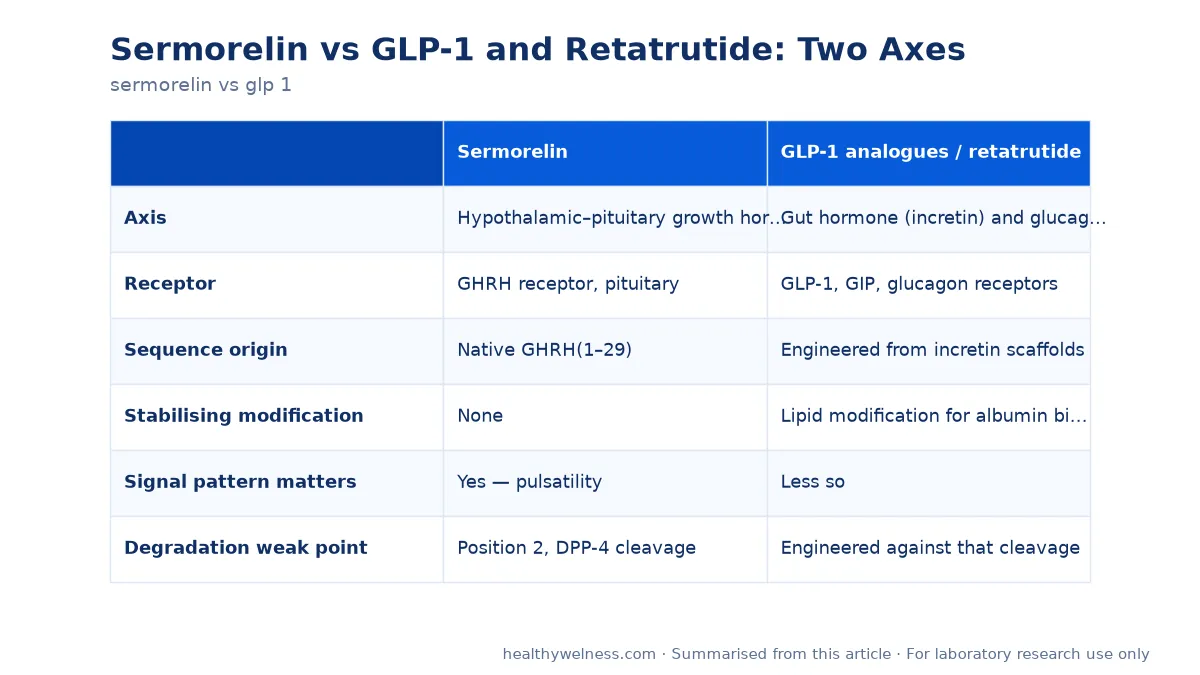
Side by side
| Sermorelin | GLP-1 analogues / retatrutide | |
|---|---|---|
| Axis | Hypothalamic–pituitary growth hormone | Gut hormone (incretin) and glucagon |
| Receptor | GHRH receptor, pituitary | GLP-1, GIP, glucagon receptors |
| Sequence origin | Native GHRH(1–29) | Engineered from incretin scaffolds |
| Stabilising modification | None | Lipid modification for albumin binding |
| Signal pattern matters | Yes — pulsatility | Less so |
| Degradation weak point | Position 2, DPP-4 cleavage | Engineered against that cleavage |
| Clinical literature | Older GHRH fragment studies | Recent randomised trials |
Sermorelin: a native sequence in a regulated loop
Sermorelin is GHRH(1–29) amide, identical to the native hormone’s active region. Everything characteristic about it follows from that: it is selective because it is native, and it is fragile because it is native.
The 1985 study by Barron and colleagues compared GHRH(1–29)-NH2 with a D-Ala2 analogue, and the 1997 study by Khorram and colleagues used a norleucine-substituted version. Reading those backwards tells you where the parent is weak: every substitution that someone bothered to make marks a liability in the native sequence, and position 2 is the dipeptidyl peptidase-4 site.
The axis it acts on has a property the incretin receptors do not share in the same way. Growth hormone is released in pulses, and the pattern carries information. The 2006 study by Ionescu and colleagues found that pulsatile secretion persisted even under continuous stimulation by a long-acting GHRH analogue — the pulse generator kept working. An intervention at the top of that axis therefore produces a patterned output, not a steady one, which is covered further in sermorelin compared with growth hormone.
Incretin peptides: engineered, and multi-receptor
Retatrutide is designed against three receptors simultaneously, and its trial evidence is aggregated in the 2025 systematic review by Abdrabou Abouelmagd and colleagues. The design is the opposite of sermorelin’s in both respects: the sequence is engineered rather than native, and the receptor engagement is deliberately broad rather than inherited.
That breadth is an interpretive constraint, not only a feature. An effect observed with a triple agonist is an effect of triple agonism, and separating the contributions needs selective comparators. The 2024 study by Sloop and colleagues on non-peptide GLP-1 receptor agonism is useful here for a different reason: it shows that the same receptor can be engaged by molecules from completely different chemical classes, which widens the set of available comparators beyond peptides.
What a comparison between the two can show
| Can establish | Cannot establish |
|---|---|
| Whether both affect one chosen endpoint | Relative potency — different receptors |
| Whether their time courses differ | A shared mechanism |
| Whether two axes converge functionally | Anything about combination, with no literature |
| Different handling requirements, concretely | That one is a substitute for the other |
The third row is the one most often overreached. There is no published co-administration work for these two classes that we can find, so a combination arm is exploratory. Saying so is better than implying a protocol exists.
Handling: the practical difference is large
This is where the comparison becomes genuinely useful, because the two classes fail in different ways.
- Sermorelin is a 29-residue peptide containing methionine and tryptophan (oxidation) and asparagine (deamidation), with no protection at the DPP-4 site. In serum-containing medium it degrades quickly, so a slow readout may outlast the exposure. Detail in sermorelin reconstitution and storage.
- Engineered incretin peptides are longer and carry a lipid modification, which raises hydrophobic character. Their characteristic failure is aggregation under shear and loss to surfaces, not rapid proteolysis.
- Both are stored sealed, dry and dark at −20 °C, warmed before opening, and aliquoted on first reconstitution.
- Both need molarity computed from net peptide content rather than vial weight, with each compound’s own molecular weight — our reconstitution calculator takes those inputs.
In a side-by-side experiment the sermorelin arm is the one more likely to be compromised by handling. If it underperforms, material integrity is the first hypothesis to test, ahead of any conclusion about the axis.
Our sermorelin acetate research material is supplied for laboratory research use. Certificates are available for listed products — contact us for the latest report.
Scope note
This material is supplied for laboratory research use only. It is not a medicine, not a supplement, and not for human or veterinary use.
Open questions
- Do the two axes converge on any shared transcriptional signature?
- How much faster does sermorelin degrade than an engineered incretin peptide under identical conditions?
- Would matched exposure change any published comparison between the classes?
Related research
Frequently asked questions
Do sermorelin and GLP-1 peptides act on the same system?
No. Sermorelin is a GHRH fragment acting at the GHRH receptor on the pituitary. GLP-1 analogues and retatrutide act at incretin and glucagon receptors, which are a different receptor family in different tissues. There is no shared pathway to reason from.
Are both classes peptides?
Yes, but of very different design. Sermorelin is a 29-residue native sequence fragment with no stabilising modification. Retatrutide and GLP-1 analogues are engineered peptides carrying lipid modifications intended to extend circulation.
Which is more fragile in the laboratory?
Sermorelin. It carries the native residue at position 2, where dipeptidyl peptidase-4 cleaves, and it contains methionine, tryptophan and asparagine. The engineered incretin peptides are built to resist that cleavage.
Can the two be compared in one experiment?
Only on a shared functional endpoint, and such a comparison says nothing about relative potency because the receptors differ. Each arm also needs its own positive control appropriate to its own axis.
Is there published work on using them together?
Not that we can find. Any experiment combining a growth hormone secretagogue with an incretin agonist is exploratory, and should be described that way rather than as following a protocol.
For laboratory research use only. The research materials supplied by HealthyWelness are not approved medicines, foods or cosmetics and are not for human or veterinary use. This article summarises published research and is not medical advice.
Sources
- Barron JL, et al. Growth hormone responses to growth hormone-releasing hormone (1-29)-NH2 and a D-Ala2 analog in normal men. Peptides. 1985. PMID: 2866496
- Khorram O, et al. Effects of [norleucine27]growth hormone-releasing hormone (GHRH) (1-29)-NH2 administration on the immune system of aging men and women. J Clin Endocrinol Metab. 1997. PMID: 9360512
- Abdrabou Abouelmagd A, et al. Efficacy and safety of retatrutide, a novel GLP-1, GIP, and glucagon receptor agonist for obesity treatment: a systematic review and meta-analysis of randomized controlled trials. Proc (Bayl Univ Med Cent). 2025. PMID: 40291085
- Sloop KW, et al. The pharmacological basis for nonpeptide agonism of the GLP-1 receptor by orforglipron. Sci Transl Med. 2024. PMID: 39693407
- Ionescu M, et al. Pulsatile secretion of growth hormone (GH) persists during continuous stimulation by CJC-1295, a long-acting GH-releasing hormone analog. J Clin Endocrinol Metab. 2006. PMID: 17018654