GHK-Cu vs Copper Tripeptide-1: The Same Molecule
Copper tripeptide-1 is the cosmetic ingredient name for GHK-Cu. Why the same compound has two names, and which other copper peptides differ.

Cover illustration: AI-generated editorial artwork. Conceptual only; not an exact molecular structure, actual laboratory result or evidence of clinical effects.
Copper tripeptide-1 and GHK-Cu are the same compound under two naming systems. One is the cosmetic ingredient name used for labelling; the other is the chemical shorthand used in the research literature. The genuinely useful part of this question is not that confusion, which resolves in a sentence, but the one next to it: several compounds share the words “copper peptide” and are not the same molecule at all.
For laboratory research use only. The research materials supplied by HealthyWelness are not approved medicines, foods or cosmetics and are not for human or veterinary use. This article summarises published research and is not medical advice.
- Copper tripeptide-1 is the cosmetic ingredient name for the complex of glycyl-L-histidyl-L-lysine with copper.
- GHK-Cu is the chemical shorthand for the same complex, and is the term used in the primary literature.
- AHK-Cu uses a different tripeptide, alanyl-histidyl-lysine, and is a distinct compound rather than a variant name.
- The copper ion is part of the defined active species, not an additive, which is why the complex has its own molecular weight.
- The 1993 Journal of Clinical Investigation study is the foundational primary evidence and studied the copper complex, not the free tripeptide.
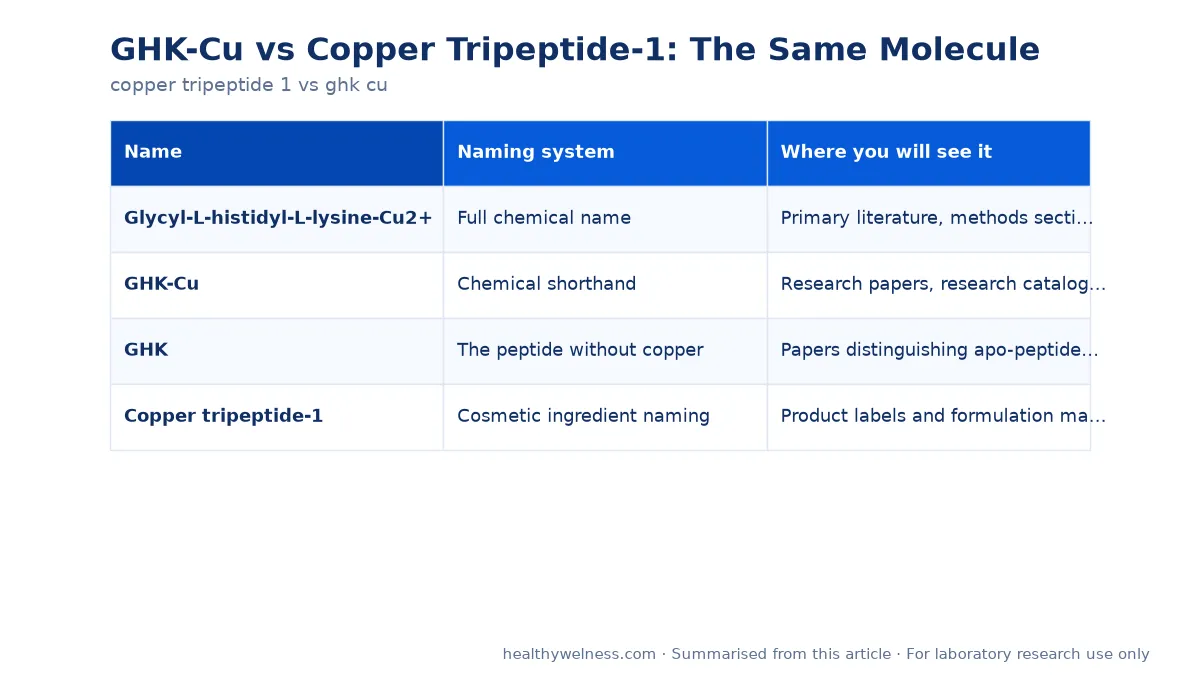
Which name belongs to which context?
| Name | Naming system | Where you will see it |
|---|---|---|
| Glycyl-L-histidyl-L-lysine-Cu2+ | Full chemical name | Primary literature, methods sections |
| GHK-Cu | Chemical shorthand | Research papers, research catalogues |
| GHK | The peptide without copper | Papers distinguishing apo-peptide from complex |
| Copper tripeptide-1 | Cosmetic ingredient naming | Product labels and formulation material |
The third row is worth pausing on. GHK and GHK-Cu are not synonyms. GHK is the tripeptide alone; GHK-Cu is the tripeptide coordinated to copper. Papers that distinguish them do so deliberately, and a report naming one when it means the other has an identity problem rather than a style preference.
Why search terms matter more than usual here
Because the two naming systems serve different audiences and surface different material.
Searching the cosmetic ingredient name returns formulation literature, product documentation and marketing material. Searching GHK or GHK-Cu returns the primary research: the 1993 study by Maquart and colleagues in the Journal of Clinical Investigation on connective tissue accumulation in rat wounds, the 2008 review by Pickart on tissue remodelling, and the recent chemistry work.
Anyone assembling evidence should search the chemical names. Anyone reading a product label will see the cosmetic name. Knowing that these point at the same molecule but at different bodies of writing prevents a predictable error: concluding that a compound has little research because the wrong term was searched.
Which copper peptides are genuinely different?
This is the part that matters for an experiment.
- AHK-Cu uses alanyl-histidyl-lysine. One residue differs from GHK, which changes the molecule, its mass and its coordination environment. It is compared in AHK-Cu compared with GHK-Cu.
- The apo-peptide, GHK without copper. A different species with a different mass, and the primary evidence base studied the complex rather than the free peptide.
- Other copper chelates entirely. Any molecule carrying copper will deliver copper, which is a separate biological input from whatever the peptide does.
The 2025 review by Adnan and colleagues places GHK among tripeptides in wound healing and skin regeneration generally, which is a useful framing precisely because it shows what is shared across the class and what is specific to one sequence.
What should a research-grade report state that a label will not?
A cosmetic ingredient name establishes identity and nothing else. For laboratory work four further things are needed, and their absence is the real risk behind the naming question.
| Item | Why it matters |
|---|---|
| Which molecular weight is stated | Free peptide, complex and salt all differ |
| Copper content or metal-to-peptide ratio | Evidence of a complex rather than a mixture |
| Counterion named | Needed for the weight; relevant in cell work |
| Purity with its method | A percentage without a method cannot be interpreted |
The copper-content row is the most informative when present and the most often missing. A stated metal-to-peptide ratio is direct evidence that the vial holds a coordinated complex rather than a physical mixture of tripeptide and a copper salt — and since the 1993 primary evidence concerns the complex, that distinction decides whether the material matches the literature.
Counterion is the ordinary peptide question. Reverse-phase purification leaves peptides as trifluoroacetate salts unless an exchange step is added, and the 2008 evaluation by Roux and colleagues found exchange approaches to differ in completeness. The full treatment is in peptide counterions: TFA versus acetate.
Does the coordination chemistry change handling?
Yes, and in a way that inverts standard peptide advice.
Peptide solutions are normally kept low in trace metal, because metal ions catalyse oxidation at histidine and tryptophan. Here the metal is bound at the histidine by design. The relevant risk is the opposite one: chelating agents such as EDTA compete for the copper and strip it from the peptide, so a buffer containing a chelator does not contain GHK-Cu for long.
Two further points follow from the same chemistry:
- pH affects coordination, because the histidine imidazole is part of the copper binding and its protonation state is pH-dependent.
- Colour is a crude but immediate integrity check. Copper complexes of this kind are visibly coloured, and a solution that has lost its colour has lost its coordination.
The 2026 review by Mateescu and colleagues in Pharmaceutics covers coordination chemistry and formulation science together and is the most directly useful recent source for handling questions. The salt-form arithmetic is in GHK-Cu acetate: salt form and copper coordination, and the evidence picture in the GHK-Cu research review.
Our GHK-Cu copper peptide research material is supplied for laboratory research use. Certificates are available for listed products — contact us for the latest report. Concentration maths should use the complex’s molecular weight rather than the free tripeptide’s, which our reconstitution calculator takes as an explicit input.
Why the copper question outranks the naming question
The naming confusion resolves in a sentence. The chemistry question behind it does not, and it is the one that changes experimental results.
GHK-Cu delivers copper, and copper is biologically active in its own right: it participates in redox chemistry and serves as a cofactor for enzymes involved in connective tissue cross-linking. So an effect observed with the complex has three candidate explanations — the peptide acting as a signal, the copper delivered in a bioavailable form, or both together.
Separating them needs a control set that is rarely reported: copper salt alone at matched copper concentration, the apo-peptide without copper, and ideally a comparable copper chelate that is not GHK. Without those arms, an experiment characterises the complex as a whole. That may be exactly what is intended, but it should be stated rather than assumed, and it is a far more consequential distinction than which of the two names appears on the label.
Scope note
This material is supplied for laboratory research use only. It is not a medicine, not a supplement, and not a cosmetic, and it is not for human or veterinary use. The cosmetic ingredient naming is discussed here only to explain why one molecule carries two names.
Open questions
- How often is copper content reported on research-grade certificates for this compound?
- How much do stated molecular weights vary between sources?
- How stable is the copper coordination in common culture media over an incubation?
Related research
Frequently asked questions
Is copper tripeptide-1 the same as GHK-Cu?
Yes. Copper tripeptide-1 is the cosmetic ingredient naming convention for the complex of glycyl-L-histidyl-L-lysine with copper. GHK-Cu is the chemical shorthand for the same thing. Two naming systems, one molecule.
Why does one molecule have two names?
Because two naming systems apply to it. Chemical nomenclature describes the structure, while cosmetic ingredient naming assigns standardised names for labelling. A compound used in both contexts picks up a name from each.
Are all copper peptides the same compound?
No, and this is where the confusion is real rather than cosmetic. AHK-Cu uses a different tripeptide, alanyl-histidyl-lysine, and is a distinct compound. Sharing the word copper does not make two peptides interchangeable.
Does the naming difference affect laboratory work?
Only through what the certificate reports. A cosmetic ingredient name tells you the identity but not the salt form, the copper-to-peptide ratio or the purity method, all of which a research report should state.
Which name appears in the scientific literature?
GHK, GHK-Cu, or the full chemical name glycyl-L-histidyl-L-lysine. Searching the cosmetic ingredient name alone returns formulation and product material rather than the primary research.
For laboratory research use only. The research materials supplied by HealthyWelness are not approved medicines, foods or cosmetics and are not for human or veterinary use. This article summarises published research and is not medical advice.
Sources
- Maquart FX, et al. In vivo stimulation of connective tissue accumulation by the tripeptide-copper complex glycyl-L-histidyl-L-lysine-Cu2+ in rat experimental wounds. J Clin Invest. 1993. PMID: 8227353
- Pickart L. The human tri-peptide GHK and tissue remodeling. J Biomater Sci Polym Ed. 2008. PMID: 18644225
- Mateescu DM, et al. GHK-Cu as a Bioactive Metallopeptide and Drug-Delivery Cargo: Coordination Chemistry, Formulation Science, Therapeutic Evidence, and a Translational Roadmap. Pharmaceutics. 2026. PMID: 42797253
- Adnan SB, et al. Exploring the Role of Tripeptides in Wound Healing and Skin Regeneration: A Comprehensive Review. Int J Med Sci. 2025. PMID: 41209547
- Roux S, et al. Elimination and exchange of trifluoroacetate counter-ion from cationic peptides: a critical evaluation of different approaches. J Pept Sci. 2008. PMID: 18035848