GHK-Cu Acetate: Salt Form and Copper Coordination
GHK-Cu has two separate chemical identities on its label: a copper complex and a salt. Why both matter for molecular weight and buffers.

Cover illustration: AI-generated editorial artwork. Conceptual only; not an exact molecular structure, actual laboratory result or evidence of clinical effects.
A label reading “GHK-Cu acetate” names two separate pieces of chemistry, and conflating them is the most common error with this compound. The copper is part of the defined molecule. The acetate is a counterion, like any peptide salt. One is the thing being studied; the other is packaging that still contributes mass.
For laboratory research use only. The research materials supplied by HealthyWelness are not approved medicines, foods or cosmetics and are not for human or veterinary use. This article summarises published research and is not medical advice.
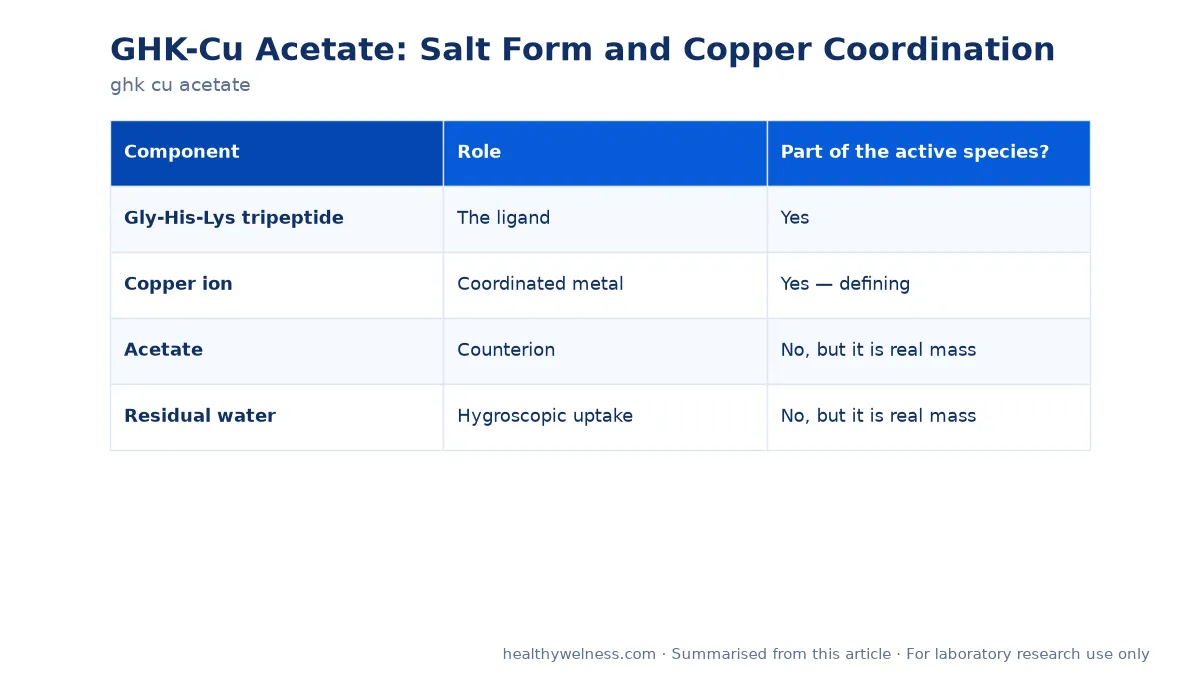
What is actually in the vial
| Component | Role | Part of the active species? |
|---|---|---|
| Gly-His-Lys tripeptide | The ligand | Yes |
| Copper ion | Coordinated metal | Yes — defining |
| Acetate | Counterion | No, but it is real mass |
| Residual water | Hygroscopic uptake | No, but it is real mass |
Three different molecular weights can therefore be quoted for “GHK-Cu”: the free tripeptide, the copper complex, and the acetate salt of the complex. They are not interchangeable, and the difference is large enough to matter at the concentrations used in cell work.
The rule is the same one that applies to any salt form: use the molecular weight of the exact form on the certificate. Our reconstitution calculator takes molecular weight as an explicit input rather than inferring it from a sequence, which is what makes it usable for a metallopeptide at all.
How the copper is held
The coordination involves the histidine imidazole together with the N-terminal amine and a backbone nitrogen. That the histidine is central has a direct practical consequence: imidazole protonation is pH-dependent, so the coordination is pH-dependent. A solution prepared at one pH and diluted into a buffer at another is not necessarily the same species in both.
The 2026 review by Mateescu and colleagues in Pharmaceutics is the current reference on exactly this, covering coordination chemistry and formulation science for GHK-Cu as a metallopeptide. It is the most directly useful paper for handling questions, more so than the biology literature.
There is also an irony worth noting. The 1998 work by Khossravi and colleagues established metal-catalysed oxidation at histidine as a major degradation route in peptides, which is why peptide solutions are normally kept low in trace metal. Here the metal is bound at the histidine by design. The usual advice does not apply, and generalising it would destroy the compound.
Buffers that are incompatible
A chelating agent competes for the copper. The practical list:
- EDTA and similar chelators: incompatible. They will strip the copper.
- Phosphate at higher concentrations: worth checking, as phosphate can interact with metal ions.
- Thiol-containing additives and reducing agents: worth checking, since they can reduce copper and alter the complex.
- Old buffer stocks of unknown composition: the commonest source of an unnoticed chelator.
Reading the buffer composition before use is a thirty-second check that prevents an experiment measuring the free tripeptide while the record says GHK-Cu. The same metal-complex logic applies to other compounds in this small category — see the peptide versus metal complex comparison and the zinc-dependent case.
The acetate question
Acetate here plays the ordinary counterion role. Reverse-phase purification normally leaves a peptide as its trifluoroacetate salt, and acetate appears after a deliberate exchange step. The 2008 critical evaluation by Roux and colleagues compared approaches to that exchange and found them to differ in completeness, which means “acetate salt” indicates that an exchange was performed rather than that no trifluoroacetate remains.
For cell work that distinction matters, because trifluoroacetate is not biologically inert at the levels that can accompany a peptide. The full arithmetic is in peptide counterions: TFA versus acetate.
Handling checklist
| Check | Why |
|---|---|
| Which molecular weight is stated | Free peptide, complex and salt all differ |
| Counterion named | Required for the weight, relevant for cell work |
| Copper content or ratio reported | Confirms the complex rather than a mixture |
| Solution colour | Loss of colour means loss of coordination |
| Buffer free of chelators | Otherwise the complex does not survive |
| Stored sealed, dry, dark, −20 °C | Hygroscopic; aliquot after reconstitution |
The copper-content row is the one most often missing from a report and the most informative when present. A stated metal-to-peptide ratio is direct evidence that what is in the vial is a complex rather than a physical mixture of tripeptide and a copper salt.
The 1993 study by Maquart and colleagues in the Journal of Clinical Investigation remains the strongest primary evidence for the complex’s activity, and it studied the complex, not the free peptide — which is the clearest argument for confirming that the material is coordinated before using it. Further handling detail is in GHK-Cu handling and the evidence picture in the GHK-Cu research review.
Our GHK-Cu copper peptide research material is supplied for laboratory research use. Certificates are available for listed products — contact us for the latest report.
Open questions
- How stable is the copper coordination in common culture media over an incubation?
- How much do stated molecular weights vary between sources of this compound?
- Is copper content reported often enough to be a useful selection criterion?
Related research
Frequently asked questions
What does GHK-Cu acetate mean?
Two things at once. GHK-Cu is the tripeptide glycyl-L-histidyl-L-lysine coordinated to a copper ion, which is the defined active species. Acetate is a counterion balancing residual charge, as it would be for any basic peptide. The copper is part of the molecule; the acetate is not.
Which molecular weight should be used in calculations?
The one for the exact form supplied, stated on the certificate. The free tripeptide, the copper complex and the acetate salt of the complex all differ. Using the free peptide’s figure understates the mass and overstates the molar concentration.
Which residue binds the copper?
The histidine imidazole is central to the coordination, together with the N-terminal amine and backbone nitrogen. Because imidazole protonation is pH-dependent, the coordination is pH-dependent too.
Can a buffer destroy the complex?
Yes. Chelating agents such as EDTA compete for the copper and strip it from the peptide. A buffer containing a chelator does not contain intact GHK-Cu for long, which inverts the usual advice to add chelators to peptide solutions.
Is there a visible way to tell?
Partly. Copper complexes of this kind are coloured, so a solution that has lost its colour has lost its copper coordination. That is a cruder check than an analytical one but it is immediate and costs nothing.
For laboratory research use only. The research materials supplied by HealthyWelness are not approved medicines, foods or cosmetics and are not for human or veterinary use. This article summarises published research and is not medical advice.
Sources
- Mateescu DM, et al. GHK-Cu as a Bioactive Metallopeptide and Drug-Delivery Cargo: Coordination Chemistry, Formulation Science, Therapeutic Evidence, and a Translational Roadmap. Pharmaceutics. 2026. PMID: 42797253
- Maquart FX, et al. In vivo stimulation of connective tissue accumulation by the tripeptide-copper complex glycyl-L-histidyl-L-lysine-Cu2+ in rat experimental wounds. J Clin Invest. 1993. PMID: 8227353
- Roux S, et al. Elimination and exchange of trifluoroacetate counter-ion from cationic peptides: a critical evaluation of different approaches. J Pept Sci. 2008. PMID: 18035848
- Khossravi M, et al. Chemical pathways of peptide degradation: IX. Metal-catalyzed oxidation of histidine in model peptides. Pharm Res. 1998. PMID: 9688066