Cagrilintide Reconstitution: 5 mg and 10 mg Vial Concentrations
Cagrilintide reconstitution for the lab: mg/mL tables for 5 mg and 10 mg vials, why amylin analogues need gentle handling, and what is known about mixing.

Cover illustration: AI-generated editorial artwork. Conceptual only; not an exact molecular structure, actual laboratory result or evidence of clinical effects.
To reconstitute cagrilintide, add a measured volume of sterile or bacteriostatic water slowly down the vial wall, swirl gently until clear, and divide the vial mass by the volume to get mg/mL. A 10 mg vial with 2.0 mL gives 5.0 mg/mL; a 5 mg vial with 2.0 mL gives 2.5 mg/mL, before net peptide correction.
For laboratory research use only. The research materials supplied by HealthyWelness are not approved medicines, foods or cosmetics and are not for human or veterinary use. This article summarises published research and is not medical advice.
- Cagrilintide is a stable, lipidated, long-acting amylin analogue developed because native amylin readily forms amyloid fibrils (Kruse et al., 2021).
- Cagrilintide is a dual amylin receptor and calcitonin receptor agonist, and is co-formulated with semaglutide as CagriSema in clinical development (Bailey et al., 2026).
- Pharmacokinetics of subcutaneous cagrilintide were not affected by renal or hepatic impairment in two single-administration studies (Nielsen et al., 2026).
- In diet-induced obese male rats, daily co-administration of cagrilintide and retatrutide reduced body weight and food intake more than either compound alone (Petersen et al., 2026).
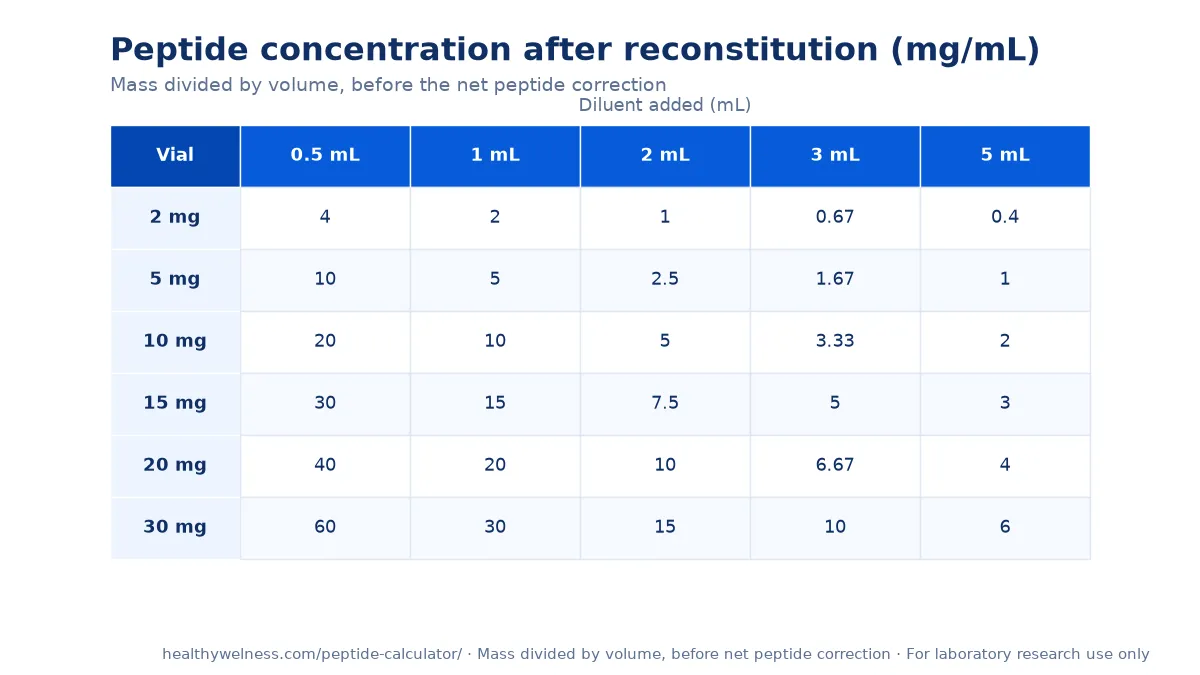
Concentration table for 5 mg and 10 mg vials
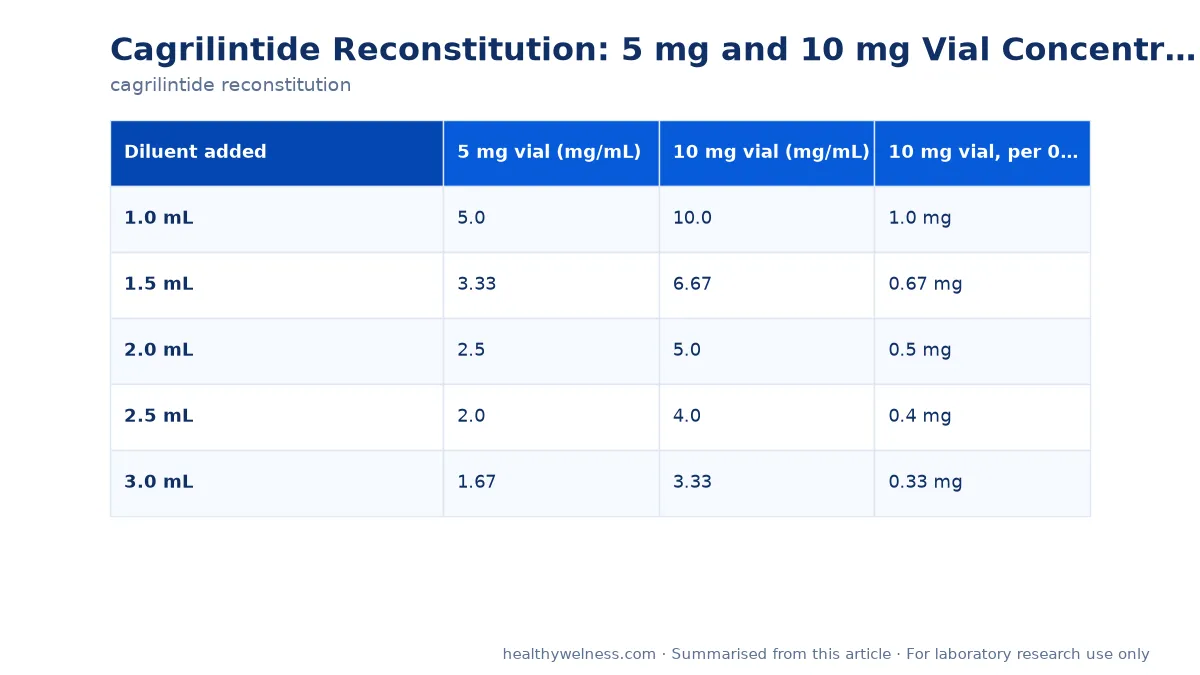
The arithmetic is mass divided by volume. The table uses label mass; correct it with the certificate’s net peptide content as described below.
| Diluent added | 5 mg vial (mg/mL) | 10 mg vial (mg/mL) | 10 mg vial, per 0.1 mL |
|---|---|---|---|
| 1.0 mL | 5.0 | 10.0 | 1.0 mg |
| 1.5 mL | 3.33 | 6.67 | 0.67 mg |
| 2.0 mL | 2.5 | 5.0 | 0.5 mg |
| 2.5 mL | 2.0 | 4.0 | 0.4 mg |
| 3.0 mL | 1.67 | 3.33 | 0.33 mg |
Choosing a volume is a trade-off. Smaller volumes give higher concentrations, which make later dilutions easier to prepare accurately but leave less room for error in drawing the diluent. Volumes that give round numbers, such as 2.0 mL for a 10 mg vial, reduce arithmetic mistakes. The peptide calculator handles any combination.
Why amylin analogues deserve extra care
Native human amylin is one of the most aggregation-prone peptides known. Kruse and colleagues opened their account of cagrilintide’s development by noting that amylin’s high propensity to form amyloid fibrils makes drug design challenging. The first commercial analogue, pramlintide, solved that partly but needed three daily administrations because of its short half-life. Cagrilintide was the outcome of structure-activity work aimed at a stable, lipidated, long-acting analogue (Kruse et al., 2021). Bailey and colleagues described pramlintide as based on the structure of non-aggregating rat amylin, and the second generation of analogues as designed with a better understanding of amylin structure-function and of amylin-calcitonin receptor complexes (Bailey et al., 2026).
Cagrilintide’s engineering addresses aggregation in its formulated state. In a laboratory, the same general rules that protect any aggregation-prone peptide still apply: avoid vigorous shaking, avoid foam, avoid repeated warming and cooling, and inspect for haze or particles. A peptide that has started to aggregate may still dissolve visibly but behave differently in assays.
Step-by-step
| Step | Action | Reason |
|---|---|---|
| 1 | Equilibrate the vial to room temperature | Prevents condensation |
| 2 | Record lot, label mass and net content | Needed for correction |
| 3 | Measure diluent volume precisely | Sets the concentration |
| 4 | Add slowly down the inside wall | Avoids foaming on the cake |
| 5 | Swirl or roll gently; do not shake | Limits aggregation risk |
| 6 | Inspect for clarity | Haze suggests aggregation |
| 7 | Label with concentration and date | Traceability |
| 8 | Refrigerate, protected from light | Slows degradation |
General technique is in how to reconstitute peptides, and diluent choice in bacteriostatic water for peptides.
Correcting for net peptide content
The label mass of a lyophilised peptide includes counter-ions and residual moisture as well as peptide. If the certificate reports net peptide content as a percentage, multiply the label-based concentration by that fraction. For example, if a 10 mg vial reconstituted with 2.0 mL is reported at 85% net content, the corrected concentration is 5.0 × 0.85 = 4.25 mg/mL. That figure is illustrative; use the number on your lot’s certificate. Counter-ions are explained in peptide counterions: TFA vs acetate.
What about mixing cagrilintide with retatrutide?
This question appears often because combination products are discussed widely. The research answer has two parts.
First, there is now a published animal study of the two compounds given together. Petersen and colleagues treated diet-induced obese male rats with daily co-administration of retatrutide and cagrilintide. The combination produced dose-dependent reductions in body weight and food intake that exceeded equimolar monotherapies and comparator combinations using semaglutide or tirzepatide, and improved cholesterol, triglycerides and insulin. Pair-feeding and weight-matching experiments indicated the effect was not explained by reduced food intake alone (Petersen et al., 2026). That is a rodent pharmacology finding about co-administration.
Second, that study did not report on the stability of the two peptides combined in one solution, and a search of PubMed on 2026-11-04 found no study that did. The only mixed-formulation data for cagrilintide come from the manufacturer’s co-formulation with semaglutide, which was developed and tested as a specific product (Bailey et al., 2026). Those data do not transfer to a different partner peptide, at a different ratio, in a different diluent.
| Question | Status |
|---|---|
| Co-administration studied in animals? | Yes, obese rats (2026) |
| Co-administration studied in people? | Not found |
| Stability of a mixed solution reported? | Not found |
| Recommended lab practice | Separate vials |
For laboratory work, reconstitute each compound in its own vial, verify each analytically, and combine only in the final working solution if an experimental design requires it. Retatrutide handling is covered in how to reconstitute retatrutide, and cagrilintide’s partner peptides in cagrilintide with incretin peptides.
Clinical background, briefly
Cagrilintide’s human data come from trials run under medical supervision. A phase 2 dose-finding trial randomized adults with overweight or obesity at 57 sites in ten countries to once-weekly cagrilintide, daily liraglutide or placebo (Lau et al., 2021). A phase 1b trial examined multiple ascending levels of cagrilintide co-escalated with semaglutide over 16 weeks in otherwise healthy adults (Enebo et al., 2021). Pharmacokinetic studies found no effect of renal or hepatic impairment on exposure after a single administration (Nielsen et al., 2026). These are reported to describe the compound’s research status; they say nothing about laboratory material. The research overview is in cagrilintide research review.
Storage after reconstitution
Keep the solution refrigerated, protected from light and tightly closed. For longer storage, divide into single-use aliquots and freeze them, which avoids repeated freeze-thaw cycles. Discard any solution that becomes cloudy or shows particles. Storage principles are in reconstituted peptide storage.
Material from the cagrilintide research peptide listing is supplied lyophilised for laboratory research only. Certificates are available for listed products — contact us for the latest report.
Frequently asked questions
What concentration does a 10 mg cagrilintide vial give with 2 mL?
Adding 2.0 mL to a 10 mg vial gives 5.0 mg/mL, or 0.5 mg in each 0.1 mL of solution, before correction for net peptide content. A 5 mg vial with 2.0 mL gives 2.5 mg/mL.
Why handle cagrilintide more gently than some peptides?
Native amylin has a high propensity to form amyloid fibrils, which made it a difficult starting point for drug design (Kruse et al., 2021). Cagrilintide was engineered to be stable, but avoiding shaking, foaming and repeated temperature cycling is still good practice with any amylin analogue.
Can cagrilintide be mixed with retatrutide in one vial?
No published stability data support it. A 2026 rat study co-administered the two and reported larger reductions in body weight and food intake than either alone (Petersen et al., 2026), but it did not report stability of a mixed solution. For laboratory work, keep them in separate vials.
Does cagrilintide need a special diluent?
No special diluent is described in the sources reviewed here. Sterile water or bacteriostatic water are the usual laboratory choices for lyophilised peptides. Whatever is used should be recorded on the vial label alongside the volume and calculated concentration.
Is cagrilintide approved?
Not in the sources reviewed here. It is in clinical development alone and in a fixed combination with semaglutide called CagriSema (Nielsen et al., 2026).
Which receptors does cagrilintide act on?
Cagrilintide is a dual amylin receptor and calcitonin receptor agonist (Bailey et al., 2026). Amylin receptors are heterodimers of the calcitonin receptor with accessory proteins.
For laboratory research use only. The research materials supplied by HealthyWelness are not approved medicines, foods or cosmetics and are not for human or veterinary use. This article summarises published research and is not medical advice.
Sources
- Kruse T, et al. Development of Cagrilintide, a Long-Acting Amylin Analogue. J Med Chem. 2021. PMID: 34288673
- Bailey CJ, et al. Long-acting amylin-related peptides as therapies for obesity and type 2 diabetes. Peptides. 2026. PMID: 41747885
- Lau DCW, et al. Once-weekly cagrilintide for weight management in people with overweight and obesity: a multicentre, randomised, double-blind, placebo-controlled and active-controlled, dose-finding phase 2 trial. Lancet. 2021. PMID: 34798060
- Enebo LB, et al. Safety, tolerability, pharmacokinetics, and pharmacodynamics of concomitant administration of multiple doses of cagrilintide with semaglutide 2·4 mg for weight management: a randomised, controlled, phase 1b trial. Lancet. 2021. PMID: 33894838
- Petersen J, et al. Cagrilintide and retatrutide combination therapy enhances weight loss and metabolic outcomes in obese male rats. Nat Metab. 2026. PMID: 42744908
- Nielsen MJF, et al. Renal or Hepatic Impairment Does Not Affect Pharmacokinetics, Safety, or Tolerability of Subcutaneous Cagrilintide. Clin Pharmacokinet. 2026. PMID: 42228334