How to Reconstitute 600 mg Glutathione for Lab Use
Reconstituting a 600 mg glutathione vial: volume and concentration table, why reduced GSH oxidises in solution, and handling that slows conversion to GSSG.

Cover illustration: AI-generated editorial artwork. Conceptual only; not an exact molecular structure, actual laboratory result or evidence of clinical effects.
A 600 mg glutathione vial is reconstituted by adding a measured volume of aqueous diluent, swirling until clear, and using the solution promptly or freezing it in portions, because reduced glutathione oxidises in solution. With 6 mL the concentration is 100 mg/mL; the table below gives other volumes.
For laboratory research use only. The research materials supplied by HealthyWelness are not approved medicines, foods or cosmetics and are not for human or veterinary use. This article summarises published research and is not medical advice.
- A 600 mg glutathione vial reconstituted with 6 mL of diluent gives 100 mg/mL, or 10 mg per 0.1 mL, when 600 mg is the net content.
- Reduced glutathione (GSH) is described as extremely vulnerable to oxidation in solution form, which limits its use in aqueous formulations (Khan et al., 2018).
- GSH in phosphate-buffered saline was susceptible to oxidation over time in longitudinal in vitro magnetic resonance spectroscopy monitoring (Arora et al., 2024).
- Oxidised glutathione (GSSG) has been used in parenteral nutrition because it is more stable than GSH, yet about 30% loss was still observed in that mixture (Raichani et al., 2022).
- Cysteine accounted for about 20% loss of GSSG over 24 hours, and with multivitamins the loss exceeded 70% (Raichani et al., 2022).
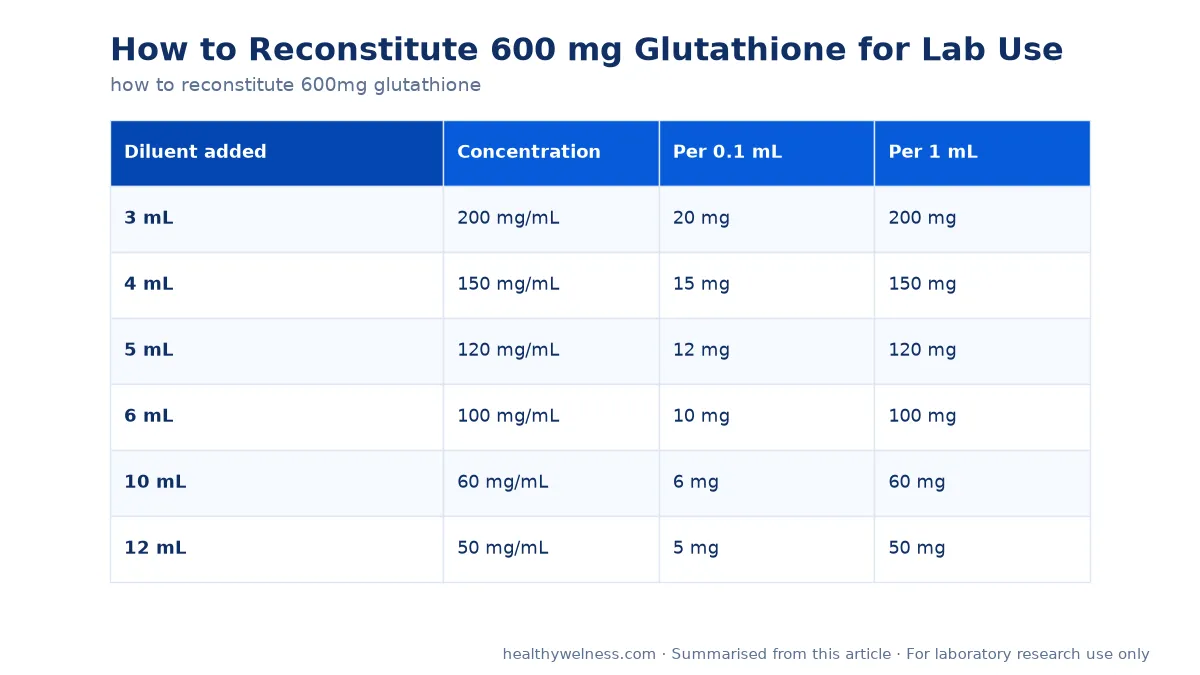
Volume and concentration for a 600 mg vial
| Diluent added | Concentration | Per 0.1 mL | Per 1 mL |
|---|---|---|---|
| 3 mL | 200 mg/mL | 20 mg | 200 mg |
| 4 mL | 150 mg/mL | 15 mg | 150 mg |
| 5 mL | 120 mg/mL | 12 mg | 120 mg |
| 6 mL | 100 mg/mL | 10 mg | 100 mg |
| 10 mL | 60 mg/mL | 6 mg | 60 mg |
| 12 mL | 50 mg/mL | 5 mg | 50 mg |
These are straight divisions of net content by volume. Two adjustments are common. The vial may state the gross weight of powder rather than an assay value for glutathione, and the volume of a solution at 200 mg/mL is noticeably larger than the volume of diluent added, because the solute itself occupies space. At the high end of the table, measuring final volume rather than added volume gives the more accurate figure. The peptide calculator handles the first adjustment; the second needs a graduated vessel.
Why glutathione is different from a typical research peptide
Glutathione is the tripeptide γ-glutamyl-cysteinyl-glycine. It is small, very soluble and, unlike most peptides sold for research, its biological role is chemical: the cysteine thiol donates electrons, and two GSH molecules join through a disulfide bond to form GSSG. That is what makes it an antioxidant, and it is exactly what makes it unstable in a vial.
| Form | Thiol state | Solution behaviour | Source |
|---|---|---|---|
| GSH (reduced) | Free thiol | Oxidises over time | Arora 2024 |
| GSSG (oxidised) | Disulfide | More stable, still lost | Raichani 2022 |
| GSH in oil droplets | Free thiol, shielded | Stable 90 days | Khan 2018 |
The third row is a formulation experiment rather than a handling method, but it illustrates the point. Khan and colleagues encapsulated GSH in oil droplets of a nanoemulsion precisely because aqueous GSH oxidises, and found the encapsulated preparation thermodynamically stable over 90 days across storage conditions (Khan et al., 2018). Keeping GSH away from water and oxygen is what kept it reduced.
What the certificate should tell you
Glutathione is supplied as reduced GSH in most cases, but the form should be confirmed on the documentation, because GSH and GSSG have different molar masses and different chemistry. Our glutathione research material is listed for laboratory use; the relevant information is the form, the assay value and the batch. More on reading those documents is in glutathione powder.
Step by step
| Step | Action | Reason |
|---|---|---|
| 1 | Equilibrate the sealed vial | No condensation on powder |
| 2 | Choose volume from the table | Fix the target concentration |
| 3 | Use deoxygenated diluent if possible | Less dissolved oxygen |
| 4 | Add diluent down the wall | Gentle wetting |
| 5 | Swirl until clear | Avoid foaming |
| 6 | Check pH | Unbuffered GSH is acidic |
| 7 | Portion and freeze, or use | Limits oxidation window |
Notes on steps 3, 5 and 6
Deoxygenation. Sparging the diluent with nitrogen or argon for a few minutes reduces dissolved oxygen, the main oxidant in a clean solution. It is optional for material used within the hour and worthwhile for anything kept longer.
Foaming. Glutathione dissolves quickly, so there is no reason to shake it. Shaking entrains air, and reconstitution of lyophilised solids already releases nanobubbles that persist in suspension for weeks (Snell et al., 2020). For a thiol, more gas interface means more exposure to oxygen.
pH. Glutathione carries carboxylic acid groups, and an unbuffered solution at high concentration is acidic. Thiol oxidation generally accelerates as pH rises, because the thiolate form is the reactive species, so an acidic stock is somewhat protective. Adjusting pH upward for an assay is best done at the point of use rather than in the stock.
What accelerates loss
The most detailed stability data come from clinical nutrition, where glutathione was added to parenteral nutrition mixtures. Raichani and colleagues incubated GSSG with dextrose, multivitamins, amino acid solutions, cysteine, cystine and peroxides over 24 hours and measured total glutathione (Raichani et al., 2022).
| Mixture component | Effect on GSSG |
|---|---|
| Multivitamins alone | No effect on stability |
| Cysteine | About 20% loss |
| Cysteine plus multivitamins | Above 70% loss |
| Cysteine removed | Degradation prevented |
The lesson for a laboratory is that other thiols and redox-active additives in a buffer can drive thiol-disulfide exchange. Glutathione stocks should be prepared in plain diluent and combined with other components only when the experiment requires it.
How long a reconstituted vial lasts
No single shelf life can be given, because the rate depends on oxygen, temperature, pH, trace metals and what else is in the solution. What the literature supports is a direction: aqueous GSH oxidises over time (Arora et al., 2024), and conversion is slowed by cold, low oxygen and the absence of reactive additives. A reasonable working rule is to make the solution close to use, keep it cold while in use, and freeze single-use portions of anything that will not be used promptly. Freeze once; repeated freeze-thaw cycles add oxygen exposure at each opening.
If an experiment depends on the GSH/GSSG ratio, measure it at the start and end rather than assuming it. Reagents that react with free thiols give a quick estimate; HPLC separates the two forms.
Recording the time from reconstitution to use, alongside the result, makes it possible to see later whether stock age is contributing to variability between runs.
Diluent choice
- Sterile water is the simplest choice and introduces nothing that reacts with thiols.
- Bacteriostatic water suits a vial accessed repeatedly; benzyl alcohol is not known to react with glutathione, but repeated access also means repeated oxygen exposure. See bacteriostatic water for peptides.
- Phosphate buffer raises pH toward neutral, which is convenient for cell work but is also the condition under which GSH oxidation was observed in vitro (Arora et al., 2024).
Related research
For the molecule itself see the glutathione overview. Its relationship with other redox compounds is covered in NAD+ and glutathione, and the frequently confused amino acid in glutamine versus glutathione. General storage rules for dry powders are in lyophilised peptide storage.
Frequently asked questions
What concentration does 600 mg of glutathione give in 6 mL?
100 mg/mL, which is 10 mg in every 0.1 mL, assuming 600 mg is the net content of glutathione in the vial. If the documentation gives a lower assay figure, the concentration falls in proportion.
Why does reduced glutathione not keep well in solution?
Its cysteine thiol oxidises. Reduced glutathione (GSH) has been described as extremely vulnerable to oxidation in solution form (Khan et al., 2018), and in vitro monitoring found GSH in phosphate-buffered saline susceptible to oxidation over time (Arora et al., 2024).
Is oxidised glutathione more stable?
In some settings, yes. Oxidised glutathione (GSSG) was chosen over GSH as a parenteral nutrition additive because of its better stability, although about 30% of GSSG was still lost in that mixture, mainly through reaction with cysteine (Raichani et al., 2022).
Which other components accelerate glutathione loss?
In the parenteral nutrition study, cysteine alone accounted for about 20% loss of GSSG over 24 hours, and cysteine together with multivitamins raised the loss above 70%; removing cysteine prevented the degradation (Raichani et al., 2022).
How do you know whether the glutathione is still reduced?
By measuring it. A thiol assay such as Ellman’s reagent reports free thiol, and HPLC can separate GSH from GSSG. Clarity and colour do not change when GSH oxidises, so visual inspection cannot detect it.
For laboratory research use only. The research materials supplied by HealthyWelness are not approved medicines, foods or cosmetics and are not for human or veterinary use. This article summarises published research and is not medical advice.
Sources
- Khan NU, et al. Stability Studies and Characterization of Glutathione-Loaded Nanoemulsion. J Cosmet Sci. 2018. PMID: 30311901
- Arora Y, et al. Longitudinal Monitoring of Glutathione Stability in Different Microenvironments. Neurochem Res. 2024. PMID: 39546088
- Raichani NE, et al. Stability of glutathione added as a supplement to parenteral nutrition. JPEN J Parenter Enteral Nutr. 2022. PMID: 34669977
- Snell JR, et al. Nanobubbles in Reconstituted Lyophilized Formulations: Interaction With Proteins and Mechanism of Formation. J Pharm Sci. 2020. PMID: 31095959