Glutathione Powder: Reading the Specification
What a glutathione powder specification states, why reduced and oxidised forms are different numbers, and what purity alone does not tell you.

Cover illustration: AI-generated editorial artwork. Conceptual only; not an exact molecular structure, actual laboratory result or evidence of clinical effects.
A glutathione powder specification has to say which form the material is — reduced or oxidised — before any purity figure on it means anything. The two forms are different compounds with different masses, and an assay that does not separate them reports a combined number.
For laboratory research use only. The research materials supplied by HealthyWelness are not approved medicines, foods or cosmetics and are not for human or veterinary use. This article summarises published research and is not medical advice.
- Reduced glutathione (GSH) is the tripeptide γ-L-glutamyl-L-cysteinylglycine, with a free cysteine thiol.
- Oxidised glutathione (GSSG) is two of those molecules joined by a disulfide, with roughly twice the mass and no free thiol.
- Both forms are white to off-white solids, so appearance does not distinguish them.
- GSSG is a product in its own right and is manufactured deliberately, including by engineered fermentation routes (Kiriyama et al., 2013).
- Chromatographic purity and net content are different measurements: the first reports the proportion of detected material, the second accounts for counterion and water.
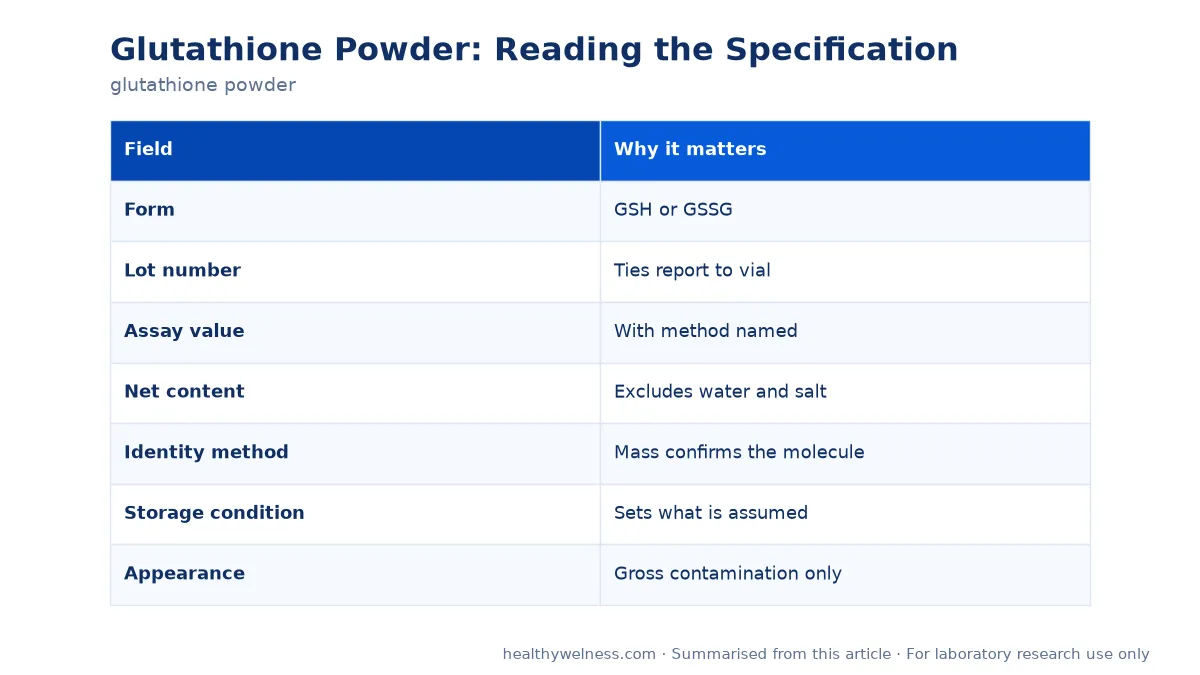
What the specification should state
| Field | Why it matters |
|---|---|
| Form | GSH or GSSG |
| Lot number | Ties report to vial |
| Assay value | With method named |
| Net content | Excludes water and salt |
| Identity method | Mass confirms the molecule |
| Storage condition | Sets what is assumed |
| Appearance | Gross contamination only |
Certificates are available for listed products — contact us for the latest report. The specification for our glutathione research material is stated on that product’s own documentation rather than inferred from the compound name.
Why the form has to be stated first
Glutathione exists as a redox couple, and the two members of that couple are not interchangeable materials.
The reduced form carries a single free cysteine thiol, and essentially all of the chemistry that glutathione is studied for runs through it — radical handling, conjugation reactions, and the wider set of roles reviewed across tissue types (Averill-Bates, 2023; Cooper et al., 1997). The oxidised form has that thiol tied up in a disulfide bond between two molecules.
So a vial of GSSG is not a less pure vial of GSH. It is a different compound, with its own molar mass, its own molarity for a given weight, and no free thiol. It is also manufactured deliberately for its own uses, including by fermentation with engineered yeast (Kiriyama et al., 2013), which is worth knowing because it means its presence in a catalogue is not a sign of degradation.
The ratio is the measurement, and handling changes it
Where both forms are present, the GSH/GSSG ratio is usually the number an experiment cares about. That creates a trap: the ratio responds to handling. Work on stored human platelet concentrates documented alterations in glutathione over storage (Burch et al., 1987) — a reminder that in a biological matrix this is a quantity that moves, and that the storage interval is part of the result.
The same logic applies to a supplied solid. A powder assayed at manufacture and a powder opened repeatedly over months need not have the same composition, and nothing about that change is visible.
What a purity figure does and does not cover
| Number | Covers | Excludes |
|---|---|---|
| Chromatographic purity | Detected peaks | Water, counterion |
| Net content | Actual compound | Nothing relevant |
| Identity by mass | Which molecule | How much |
| Appearance | Gross defects | Everything fine |
A chromatographic purity value answers one question: of the material the detector saw, what proportion was the target peak. Water and counterion do not produce peaks, so they are outside that figure entirely. Two vials can both report high chromatographic purity and still contain measurably different amounts of compound per milligram.
Net content is the figure that resolves this, and it is the one to put into a concentration calculation. The peptide calculator handles the conversion once that number is in hand; the common error is not the arithmetic but using label weight in place of net content.
Identity by mass is not optional here
Because GSH and GSSG differ by roughly a factor of two in mass, a mass spectrometry result distinguishes them unambiguously where a purity percentage cannot. If a report gives only a purity figure, the form is being asserted rather than demonstrated. Asking whether the deconvoluted mass is stated is a reasonable question to put to any supplier’s documentation, including ours.
Questions worth putting to any report
These apply to documentation from any supplier, ours included. None of them requires analytical equipment to ask.
| Ask | What a weak answer looks like |
|---|---|
| Which form is this? | Silence, or “glutathione” |
| What method gave the assay? | A number with no method |
| Is net content stated? | Only a purity percentage |
| Does the lot match the vial? | No lot on the report |
| Is the mass deconvoluted? | A raw spectrum image |
| Who performed the test? | Unattributed |
The last row is worth dwelling on. A report naming the laboratory that performed the analysis is stronger evidence than an unattributed in-house result, because it can be followed up. That is a statement about how to read documentation, not a claim about what any particular report contains.
Why “pure glutathione” is not a specification
The phrase appears often in catalogue copy and settles nothing. It does not say which form, it does not name a method, and it does not distinguish chromatographic purity from net content. Two materials both honestly described that way can differ in molar content per milligram by a wide margin, and an experiment using them interchangeably will see that difference as an unexplained result rather than as what it is.
Handling in the lab
- Record the form from the documentation before anything else; everything downstream depends on it.
- Limit vial entries and headspace. Each opening gives a free thiol access to oxygen, and that is the one variable the handler controls.
- Prepare working solutions close to the time of use rather than holding dilute aqueous stocks, which is where the composition shifts fastest.
- Date every vial and every prepared solution. A ratio measurement without a known age is not interpretable.
- Treat an unexplained assay drift as a handling question before a material question; the handling is usually the variable that changed.
Related research
For the compound itself see what glutathione is, and for how it relates to a commonly confused amino acid glutamine versus glutathione. The connection to the nicotinamide nucleotides is in NAD+ and glutathione and NAD+ versus NADPH.
One further point about appearance deserves stating plainly, because it is the inspection most people actually perform. A cake that has collapsed, discoloured or absorbed moisture tells you something went wrong; an intact white cake tells you only that nothing went visibly wrong. The absence of a visible defect is not a result.
Open questions
Published stability data for lyophilized glutathione as a supplied research solid is thin. As of 2026-11-07, PubMed searches combining “glutathione” with “lyophilized stability”, “powder stability” and “solid state oxidation” returned no study characterising oxidation of the dry solid over a defined storage interval. The storage conditions stated on a specification are therefore a manufacturer’s condition rather than a reference to a published shelf-life study, and this absence describes the searches run rather than proving no such data exists.
Frequently asked questions
What should a glutathione powder specification state?
At minimum: which form the material is, reduced (GSH) or oxidised (GSSG); an assay value with the method named; and the lot number. A purity percentage without a stated method and without the form identified does not say what was measured.
Is reduced glutathione the same material as oxidised glutathione?
No. GSSG is two glutathione molecules joined by a disulfide bond, with roughly twice the mass of GSH and no free thiol. They are distinct compounds and an assay that does not distinguish them is reporting a combined figure.
Why does the appearance of the powder tell you so little?
Both forms are white to off-white solids, and the oxidation that converts one to the other produces no visible change at the levels that matter analytically. A visual inspection can detect gross contamination and nothing finer.
Does chromatographic purity account for the counterion and water?
No. A chromatographic purity figure reports the proportion of detected material that is the target peak. Counterion, residual solvent and water are not peaks in that trace, which is why net content is reported separately.
How should a prepared solution be treated differently from the powder?
As the less stable form. A free thiol in aqueous solution has oxygen available to it in a way a dry solid does not, so a solution’s composition can shift while a correctly stored powder’s does not.
For laboratory research use only. The research materials supplied by HealthyWelness are not approved medicines, foods or cosmetics and are not for human or veterinary use. This article summarises published research and is not medical advice.
Sources
- Averill-Bates DA. The antioxidant glutathione. Vitam Horm. 2023. PMID: 36707132
- Cooper AJ, et al. Multiple roles of glutathione in the central nervous system. Biol Chem. 1997. PMID: 9377474
- Kiriyama K, et al. Oxidized glutathione fermentation using Saccharomyces cerevisiae engineered for glutathione metabolism. Appl Microbiol Biotechnol. 2013. PMID: 23820559
- Burch PT, et al. Alterations in glutathione during storage of human platelet concentrates. Transfusion. 1987. PMID: 3603664