Ipamorelin Reconstitution: Steps and Concentration Table
How to reconstitute ipamorelin 5 mg and 10 mg vials for lab work: diluent choice, step sequence, solution concentrations and what limits stability.

Cover illustration: AI-generated editorial artwork. Conceptual only; not an exact molecular structure, actual laboratory result or evidence of clinical effects.
Ipamorelin is reconstituted by adding a measured volume of the documented diluent down the vial wall, swirling until clear, and calculating concentration from net peptide content. A 5 mg vial in 2 mL gives 2.5 mg/mL; the figures below cover common vial sizes and volumes.
For laboratory research use only. The research materials supplied by HealthyWelness are not approved medicines, foods or cosmetics and are not for human or veterinary use. This article summarises published research and is not medical advice.
- Ipamorelin is the pentapeptide Aib-His-D-2-Nal-D-Phe-Lys-NH2, with a C-terminal amide and two D-amino acids (Raun et al., 1998).
- A 5 mg ipamorelin vial reconstituted with 2 mL of diluent gives 2.5 mg/mL, or 0.25 mg per 0.1 mL, when 5 mg is the net peptide content.
- Reconstituted lyophilised teriparatide precipitated within two to four weeks under some conditions, while never-lyophilised solutions stayed clear for twelve weeks (Merutka et al., 2016).
- Lyophilised secretin stored at 25 °C and 60% relative humidity showed growing particulates and longer reconstitution times over eight weeks (Srinivasan et al., 2015).
- In rats, 60–80% of administered ipamorelin and related secretagogues was recovered intact in bile and urine, indicating moderate resistance to metabolism (Johansen et al., 1998).
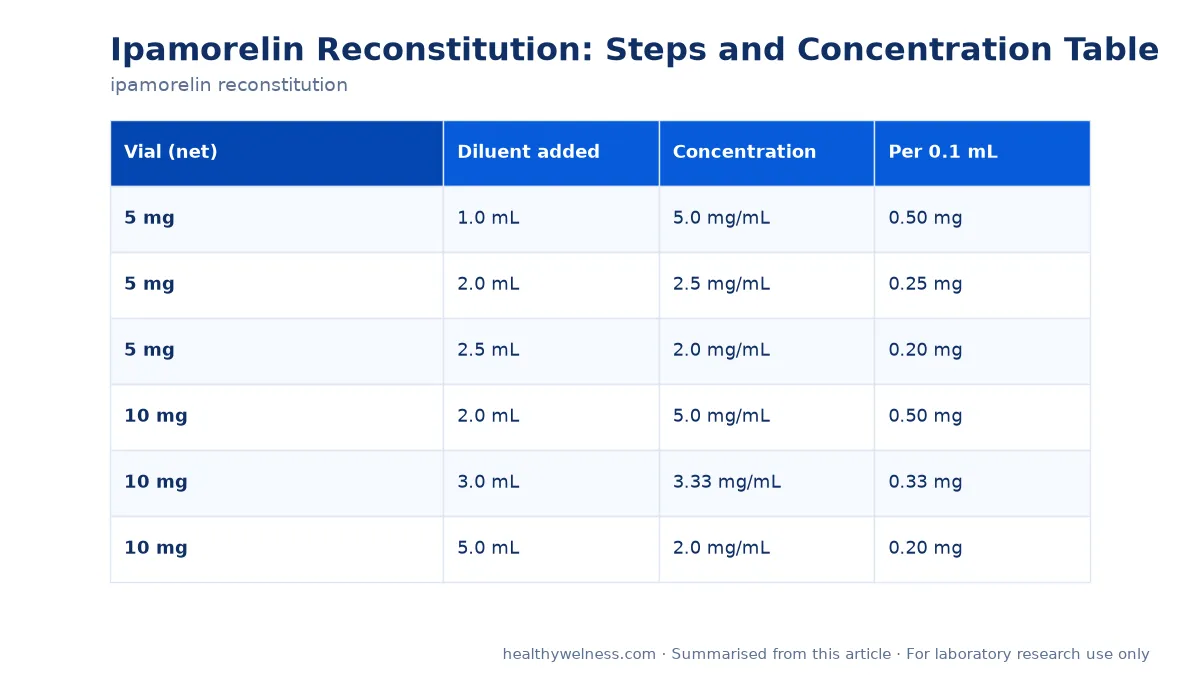
Solution concentrations by vial and volume
| Vial (net) | Diluent added | Concentration | Per 0.1 mL |
|---|---|---|---|
| 5 mg | 1.0 mL | 5.0 mg/mL | 0.50 mg |
| 5 mg | 2.0 mL | 2.5 mg/mL | 0.25 mg |
| 5 mg | 2.5 mL | 2.0 mg/mL | 0.20 mg |
| 10 mg | 2.0 mL | 5.0 mg/mL | 0.50 mg |
| 10 mg | 3.0 mL | 3.33 mg/mL | 0.33 mg |
| 10 mg | 5.0 mL | 2.0 mg/mL | 0.20 mg |
Every value is net peptide divided by total volume. The label weight on a vial is often the gross weight of the lyophilised cake, which includes counter-ion and residual water. If the certificate gives a net peptide content of, say, 85%, a “5 mg” vial holds about 4.25 mg of peptide and every concentration in the table falls by the same proportion. The peptide calculator takes net content as an input for this reason.
Step sequence
| Step | Action | Why |
|---|---|---|
| 1 | Bring sealed vial to room temperature | Prevents condensation on the cake |
| 2 | Read net content on the certificate | Concentration depends on it |
| 3 | Wipe septum, add diluent down the wall | Avoids jetting onto the cake |
| 4 | Swirl or roll, do not shake | Limits interface stress |
| 5 | Inspect against light and dark | Haze or particles mean stop |
| 6 | Label with date and concentration | Traceability |
| 7 | Aliquot if storing frozen | Avoids repeat freeze-thaw cycles |
Why step 4 is not a formality
Snell and colleagues showed that reconstituting lyophilised disaccharide formulations releases nanosized air bubbles that persist in suspension for weeks. They traced the bubbles to nanoscale voids left by ice crystals in the dried matrix, and where protein was present, nanobubble levels correlated with insoluble aggregate (Snell et al., 2020). Shaking adds a large air-liquid interface on top of that. A small pentapeptide like ipamorelin is less prone to unfolding than a protein, but adsorption and particle seeding at interfaces are not limited to large molecules.
Choosing a diluent
Ipamorelin carries a basic lysine and histidine and dissolves readily in water. The choice of diluent therefore turns on use pattern rather than solubility.
- Bacteriostatic water (0.9% benzyl alcohol) suits a vial that will be sampled several times. The preservative limits microbial growth, not chemical degradation. See bacteriostatic water for peptides.
- Sterile water suits single-use preparation or assays where benzyl alcohol would interfere.
- Buffered saline or assay buffer is appropriate when the downstream assay requires it, but phosphate can precipitate with some counter-ions and should be checked first.
The general comparison is in bacteriostatic versus sterile water.
What limits the solution
There is little peptide-specific stability literature on ipamorelin solutions, so the guidance here draws on general peptide formulation work and should be treated as a starting point to verify, not a validated shelf life.
Two findings shape it. First, lyophilisation itself can change how a peptide behaves after reconstitution. Merutka and colleagues found that teriparatide, a 34-residue peptide, precipitated within weeks after reconstitution at some concentrations and temperatures, while never-dried solutions did not, and attributed this to freezing and drying stresses on higher-order structure (Merutka et al., 2016). Second, storage of the dry cake matters: lyophilised secretin held warm and humid showed falling HPLC content, growing particle size and slower reconstitution over eight weeks (Srinivasan et al., 2015).
| Factor | Effect | Practical response |
|---|---|---|
| Higher concentration | More aggregation risk | Do not over-concentrate |
| Higher temperature | Faster degradation | Refrigerate in use |
| Humid dry storage | Particles, slow dissolution | Keep cake sealed and cold |
| Repeated thawing | Interface and ice stress | Single-use aliquots |
Structural features that help
Ipamorelin’s design includes features that resist enzymatic attack: the non-natural Aib at position one, two D-amino acids and a C-terminal amide (Raun et al., 1998). In rats most of an administered amount was recovered intact (Johansen et al., 1998). These features protect against proteases; they do not protect against oxidation, adsorption or microbial contamination in a vial.
Diluting a working solution
Assays rarely use the reconstitution concentration directly. A stock is usually prepared at a convenient strength and diluted into assay buffer immediately before use. The arithmetic is the same C1V1 = C2V2 relationship throughout, but it helps to lay out a worked example, because errors usually enter at the second step rather than the first.
| Stage | Starting point | Operation | Result |
|---|---|---|---|
| Stock | 5 mg net in vial | Add 2.0 mL | 2.5 mg/mL |
| Intermediate | 0.1 mL of stock | Add 0.9 mL buffer | 0.25 mg/mL |
| Working | 0.1 mL intermediate | Add 0.9 mL buffer | 25 µg/mL |
| Molar check | 25 µg/mL | Divide by molar mass | Read from certificate |
The molar step is deliberately left open. Ipamorelin’s molar mass depends on whether the figure refers to the free base or a salt form, and the correct number is the one on the material’s own documentation. Pharmacology papers often report ipamorelin activity in molar units, for example an in vitro EC50 of 1.3 nmol/L (Raun et al., 1998), so a working solution prepared in mass units has to be converted before results can be compared with them.
Dilute solutions have a different problem from concentrated ones: a larger fraction of the peptide is lost to adsorption on tube and tip surfaces. Low-binding plastics and preparing the most dilute step last reduce that loss.
Half-life is not shelf life
A frequent confusion is to read ipamorelin’s 2-hour terminal half-life in volunteers (Gobburu et al., 1999) as a statement about the solution. It is a measure of clearance from circulation. A solution kept cold and clean can remain usable for far longer; a solution left warm can degrade in less time. The half-life calculator is for planning sampling around the circulating value, not for estimating vial life.
Related research
Material from our ipamorelin research peptide listing is supplied lyophilised. For storage once in solution, see ipamorelin stability and storage; for the general procedure applied to other peptides, how to reconstitute peptides; and for pharmacology, the ipamorelin overview.
Frequently asked questions
What concentration does a 5 mg ipamorelin vial give with 2 mL of diluent?
2.5 mg/mL, which is 0.25 mg in every 0.1 mL, assuming the 5 mg figure is the net peptide content. If the certificate states a lower net content, the real concentration is proportionally lower, so the calculation should start from that figure.
Which diluent is used for ipamorelin?
The diluent named on the product’s documentation should be used. Bacteriostatic water suits solutions that will be sampled repeatedly from one vial; sterile water suits single-use preparations. Ipamorelin is a charged pentapeptide and dissolves readily in aqueous diluent.
Should the vial be shaken to dissolve the powder?
No. Swirling or rolling is enough. Vigorous agitation creates air-liquid interface, and reconstituted lyophilised formulations already contain nanobubbles that can interact with proteins and promote particle formation (Snell et al., 2020).
Why can a reconstituted solution behave differently from a never-dried one?
Lyophilisation can perturb peptide structure. Reconstituted teriparatide formed precipitate within two to four weeks in some conditions, while equivalent never-lyophilised solutions stayed clear for twelve weeks (Merutka et al., 2016).
Does ipamorelin's 2-hour half-life tell you how long the solution lasts?
No. The 2-hour figure is a terminal half-life measured in volunteers (Gobburu et al., 1999). It describes clearance from circulation, not chemical stability in a vial, which depends on temperature, pH, diluent and handling.
For laboratory research use only. The research materials supplied by HealthyWelness are not approved medicines, foods or cosmetics and are not for human or veterinary use. This article summarises published research and is not medical advice.
Sources
- Raun K, et al. Ipamorelin, the first selective growth hormone secretagogue. Eur J Endocrinol. 1998. PMID: 9849822
- Gobburu JV, et al. Pharmacokinetic-pharmacodynamic modeling of ipamorelin, a growth hormone releasing peptide, in human volunteers. Pharm Res. 1999. PMID: 10496658
- Merutka G, et al. Stability of lyophilized teriparatide, PTH(1-34), after reconstitution. Eur J Pharm Biopharm. 2016. PMID: 26620825
- Snell JR, et al. Nanobubbles in Reconstituted Lyophilized Formulations: Interaction With Proteins and Mechanism of Formation. J Pharm Sci. 2020. PMID: 31095959
- Srinivasan C, et al. Stability characterization and appearance of particulates in a lyophilized formulation of a model peptide hormone-human secretin. Int J Pharm. 2015. PMID: 25636302
- Johansen PB, et al. Pharmacokinetic evaluation of ipamorelin and other peptidyl growth hormone secretagogues with emphasis on nasal absorption. Xenobiotica. 1998. PMID: 9879640