Peptide Container Integrity: What a Leak Test Establishes
Read peptide research container integrity tests through detection capability, package controls and temperature, separating leakage from initial sterility.
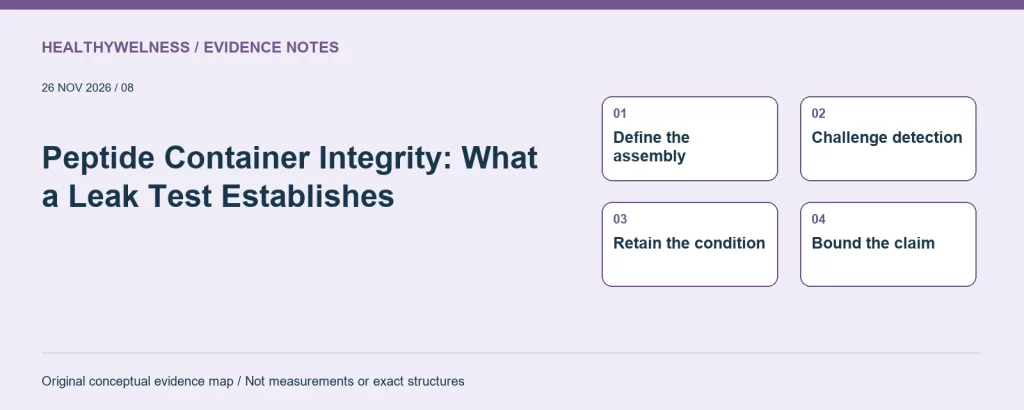
A leak-test pass means that the tested peptide container met a defined integrity criterion under the evaluated conditions; it does not establish initial sterility or chemical stability. Visual inspection, container-closure integrity testing and microbial testing examine different evidence. Interpreting a pass requires the assembled package, detection capability, controls, temperature and acceptance criterion.
For laboratory research use only. The compounds discussed are not approved for human or veterinary use and are not drugs, foods or cosmetics. This article summarises published research and is not medical advice.
- Container-closure integrity concerns the assembled container and seal, rather than the appearance of one component.
- FDA’s February 2008 guidance states that integrity testing cannot demonstrate a product’s initial sterility.
- A leak-test detection limit and a package’s acceptable leakage criterion are different quantities.
- A passing test at one temperature cannot automatically exclude a transient seal opening under another condition.
Start with the exact claim made by the package test
A sealed research vial arrives with an intact-looking crimp. An inspection record says pass. That observation is useful, but the word pass has no complete meaning without its test definition. A visual examination might identify a displaced stopper or damaged glass. An instrument might assess gas movement through the assembled package. A microbiological test might seek viable organisms in a sampled preparation. These observations should not be collapsed into one general quality certificate.
FDA’s final February 2008 guidance distinguishes initial product sterility from the ability of a package to maintain its barrier during storage. It discusses validated integrity tests as alternatives to sterility testing within specified sterile-product stability programs, while expressly excluding replacement of initial release sterility testing. That is a drug-development context, not a qualification of research catalog materials. [1]
| Observation | Question addressed | Unresolved question |
|---|---|---|
| Visual inspection | Visible condition | Small transport path |
| Integrity measurement | Barrier under test | Initial contamination |
| Microbial examination | Sampled viable organisms | Future package behavior |
| Chemical analysis | Material composition | Seal performance |
The distinction matters even when every observation is satisfactory. Four different questions can each have a supported answer, but one answer cannot silently supply the other three. A report should name its endpoint rather than using a broad assurance that leaves the reader to guess what was measured.
Separate the instrument signal from a leakage criterion
A detector has a capability under defined conditions. A research question has an acceptance criterion. The detector must be capable of resolving the relevant difference, and the criterion must have a justified relationship to the package and material. A very sensitive instrument does not choose that criterion automatically. Conversely, a generous criterion cannot improve a detector’s sensitivity.
Pfeiffer’s first-party technical page describes helium tracer-gas mass spectrometry and vacuum-based mass extraction as different physical measurements. It also notes that an integral integrity test need not locate the defect. These descriptions establish measurement principles; the vendor’s advertised performance is not adopted here as a validated limit for any peptide vial. [3]
A useful record therefore keeps four entries separate: the raw signal, the conversion or decision model, the demonstrated detection capability and the acceptance threshold. If a document supplies only a green pass icon, ask which of those entries is recoverable from its method attachment. A unit-free number cannot be compared to a leak-rate criterion expressed in pressure–volume per time.
Leak rate also needs test context. Gas identity, pressure difference and temperature belong to its interpretation. A nominal defect diameter is a geometric description, whereas an observed transport rate is a physical response under stated conditions. Identical diameter labels do not establish identical path length, shape or flow behavior. This is a reason to retain the actual control description rather than translating every finding into one universal hole size.
An invented control series shows why a pass can be uninformative
Original hypothetical example: imagine a research packaging study using an unnamed gas-flow method. Stipulate an acceptance threshold of 2 arbitrary flow units. This invented threshold has no regulatory or material-specific meaning. The study prepares intact negative controls and artificial-defect positive controls at 1, 2, 4 and 8 units. Known inputs are assigned solely for this teaching example.
| Control input | Flagged | Not flagged | Observed fraction |
|---|---|---|---|
| Intact negative | 0 | 10 | 0/10 flagged |
| 1 flow unit | 2 | 8 | 20% detected |
| 2 flow units | 5 | 5 | 50% detected |
| 4 flow units | 10 | 0 | 100% observed |
| 8 flow units | 10 | 0 | 100% observed |
The instrument is highly consistent at the two largest stipulated inputs. Nevertheless, at the acceptance boundary it misses half the artificial defects in this small example. Calling every unflagged study package acceptable would ignore the mismatch between the question and the demonstrated discrimination. The required conclusion is about method suitability, not about how impressive the largest control looks.
The arithmetic is simple: observed detection fraction equals detected packages divided by tested positive controls. Five divided by ten is 50%. These small fractions are descriptive, not precise population probabilities. Ten successes do not establish that future detection is certain. A complete validation would require a justified design and acceptance rules, not merely repetition of this invented table.
Now imagine that all controls were tested empty while study packages contained a liquid that could interfere with the selected measurement. The numerical detection fractions would still be calculated correctly, but their relevance would be unresolved. Controls need to challenge the actual decision, including the applicable package configuration. Correct arithmetic cannot repair an inappropriate control model.
Challenge the assembled system at the condition of interest
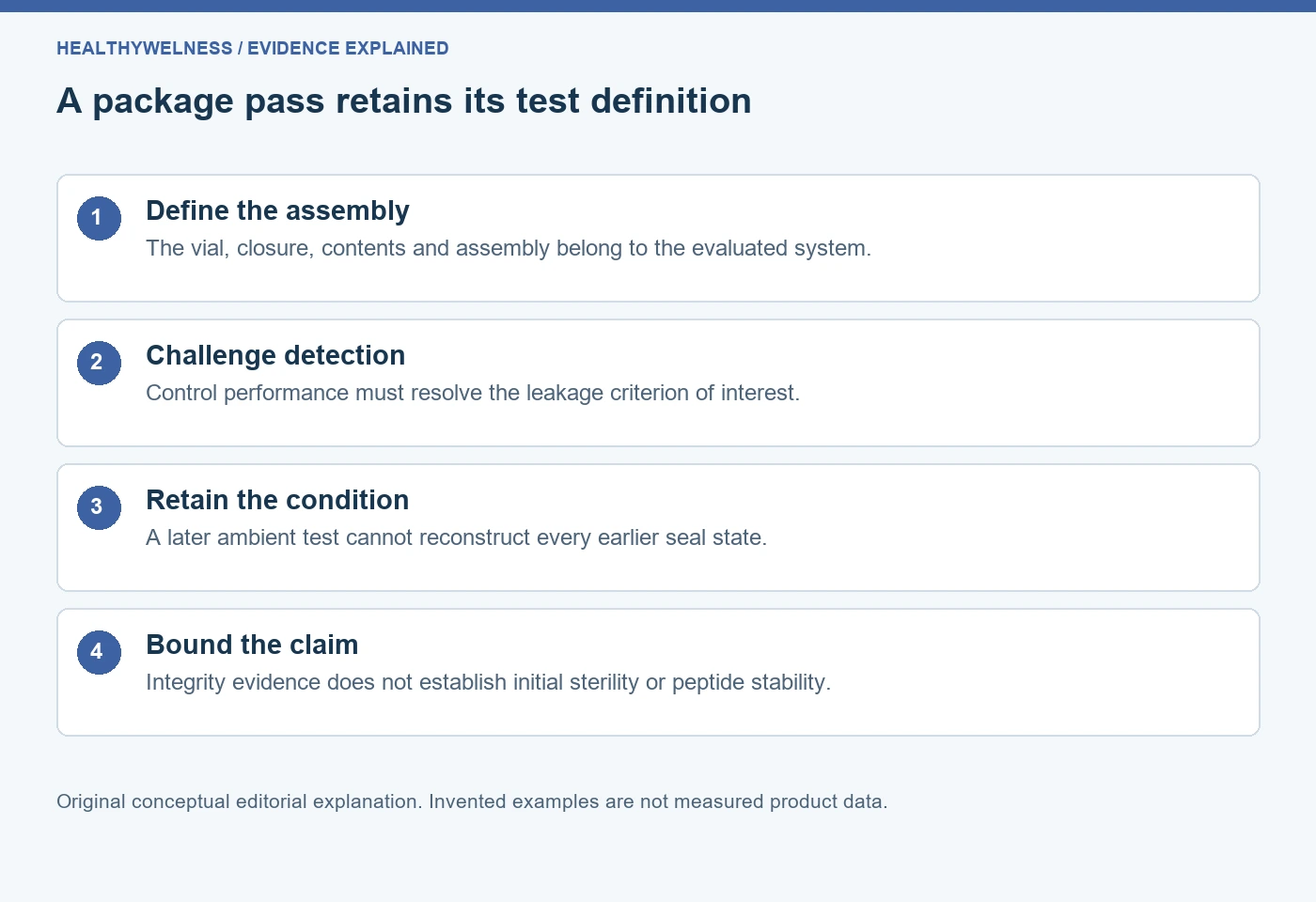
The tested object includes vial, stopper, assembly and contents where relevant to the method. A component specification can support material selection without proving how the completed seal behaves. A change in assembly or fill configuration can therefore create a new comparability question even when the component names remain familiar.
FDA’s August 2026 draft container-closure guidance discusses method suitability, sensitivity and positive and negative controls for the specific system. It also describes transient integrity loss at extreme storage conditions that may disappear when elastomers reseal on warming. The document is explicitly a draft, not for implementation; it supplies a current technical discussion rather than a binding rule for this research article. [2]
The practical inference is temporal. A measurement after return to ambient conditions is a measurement at that later stage. It cannot independently reconstruct every earlier seal state. Equally, a failure during an extreme challenge does not prove that the same pathway exists continuously during ordinary storage. Preserve the stage and condition instead of flattening them into a timeless pass or fail.
- Identify the complete package configuration and relevant contents.
- Record the actual test temperature and stage relative to any storage challenge.
- Describe positive-control defects and negative-control preparation.
- State the decision threshold and demonstrated sensitivity separately.
- Report whether testing changes or consumes the package.
Keep leakage separate from permeation and internal redistribution
A package can exchange material through more than one route. A leak pathway, transport through a packaging material and movement from an internal component into the cake are distinct hypotheses. A gas-flow integrity test is not automatically a water-content assay. Its outcome needs to be connected to the route that the experiment was designed to evaluate.
The existing stopper moisture transfer article examines internal water reservoirs and external moisture transport. This article instead asks whether a selected integrity measurement can support a particular barrier claim. The endotoxin versus sterility guide explains another separate evidence boundary: a microbial-related endpoint should retain its own definition.
Consider an unexplained increase in cake water accompanied by a passing integrity result. The two observations are not necessarily contradictory. The water finding may concern a mechanism outside the selected leak test’s claim. Alternatively, the integrity method may have inadequate sensitivity or may have sampled the wrong condition. Both are hypotheses to investigate; neither is established just by placing the two records side by side.
Likewise, a failed barrier test does not quantify peptide oxidation or identify a degradation product. A molecular assay would be needed for that question. A physical vulnerability can motivate investigation without supplying a chemical result that was never measured.
Write a conclusion that another laboratory can audit
A useful conclusion states that specified packages met a defined criterion using a named method at stated conditions, with applicable control performance. It also states which inference was excluded, such as initial sterility or molecular preservation. This wording may be longer than passed inspection, but it preserves the evidence needed to assess the claim.
A sampling statement is equally necessary. Results from a subset of packages describe the tested subset directly. Extending them to a larger population requires a defensible sampling and manufacturing framework. A nondestructive method may permit further work on the same package, but that feature does not remove the need to explain what was sampled.
The COA lookup is a route to available material documents. A chemical identity or purity document should not be read as an unlisted packaging validation. HealthyWelness reports no product-specific integrity experiment here. All control counts and thresholds in this article are invented reasoning examples, and no universal leakage limit or sterile designation is assigned.
Questions about peptide container integrity evidence
Does an intact-looking crimp establish a leak-tight package?
Appearance establishes what the visual examination could resolve. A small transport pathway requires a suitable integrity method and demonstrated detection capability.
Can a container integrity test establish initial sterility?
No. FDA’s 2008 guidance explicitly separates the initial sterility question from integrity testing used within a sterile-product stability program.
Is the smallest detectable leak the acceptance threshold?
No. Detection capability describes the method. An acceptance threshold needs a justified relationship to the specific package and protected material.
Does an integral leak test identify the leak location?
Not necessarily. A whole-package signal can show transport without identifying its precise path. Localization is a separate measurement question.
Can an ambient test exclude a transient cold-condition opening?
No. A later measurement cannot independently reconstruct an earlier seal state. Testing conditions must match the inference being made.
References
- FDA. Container and Closure System Integrity Testing in Lieu of Sterility Testing as a Component of the Stability Protocol for Sterile Products. Final guidance, February 2008. Scope, alternatives and implementation read.
- FDA. Container Closure Systems for Human Drugs and Biological Products. Draft guidance, August 2026; not for implementation. Section V.A.2, integrity testing, read.
- Pfeiffer Vacuum+Fab Solutions. Leak Detection for Container Closure Integrity Testing (CCIT). Undated first-party technical page. Technology principles and leak-location limitation read.
For laboratory research use only. The compounds discussed are not approved for human or veterinary use and are not drugs, foods or cosmetics. This article summarises published research and is not medical advice.
Cover and evidence map: original conceptual editorial schematics, not measured results, exact molecular structures, or photographs of HealthyWelness facilities.
Sources
- FDA. Container and Closure System Integrity Testing in Lieu of Sterility Testing as a Component of the Stability Protocol for Sterile Products. Final guidance, February 2008. Scope, alternatives and implementation read.
- FDA. Container Closure Systems for Human Drugs and Biological Products. Draft guidance, August 2026; not for implementation. Section V.A.2, integrity testing, read.
- Pfeiffer Vacuum+Fab Solutions. Leak Detection for Container Closure Integrity Testing (CCIT). Undated first-party technical page. Technology principles and leak-location limitation read.