Peptide Headspace Oxygen: Concentration and Inventory
Distinguish oxygen percentage, partial pressure, dissolved concentration and gas inventory when interpreting peptide research and oxidation evidence.

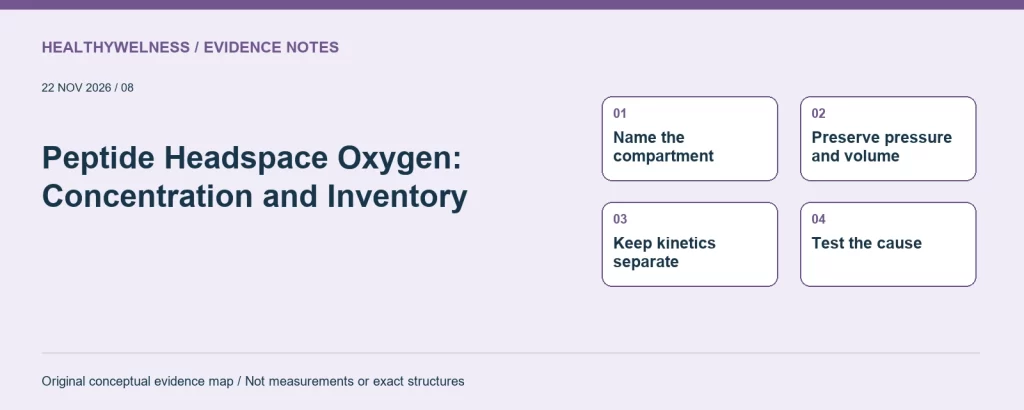
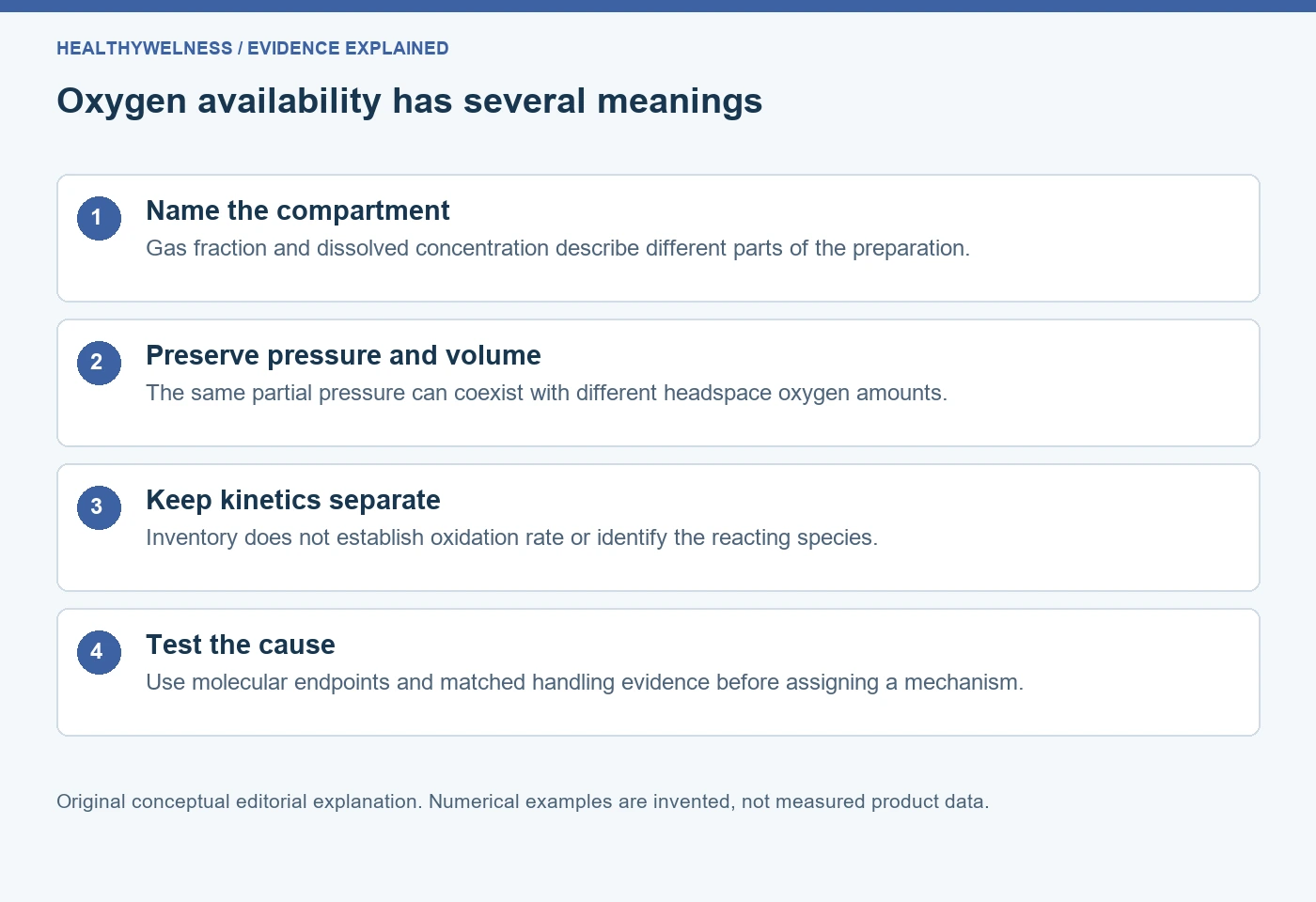
Headspace oxygen percentage, dissolved oxygen concentration and the total oxygen available to a peptide preparation are different quantities. More headspace can provide a larger gas reservoir without changing the initial equilibrium dissolved concentration at the same oxygen partial pressure. None of those quantities independently predicts a peptide oxidation rate or identifies the reacting oxidant.
For laboratory research use only. This discussion concerns research sample interpretation and provides no human or veterinary use recommendations. All numerical examples are invented models, not measurements of HealthyWelness products.
- A gas percentage needs total pressure to determine oxygen partial pressure.
- At a fixed temperature and suitable dilute-solution conditions, dissolved oxygen depends on its partial pressure and the solvent-specific equilibrium relationship.
- Gas-phase oxygen amount also depends on headspace volume.
- Oxygen availability and chemical reactivity are separate parts of an oxidation explanation.
Name the oxygen quantity before comparing containers
A research record says that two vials were stored under air. One has a small liquid fill and the other is nearly full. The phrase under air identifies neither the total oxygen inventory nor the dissolved concentration actually present when measurements begin. It also leaves pressure, temperature, equilibration and earlier handling unspecified. Those omissions matter when an oxidation explanation is proposed from the vial geometry alone.
Separate four quantities: oxygen mole fraction in the gas, its partial pressure, the amount in the gas compartment, and its dissolved amount. A headspace sensor generally supplies information about the gas compartment. A liquid-phase oxygen measurement addresses another compartment. Translating either into a complete inventory requires additional volume and physical-model information.
| Record | Meaning | Still needed |
|---|---|---|
| Gas oxygen fraction | Share of gas molecules | Total pressure |
| Oxygen partial pressure | Gas equilibrium driver | Liquid composition and temperature |
| Headspace oxygen amount | Gas reservoir | Dissolved amount and later exchange |
| Dissolved oxygen | Oxygen in sampled liquid | Reaction mechanism and kinetics |
The existing vial overview introduces headspace and packaging. This article develops the narrower accounting problem: what does a reported atmosphere establish about the oxygen that can contact a research preparation?
Partial pressure and dissolved concentration share an equilibrium relationship
For an ideal gas mixture, oxygen partial pressure is its mole fraction multiplied by total pressure. A stipulated fraction of 0.20 at a total pressure of 1.00 bar gives 0.20 bar. The same fraction at 0.50 bar gives 0.10 bar. Identical percentages therefore need not describe identical driving conditions for gas dissolution.
NIST’s Chemistry WebBook oxygen entry reports a Henry-law solubility convention based on molality divided by gas partial pressure and includes a temperature-dependent expression. Its units are essential because other conventions use the inverse relationship. This article uses the entry to establish that a stated equilibrium constant needs its definition; it does not select a database value as a validated coefficient for peptide buffers. NIST oxygen entry, Henry-law section.
For the invented calculations below, define C = Hp, where C is molar concentration in liquid, p is oxygen partial pressure and H is an explicitly stipulated coefficient. This convention differs in reporting basis from the NIST molality example. Real buffers, salts, cosolvents and temperature can require a different coefficient. The teaching calculation is not a substitute for measuring the actual research medium.
Equilibrium is also an assumption. A liquid just transferred from another container may not yet match the gas above it. Conversely, a chemically consuming system can maintain a concentration gradient. A nominal atmosphere does not determine the concentration at every earlier time or at every position in the liquid.
An invented inventory calculation separates concentration from amount
Hypothetical model: compare two closed vessels at 298 K and total pressure 1.00 bar, each with oxygen fraction 0.20 and 1.00 mL of liquid. Give vessel A 1.00 mL of headspace and vessel B 4.00 mL. Assume ideal gas behavior, negligible vapor-pressure complications, no reaction and initial gas–liquid equilibrium. Stipulate H = 1.00 mmol L−1 bar−1 purely for transparent arithmetic.
Both liquids then have C = 1.00 × 0.20 = 0.20 mmol/L, or 0.20 micromol in 1.00 mL. Gas-phase oxygen is n = pV/(RT). With R = 0.08314 L bar mol−1 K−1, A contains approximately 8.07 micromol in its gas compartment; B contains approximately 32.29 micromol. The difference follows from volume, while the stipulated initial dissolved concentration stays unchanged.
| Quantity | Vessel A | Vessel B |
|---|---|---|
| Headspace | 1.00 mL | 4.00 mL |
| Dissolved concentration | 0.20 mmol/L | 0.20 mmol/L |
| Gas oxygen amount | 8.07 micromol | 32.29 micromol |
| Total initial oxygen | 8.27 micromol | 32.49 micromol |
The table establishes no fourfold increase in oxidation rate. It describes an inventory at one stipulated state. If oxygen is consumed, later partial pressure and dissolved concentration can change, and the rate of gas transfer may become relevant. A larger reservoir can sustain availability differently while leaving the initial equilibrium concentration identical.
The gas amount also is not an automatic reaction yield. Even if a proposed product contains oxygen, the source of that oxygen and reaction stoichiometry require a chemical model. Counting available oxygen molecules cannot prove that all will react with the peptide, that only one pathway occurs, or that the pathway proceeds during the observation interval.
Closing the vial does not establish a constant oxygen history
A closed vessel can redistribute oxygen between gas and liquid while total oxygen remains unchanged in the no-reaction idealization. A sealed vessel containing an oxygen-consuming reaction can lose molecular oxygen internally without external exchange. An imperfectly isolated vessel can gain oxygen from outside while the reaction consumes it. These histories can produce similar endpoint readings.
FDA’s 1999 container-closure guidance distinguishes transport through permeable material from diffusion past a seal and emphasizes the assembled packaging system. The document concerns human drug packaging; only its physical protection distinction is used here, without implying approval, qualification or compliance for research materials. A glass wall by itself does not establish a gas-tight closure. FDA container-closure guidance, protection section.
Opening, sampling and transferring create additional events. Replacing removed liquid with ambient gas changes the compartment volumes and can introduce oxygen. A record that notes only the final cap position may omit these exchanges. State the relevant sampling history when comparing measurements rather than treating sealed as a complete experimental description.
An oxygen-containing product does not identify the oxidant
Dufield and colleagues’ 2004 original model-peptide study examined iron/peroxide chemistry and reported evidence for a metal-bound oxidant with methionine selectivity. Its abstract compares defined model structures and oxidizing conditions. The lesson here is chemical specificity: a product assignment and an atmospheric oxygen measurement are different evidence. This article relies on the actual abstract, not a reanalysis of the full experiment. Dufield et al., PMID 15067689.
That study is not evidence that the same pathway occurs in an unknown vial. Nor does it justify adding its reagents to a research preparation. It illustrates why reaction conditions and molecular accessibility can matter beyond oxygen inventory. Peroxides, photosensitizing components, trace metals and preparation history are possible questions for a targeted investigation, rather than causes established by the presence of a +16 Da feature.
Use oxidation and deamidation mass evidence for product-assignment limits. A properly assigned modification still needs a time course and discriminating comparisons to investigate when and why it arose. Endpoint chromatography and headspace oxygen alone cannot reconstruct that entire chain.
Make the comparison answer one causal question
A useful experiment specifies whether it is comparing initial dissolved concentration, reservoir size, transfer history or a chemical endpoint. Hold other relevant variables sufficiently consistent and measure the quantities needed for that question. If changing fill volume also changes interface, mixing and concentration, describe the combined preparation change rather than attributing every difference to oxygen.
Preserve gas composition, pressure, liquid and headspace volumes, temperature, medium, opening history and measurement timing. For oxygen sensors, retain calibration and whether the reading represents gas or liquid. For the peptide endpoint, retain identity, recovery and quantification evidence. An apparent absence of dissolved oxygen does not automatically establish absence of every oxidizing species.
The peptide concentration calculator supports nominal mass–volume arithmetic. It does not model gas transfer or reaction kinetics. No calculation here supplies a storage period, oxygen specification or product-stability claim for the HealthyWelness catalog.
Questions about oxygen in peptide preparations
Does more headspace always mean more dissolved oxygen?
No. At the same applicable equilibrium partial pressure, temperature and medium, dissolved concentration can be unchanged while the gas reservoir grows.
Is oxygen percentage enough to compare atmospheres?
No. Total pressure is needed to calculate partial pressure, and liquid conditions and equilibration are needed to interpret dissolved concentration.
Does a larger oxygen inventory establish faster oxidation?
No. Availability, transfer and chemical kinetics are different quantities. The rate requires evidence for the actual molecular system and conditions.
Does a closed glass vial prove oxygen cannot enter?
No. Protection concerns the assembled wall and closure system, its condition and handling history. The glass material alone does not establish seal performance.
Does an oxygen-added peptide peak identify atmospheric oxygen as the cause?
No. Product assignment does not identify its oxygen source, reacting species or time of formation. Those claims need additional discriminating evidence.
For laboratory research use only. The models explain measurement boundaries and are not product experiments, stability certification or human or veterinary recommendations.
Cover and evidence map: original conceptual editorial schematics, not measured results, exact molecular structures, or photographs of HealthyWelness facilities.
Sources
- NIST Chemistry WebBook SRD69. Oxygen. Henry-law solubility section.
- FDA. Container Closure Systems for Packaging Human Drugs and Biologics. May1999. Protection section.
- Dufield DR, et al. Selective site-specific fenton oxidation of methionine in model peptides: evidence for a metal-bound oxidant. J Pharm Sci. 2004. PMID15067689.