Peptide Powder Weighing: Donor Loss and Receiver Gain
Interpret peptide powder transfers by comparing donor loss, receiver gain, exposure history and uncertainty before assigning a research solution amount.

Weighing a peptide powder by difference establishes the donor container’s mass change; it does not by itself establish how much reached the receiving vessel. A defensible transfer record distinguishes donor loss, receiver gain, changes during exposure and the uncertainty of their difference. Chemical content and subsequent dissolution require separate evidence.
For laboratory research use only. The compounds discussed are not approved for human or veterinary use and are not drugs, foods or cosmetics. This article summarises published research and is not medical advice.
- A donor weighing before removal and after removal measures a difference in the mass of the weighed assembly.
- Donor loss and receiver gain are separate observations; agreement requires a stated measurement uncertainty.
- Moisture exchange can change a powder’s mass during the weighing interval without changing the amount of peptide transferred.
- A balance does not identify the chemical composition of material that changes its reading.
Put a boundary around each weighed assembly
In peptide research, a preparation sometimes begins with a small portion of powder removed from a larger container. The notebook may record a single mass as “transferred,” even though only the source vial was weighed. That shorthand joins two different events: leaving the source and arriving at the destination. A particle remaining on an intermediate tool has completed the first event but not the second.
The University of California, Davis Chemistry 2C manual describes weighing by difference as recording a sample container prior to and following removal of a portion. The subtraction supplies the mass removed from that container. Its balance section establishes the measurement principle, rather than a validated method for any particular peptide. [1]
| Observation | Defined subtraction | Immediate meaning |
|---|---|---|
| Donor loss | Donor before − after | Mass leaving donor assembly |
| Receiver gain | Receiver after − before | Mass added to receiver assembly |
| Closure difference | Donor loss − receiver gain | Unreconciled mass difference |
| Target amount | Separate analytical assignment | Chemically defined quantity |
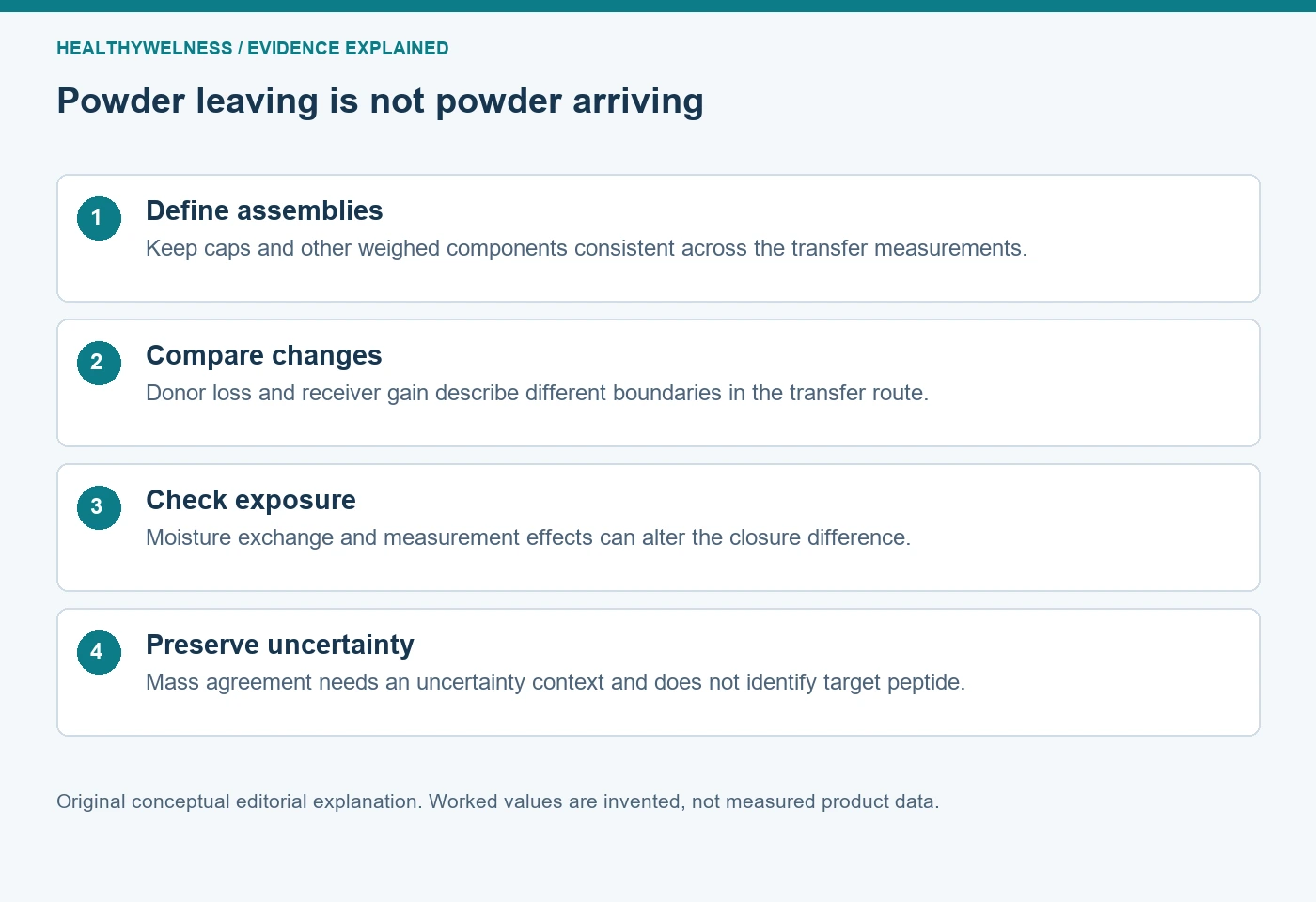
Specify what belongs to an assembly. If the initial donor reading includes a cap and the final reading excludes it, their subtraction includes the cap. If a receiving tube is weighed with its cap in one reading and without it in another, the displayed gain does not isolate powder addition. These are bookkeeping errors that can exceed the intended sample mass while still producing apparently precise readings.
A receiver check asks whether the transfer route closes
Define the donor loss as D and receiver gain as R. In an ideal closed transfer with stable assemblies and no change in the material, D equals R. The observed closure difference is E = D − R. A positive E means the measured donor loss exceeds measured receiver gain; it does not uniquely identify a spill. A negative E means the receiver gained more measured mass than the donor lost; it does not establish that extra peptide appeared.
Possible explanations depend on the route. Powder can remain on an intermediate surface, an assembly can exchange moisture, or the two weighings can have different measurement effects. Several contributions can occur together and partially cancel. Closure is therefore a consistency observation under stated conditions, not chemical proof of complete recovery.
Consider two invented transfer routes. Route A empties a donor directly into a receiver. Route B passes through a weighing vessel and another tool. Both might eventually deliver the same amount, but the second route has additional places where material can remain. The useful record names those places. Describing both routes as a single “transfer” hides a difference that could explain later disagreement.
- Identify the donor, receiver and intermediate surfaces.
- Preserve the raw before-and-after readings and their units.
- Record the state of each cap and other included component.
- Define whether subsequent rinses belong to the original transfer or a separately measured step.
An invented example separates loss from an unresolved difference
Hypothetical teaching example: a donor assembly weighs 8.51240 g before removal and 8.50000 g afterward. Its measured loss is 0.01240 g, or 12.40 mg. A receiver weighs 5.10000 g before addition and 5.11180 g afterward. Its measured gain is 11.80 mg. Assume that the assemblies were weighed comparably and that all stated observations are usable.
The closure difference is 12.40 − 11.80 = 0.60 mg. Relative to donor loss, the receiver gain is 11.80/12.40 × 100 = approximately 95.2%. This is a ratio of measured bulk-mass changes. It is not a target-peptide assay, and the remaining approximately 4.8% is not automatically adsorption or degradation.
| Invented quantity | Value | Interpretation |
|---|---|---|
| Donor loss D | 12.40 mg | Measured source change |
| Receiver gain R | 11.80 mg | Measured destination change |
| D − R | 0.60 mg | Unresolved closure difference |
| 100R/D | 95.2% | Bulk-mass transfer ratio |
Suppose examination of an intermediate vessel subsequently identifies some remaining material. That observation supports a transfer-route contribution, but identifying its appearance alone does not quantify its mass or peptide content. A suitable additional measurement could narrow the explanation. The original 0.60 mg discrepancy should remain in the record rather than being replaced retroactively by an assumed cause.
Alternatively, suppose both assemblies were exposed differently and the receiver absorbed water. Receiver gain could then overstate transferred dry material. Good numerical closure could result from a powder loss and water gain that happen to offset. The example shows why a balance agreement and a chemically defined recovery answer different questions.
Time-dependent mass can undermine a clean subtraction
METTLER TOLEDO’s 2007 technical note identifies humidity, airflow, electrostatic effects, temperature and balance drift as weighing influences. It specifically notes that hygroscopic powder can change mass over time. Those general cautions are useful here; its instrument-specific performance calculations are not acceptance limits for a different balance or peptide workflow. [2]
An invented moisture scenario makes the sign clear. Suppose 10.00 mg actually leaves a donor, while its remaining contents gain 0.20 mg of water between readings. The observed donor loss would be 9.80 mg under this simple model. If the receiver gains the full 10.00 mg and nothing else changes, R exceeds D. The negative closure difference would be caused by mass gained at the donor, rather than excess transfer from it.
The opposite direction is possible if the donor loses volatile material in addition to the removed powder. These examples are mass accounting, not evidence that a named peptide has a particular moisture uptake rate. No universal exposure duration can be inferred from them. The relevant question is whether the material and measurement conditions remain sufficiently stable for the intended subtraction.
A useful blank or handling comparison should address a proposed contribution. Repeated observations of an unchanged assembly can examine drift under the selected conditions. An exposure comparison can examine mass change during a similar interval. Neither automatically recreates a powder’s behavior. A comparison with a different surface, composition or opening history should retain that limitation.
Evaluate the difference at the scale being claimed
A display increment is not a complete uncertainty estimate. NIST Technical Note 1297 describes an output as a function of measurement inputs and includes covariance in propagation of uncertainty. Applied to a closure calculation, the model must represent the relevant observations and their dependence. Sharing one balance does not make every influence cancel, and taking four readings does not make them independent. [3]
For illustration only, assume D and R each have independent standard uncertainties of 0.10 mg. The standard uncertainty of E is then √(0.10² + 0.10²) = approximately 0.14 mg. If instead both have independent standard uncertainties of 0.50 mg, the corresponding value is approximately 0.71 mg. The same observed 0.60 mg discrepancy has a different evidential context in these two invented cases.
These examples do not establish a rejection rule or a confidence interval. An actual comparison needs its own uncertainty evaluation and decision requirement. A laboratory could have a meaningful reason to investigate a small discrepancy, or discover that its method cannot resolve the claimed difference. Reporting more digits does not resolve that limitation.
Keep powder transfer separate from target recovery in solution
After receiving the powder, a laboratory may dissolve it and assign a nominal concentration. This introduces additional questions: whether all relevant material entered the solution, whether the chosen analyte remained intact, and what concentration basis is supported. A successful bulk-mass check does not settle those questions. Conversely, a later analytical discrepancy should not automatically be assigned to the balance.
The existing purity versus content guide explains why a chromatographic percentage cannot simply identify the desired peptide fraction of weighed powder. The Karl Fischer measurement guide addresses water specifically. Those composition questions complement the transfer boundary developed here.
Use the peptide concentration calculator only with clearly defined inputs. Record whether a calculation uses bulk powder mass, an assigned peptidic amount or a target-specific amount. Keeping the original transfer record allows later analytical information to improve a concentration assignment without rewriting what was physically observed.
Questions about weighing peptide research powders
Does weighing by difference prove that all removed powder reached the receiver?
No. It establishes the measured change in the donor assembly. A receiver measurement and an understood transfer route are needed to assess destination gain.
Does a zero closure difference prove complete peptide recovery?
No. Opposing contributions can cancel, and bulk mass does not identify chemical composition. Report closure together with the measurement conditions and uncertainty.
Can a negative closure difference occur without extra powder being added?
Yes. For example, moisture uptake at the donor can reduce its apparent loss. Measurement effects or changes at the receiver can also contribute.
Is the smallest displayed digit the uncertainty?
No. Readability describes the display. A usable uncertainty evaluation considers the relevant measurement process and significant contributions under its actual conditions.
Should a rinsed intermediate vessel be counted as fully recovered?
Only if evidence supports that claim. A rinse is another transfer with its own destination and possible losses; its existence alone does not quantify target recovery.
References and access scope
- University of California, Davis. Chemistry 2C Lab Manual. Fall 2020. Common Laboratory Procedures, A-69: taring and weighing by difference. Relevant section read.
- METTLER TOLEDO. Uncertainty of Weighing Measurement: Understanding Balance Readings. December 2007. Definitions and environmental-influence sections read.
- Taylor BN, Kuyatt CE. Guidelines for Evaluating and Expressing the Uncertainty of NIST Measurement Results. NIST Technical Note 1297. 1994 edition. Appendix A. Measurement-model and covariance passages read.
Sources accessed 23 November 2026. Numerical examples are original hypothetical mass-accounting exercises. No product-specific weighing, transfer or analytical testing is reported.
For laboratory research use only. The compounds discussed are not approved for human or veterinary use and are not drugs, foods or cosmetics. This article summarises published research and is not medical advice.
Cover and evidence map: original conceptual editorial schematics, not measured results, exact molecular structures, or photographs of HealthyWelness facilities.
Sources
- University of California, Davis. Chemistry 2C Lab Manual. Fall 2020. Common Laboratory Procedures, A-69: taring and weighing by difference.
- METTLER TOLEDO. Uncertainty of Weighing Measurement: Understanding Balance Readings. December 2007.
- Taylor BN, Kuyatt CE. Guidelines for Evaluating and Expressing the Uncertainty of NIST Measurement Results. NIST Technical Note 1297. 1994 edition. Appendix A.