SS-31 Reconstitution, Sequence and the N-Acetyl Question
SS-31 is a cationic four-residue peptide with an unnatural amino acid. How to reconstitute it, and why the terminal form on the label matters.


Cover illustration: AI-generated editorial artwork. Conceptual only; not an exact molecular structure, actual laboratory result or evidence of clinical effects.
SS-31 is short, water-tolerant and easy to dissolve, which makes it feel like a forgiving reagent. Two of its properties mean it is not quite: it is strongly cationic, so dilute solutions lose material to surfaces, and it belongs to a family where the terminal form on the label is part of the molecule’s identity. Both are cheap to control for once you know they are there.
For laboratory research use only. The research materials supplied by HealthyWelness are not approved medicines, foods or cosmetics and are not for human or veterinary use. This article summarises published research and is not medical advice.
- SS-31, also called elamipretide, is built on a motif of alternating aromatic and cationic residues.
- That motif is the targeting mechanism: the peptide concentrates on the inner mitochondrial membrane with no attached targeting group, and reported uptake is independent of the mitochondrial potential (Szeto, Br J Pharmacol 2014, PMID 24117165).
- Cardiolipin, a lipid of the mitochondrial inner membrane, is described as its binding target (Szeto, Br J Pharmacol 2014, PMID 24117165).
- An acetylated N-terminus differs from a free one by 42 mass units, so the terminal form changes the expected mass.
- Reverse-phase purification leaves cationic peptides as the trifluoroacetate salt unless an exchange step is performed (Roux et al., 2008, PMID 18035848).
How should SS-31 be reconstituted?
- Let the sealed vial reach room temperature before opening. Cold glass condenses atmospheric moisture, and a hygroscopic peptide takes it up at once. Nearly every downstream problem starts here.
- Centrifuge briefly if powder may have moved in transit. Material in the cap is material not in the solution, and for a small quantity that fraction is not negligible.
- Use the diluent named on the certificate. A permanently charged peptide is usually water-tolerant, but solubility depends on the exact salt form and the lot’s own document is the authority.
- Add the diluent slowly down the inside wall so it runs over the cake rather than onto it.
- Swirl until fully dissolved. No vortexing and no vigorous pipetting.
- Inspect against a dark background. A clear solution is the minimum acceptable state, not a good sign.
- Aliquot immediately into single-use volumes, then freeze. Date and label with concentration and diluent.
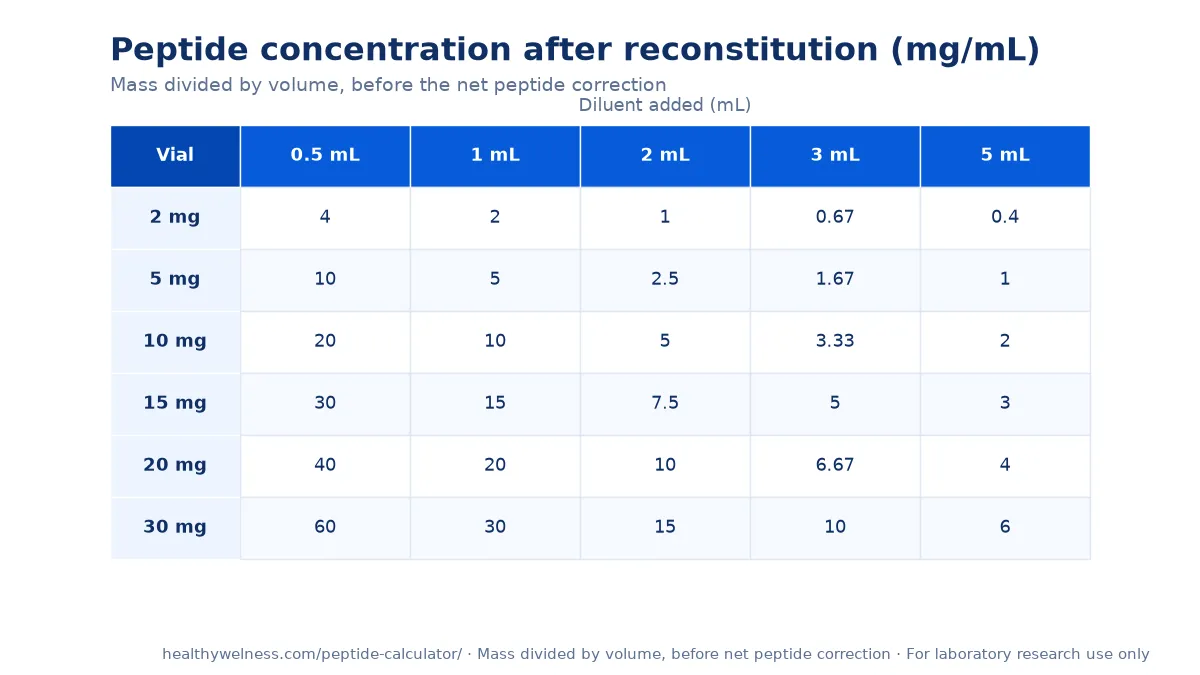
The chart above gives the gross arithmetic — mass divided by volume for common vial sizes. The correction that makes it accurate is the net peptide content, which our reconstitution calculator applies.
Why does a cationic peptide lose material to surfaces?
Because glass and most plastics carry a net negative surface charge, and a peptide carrying several positive charges binds to it. The loss is proportionally worst where it matters most: at low working concentrations, where the amount in solution is small relative to the available surface.
Mitigations, in order of effectiveness:
- Prepare dilute solutions immediately before use. Adsorption is time-dependent, so a tube that waits loses more.
- Include carrier protein where the assay tolerates it; it saturates the surfaces before the peptide can bind them.
- Use low-binding plasticware, and keep the same consumables across an experiment so that any loss is at least consistent between arms.
- Minimise transfer steps. Each extra container is another surface.
The 2016 study by Stalmans and colleagues on quality control of cationic cell-penetrating peptides is a useful reference on how far the behaviour of this peptide class can diverge from assumption.
What does the N-acetyl question come down to?
Terminal modifications are part of a peptide’s identity, not optional decoration. An acetylated N-terminus removes the free positive charge at that end and adds 42 mass units relative to the free amine form.
For a cationic peptide whose targeting mechanism depends on charge, removing a charge is not a trivial change. So the checks are worth doing properly:
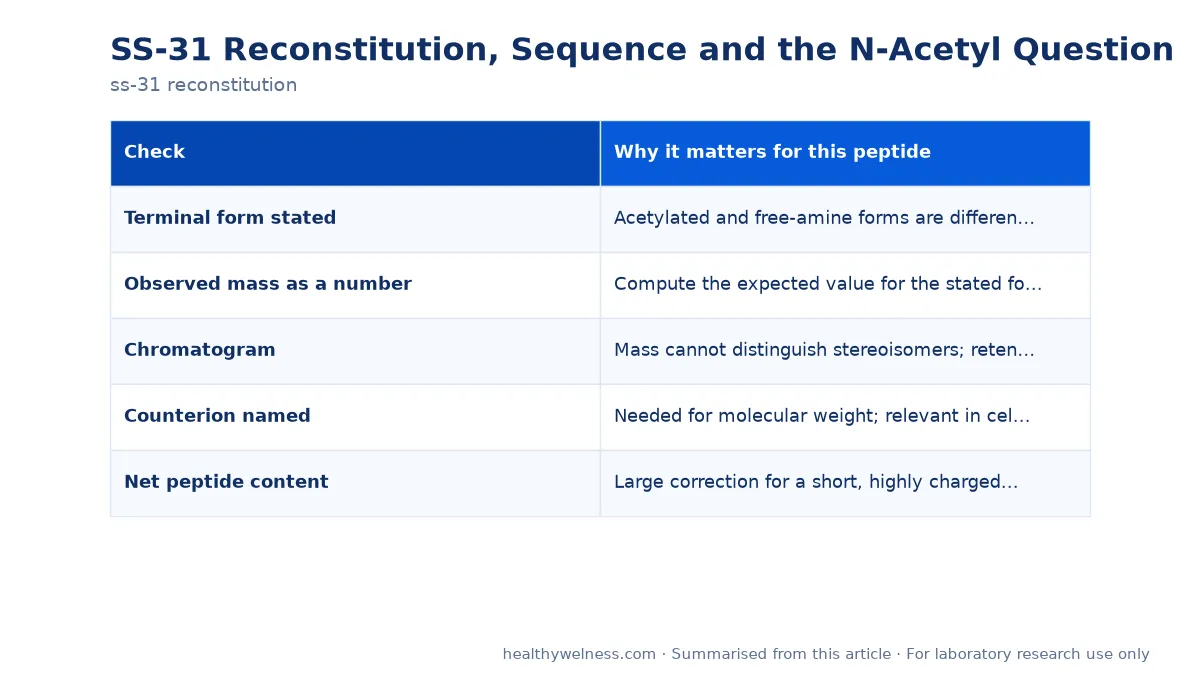
| Check | Why it matters for this peptide |
|---|---|
| Terminal form stated | Acetylated and free-amine forms are different molecules |
| Observed mass as a number | Compute the expected value for the stated form and compare |
| Chromatogram | Mass cannot distinguish stereoisomers; retention can |
| Counterion named | Needed for molecular weight; relevant in cell work |
| Net peptide content | Large correction for a short, highly charged peptide |
The general framework is in how to read a certificate of analysis.
Why is the counterion correction large here?
Because counterion mass is a cost per charged residue, and a short peptide has few residues to spread it over. A highly cationic short peptide therefore carries proportionally more non-peptide mass than a long one.
The default counterion is trifluoroacetate, because reverse-phase purification is normally run with trifluoroacetic acid in the mobile phase and the peptide is lyophilized as that salt unless an exchange step is added. The 2008 critical evaluation by Roux and colleagues compared exchange approaches and found them to differ in completeness — so “acetate salt” means an exchange was performed, not that no trifluoroacetate remains.
That matters beyond arithmetic for cell work, because trifluoroacetate is not biologically inert at the levels that can accompany a peptide. The full treatment is in peptide counterions: TFA versus acetate.
How does the targeting mechanism affect storage decisions?
The aromatic residues that make the targeting motif work are also the ones that make the peptide light-sensitive, so the same feature drives both the pharmacology and the storage rule.
- Store sealed, dry and dark at −20 °C. Amber vials or foil overwrap are not cosmetic for an aromatic-rich peptide.
- Use a clean, low-metal diluent. Trace metal catalyses oxidation generally.
- Aliquot on first reconstitution so no tube is warmed and refrozen repeatedly. See storing reconstituted peptides.
Why this is worth the discipline: the 2020 study by Chavez and colleagues mapped SS-31’s mitochondrial protein interaction landscape, and the 2025 review by Tung and colleagues covers structure and mechanism together. Work at that level of resolution depends on the material being what the protocol says it is — a partly oxidised or partly adsorbed preparation makes an interaction map unreliable rather than merely weaker.
Our SS-31 research material is supplied for laboratory research use. Certificates are available for listed products — contact us for the latest report. The renal literature is reviewed in SS-31 kidney research.
Why potential-independent uptake changes what you have to control
SS-31 accumulates in mitochondria because the inner membrane maintains a negative potential that draws cationic species inward. That is the targeting mechanism, and it carries a design consequence that is easy to miss.
Uptake does not depend on the potential being there. Uptake of the SS peptides into isolated mitochondria was reported as rapid and independent of mitochondrial potential, with the peptides concentrating on the inner membrane rather than in the matrix (Szeto, Br J Pharmacol 2014, PMID 24117165). This is the property the literature contrasts with triphenylphosphonium-conjugated probes, whose accumulation is voltage-driven, and the same review notes uptake into myocardium after ischaemia.
Two things follow for a method. An uncoupler or respiratory inhibitor used alongside the peptide is not expected to gate its access to the target, so a weaker response under those conditions should not be attributed to reduced delivery without measuring delivery. And because the binding partner is cardiolipin rather than a voltage gradient, conditions that alter cardiolipin content or oxidation state are the ones worth recording. Where the model allows it, measure accumulation directly instead of inferring it from the potential.
Scope note
This material is supplied for laboratory research use only. It is not a medicine, not a supplement, and not for human or veterinary use.
Open questions
- How much material is lost to surfaces at nanomolar working concentrations?
- Does the acetylated form accumulate in mitochondria as efficiently as the free-amine form?
- How quickly do the aromatic residues oxidise under ordinary bench lighting?
Related research
Frequently asked questions
How is SS-31 reconstituted?
Warm the sealed vial to room temperature, add the diluent named on the certificate down the inside wall, swirl rather than vortex, inspect for haze, then aliquot into single-use tubes and freeze. Concentration comes from net peptide content, not from the nominal vial weight.
What is SS-31's structure?
A short peptide built on alternating aromatic and cationic residues. That motif is the targeting mechanism: it concentrates on the inner mitochondrial membrane and binds cardiolipin, with no attached targeting group required. Reported uptake is rapid and independent of the mitochondrial potential.
Does the N-terminal form matter?
Yes. Peptides of this family are supplied in defined terminal states, and an acetylated N-terminus is a different molecule from a free one, differing by 42 mass units. The certificate should state the terminal form, and the observed mass should be checked against the expected value for that form.
Why does a cationic peptide need extra care when dilute?
Because cationic peptides adsorb to negatively charged glass and plastic. At low working concentrations a meaningful fraction can be lost to surfaces before the solution reaches the cells, so the effective concentration is below the nominal one.
Can mass spectrometry alone confirm identity?
Not completely. Mass confirms composition but cannot distinguish stereoisomers, and peptides built with unnatural or D-configured residues have same-mass alternatives. The chromatogram is the complementary evidence.
For laboratory research use only. The research materials supplied by HealthyWelness are not approved medicines, foods or cosmetics and are not for human or veterinary use. This article summarises published research and is not medical advice.
Sources
- Tung C, et al. Elamipretide: A Review of Its Structure, Mechanism of Action, and Therapeutic Potential. Int J Mol Sci. 2025. PMID: 39940712
- Szeto HH. First-in-class cardiolipin-protective compound as a therapeutic agent to restore mitochondrial bioenergetics. Br J Pharmacol. 2014. PMID: 24117165
- Chavez JD, et al. Mitochondrial protein interaction landscape of SS-31. Proc Natl Acad Sci U S A. 2020. PMID: 32554501
- Roux S, et al. Elimination and exchange of trifluoroacetate counter-ion from cationic peptides: a critical evaluation of different approaches. J Pept Sci. 2008. PMID: 18035848
- Stalmans S, et al. Quality control of cationic cell-penetrating peptides. J Pharm Biomed Anal. 2016. PMID: 26397208