Peptide Policy and Research: Week to 2 November 2026
HHS published a draft enforcement discretion policy covering six compounded peptides, and a new orthopaedic review assessed BPC-157 and TB-500.


Cover illustration: AI-generated editorial artwork. Conceptual only; not an exact molecular structure, actual laboratory result or evidence of clinical effects.
The week’s significant development was regulatory, not scientific: on 30 October 2026 the Department of Health and Human Services published a notice of availability for a draft enforcement discretion policy covering six peptide bulk drug substances used in 503A pharmacy compounding. The same week, an orthopaedic review assessed the published evidence for three of them and concluded that routine clinical use cannot currently be recommended.
For laboratory research use only. The research materials supplied by HealthyWelness are not approved medicines, foods or cosmetics and are not for human or veterinary use. This article summarises published research and is not medical advice.
- The Department of Health and Human Services published the notice at 91 FR 68526 on 30 October 2026, under docket HHS-OASH-2026-0496 and RIN 0910-ZD94, signed by Secretary Robert F. Kennedy, Jr.
- The draft policy names six bulk drug substances: BPC-157, TB-500, epitalon, semax, KPV and MOTS-c. A seventh substance reviewed in July 2026, emideltide, is not included.
- The Federal Register notice states that the draft policy “does not establish any rights for any person and is not binding on HHS or the public.”
- Tham and colleagues reported in the Journal of the American Academy of Orthopaedic Surgeons on 27 October 2026 that human musculoskeletal evidence for BPC-157 is limited to one small retrospective uncontrolled case series without validated outcome measures (PMID 42937313).
- The 2027 World Anti-Doping Agency Prohibited List takes effect on 1 January 2027, with BPC-157 listed under class S0 and TB-500 under class S2, according to the US Anti-Doping Agency’s athlete advisory.
1. HHS published a draft enforcement discretion policy for six peptides
The Office of the Secretary at the Department of Health and Human Services filed the notice on 28 October 2026 and it was published in the Federal Register on 30 October 2026 as document 2026-22192, at 91 FR 68526. The action type is a notice of availability, which means the agency is announcing that a document exists and inviting comment — not issuing a rule.
The policy itself is described in the notice as a draft. Its operative sentence is narrow: HHS “does not intend to take enforcement action against a State-licensed pharmacy, Federal facility, or licensed physician compounding a drug product using a peptide bulk drug substance found in Appendix A.” The stated reason is the volume of existing use combined with the absence of approved products, and the notice says FDA’s future rulemakings may propose adding some or all of these peptides to the 503A bulks list.
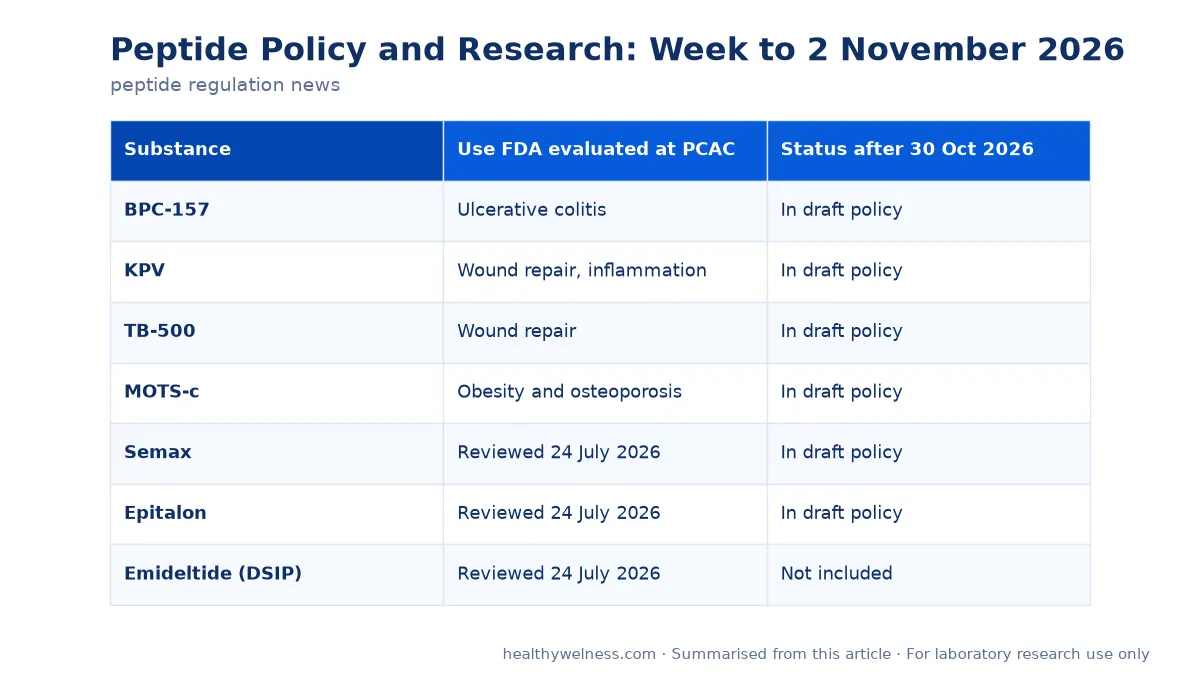
The six substances, and the uses FDA had evaluated when the Pharmacy Compounding Advisory Committee met on 23–24 July 2026, are set out below. The committee’s agenda, published by FDA, lists the specific use reviewed for each nominated substance.
| Substance | Use FDA evaluated at PCAC | Status after 30 Oct 2026 |
|---|---|---|
| BPC-157 | Ulcerative colitis | In draft policy |
| KPV | Wound repair, inflammation | In draft policy |
| TB-500 | Wound repair | In draft policy |
| MOTS-c | Obesity and osteoporosis | In draft policy |
| Semax | Reviewed 24 July 2026 | In draft policy |
| Epitalon | Reviewed 24 July 2026 | In draft policy |
| Emideltide (DSIP) | Reviewed 24 July 2026 | Not included |
The sequence that produced this is worth keeping straight, because it is frequently compressed into a single event. In April 2026 FDA removed these substances from 503A Category 2, the designation reserved for nominated substances the agency has identified as presenting significant safety risks, and announced in the Federal Register of 16 April 2026 that an advisory committee would consider seven peptides for the bulks list. The committee met in July and voted in favour of six of the seven, departing from FDA staff, who had recommended against inclusion. An advisory committee recommendation is not a rule, so nothing changed in law at that point. The October notice is the first document in which the department states an enforcement position.
2. The conditions are the substance of the policy
Read only the headline and the policy looks like an opening. Read the conditions and it looks more like a specification for documentation. The draft sets out requirements that fall into four groups.
- Origin of the active ingredient. The original manufacturer of the active pharmaceutical ingredient must be registered with FDA under section 510 and compliant with current good manufacturing practice, and the manufacturing facility’s location must appear on the certificate of analysis. Registration of a repacker, relabeler or distributor does not satisfy this on its own.
- Analytical evidence. The active ingredient must be supported by testing for identity, purity, potency, impurities and contaminants — named items include the peptide sequence, residual solvents, elemental impurities, microbial contamination and bacterial endotoxins.
- One active ingredient per preparation. A compounded product may contain only one of the covered substances. A preparation combining BPC-157 with TB-500 in a single vial falls outside the policy.
- Prescription, labelling and reporting. Section 503A’s patient-specific prescription requirement continues to apply; the policy does not independently reach 503B outsourcing facilities. Serious adverse events and product quality problems are reported through FDA’s MedWatch programme, and products carry the statement “This is a compounded drug product. Not for resale.”
Two of those conditions deserve attention from anyone who reads certificates of analysis for a living. The first is that the certificate must name the facility, not merely the company — a requirement that distinguishes a manufacturer’s document from a distributor’s. The second is that sequence confirmation is named explicitly alongside purity. Those are the same two questions we argue should be asked of any peptide document, and the draft policy has now put them in a federal register notice. Our note on how to read a peptide certificate of analysis covers what each section of such a document can and cannot establish.
3. What the draft policy does not do
The notice is unusually direct about its own limits, and the limits are the part most likely to be misreported.
It does not add any substance to the 503A bulks list, which is established through notice-and-comment rulemaking and remains in progress; commentators tracking the docket put that process at twelve to twenty-four months. It does not confer FDA approval: compounded drugs are not reviewed by FDA for safety, effectiveness or quality before marketing, a point the notice makes in its own background section. It does not authorise importation, displace state boards of pharmacy, or extend to peptides outside Appendix A. And in the notice’s own words, the draft “does not establish any rights for any person and is not binding on HHS or the public.” HHS adds that it may revisit the policy in whole or in part if a safety signal or product quality issue arises.
For a laboratory supplier the practical reading is narrow. The policy describes a pathway for licensed pharmacies and physicians dispensing against a patient-specific prescription, using an active ingredient from an FDA-registered CGMP manufacturer. Material sold for laboratory research use is not within that pathway, and nothing in the notice changes what research-use-only material is for. What has changed is the documentation standard the conversation now assumes.
4. A new orthopaedic review assessed three of the six
Published online ahead of print on 27 October 2026 in the Journal of the American Academy of Orthopaedic Surgeons, Tham, Hodgkins and Kennedy reviewed BPC-157, thymosin beta-4 and TB-500 (PMID 42937313). The authors searched PubMed/MEDLINE, EMBASE and Scopus from inception through June 2026 and also reviewed primary regulatory and anti-doping sources.
Their findings are specific enough to quote. BPC-157 has the largest body of direct musculoskeletal preclinical evidence, predominantly small-animal studies covering tendon, ligament, muscle, inflammatory joint disease and bone; human musculoskeletal evidence is limited to one small retrospective uncontrolled case series without validated outcome measures. Thymosin beta-4 has broader experimental and human experience in ophthalmic, dermatologic and cardiovascular settings, but direct musculoskeletal evidence remains confined to in vitro and rodent work, and the authors state that those findings cannot establish musculoskeletal efficacy or safety.
The naming point is the one most relevant to anyone comparing a product label against the literature. The review describes TB-500 as a distinct seven amino-acid fragment of thymosin beta-4 that is frequently conflated with the full-length protein despite the absence of validated biologic or clinical equivalence. A paper about thymosin beta-4 is therefore not automatically a paper about TB-500. The same distinction, applied to the BPC family, is set out in our note on BPC-157 name variants, and the thymosin case is covered in BPC-157 compared with TB-500.
The review also flags identity, purity, concentration, sterility and manufacturing consistency as concerns for commercially marketed products, and concludes that none of these agents has an FDA-approved musculoskeletal indication or controlled human orthopaedic efficacy evidence, and that routine clinical use cannot currently be recommended. Published two days before the HHS notice, it is a useful corrective to reading the policy as a scientific endorsement: the regulatory position and the evidence position moved in different directions in the same week.
5. Other papers indexed this week
| Compound | Paper | Type |
|---|---|---|
| BPC-157 | Sever M, et al. Cytoprotective liver therapy and standard agents. Pharmaceuticals (Basel). PMID 42943255 | Narrative review |
| Retatrutide | Mateescu DM, et al. Molecular design and pharmaceutical development of a unimolecular GIP/GLP-1/glucagon tri-agonist. Pharmaceutics. PMID 42942810 | Review |
| MOTS-c | Li S, et al. Placental vascular endothelial cell apoptosis and K33-linked deubiquitination of BACH1. Cell Commun Signal. PMID 42934731 | Preclinical |
| Copper peptides | Yi KH, et al. Peptides in aesthetic dermatology: classification and fibroblast-centred mechanisms. Life (Basel). PMID 42942246 | Review |
The retatrutide review is the most useful of these for anyone tracking the incretin class, because it treats the molecule as a design problem — how one chain engages three receptors — rather than as a trial result.
6. Watch at the source
FDA broadcast both days of the July advisory committee meeting on its official YouTube channel, and the recordings remain the primary record of how the committee reached a different conclusion from agency staff. Day one covers BPC-157, KPV, TB-500 and MOTS-c.
7. What to watch next
- The comment docket. Written comments on the draft close two weeks after publication, through docket HHS-OASH-2026-0496 on regulations.gov. Four comments had been posted at the time of writing.
- A proposed rule. Enforcement discretion is not rulemaking. The question that settles the status of these six substances is whether FDA issues a proposed rule adding them to the 503A bulks list, and on what conditions.
- The second advisory committee meeting. FDA indicated in April 2026 that a further five peptides would be considered at a meeting before the end of February 2027.
- Anti-doping status, which is unaffected. The 2027 World Anti-Doping Agency Prohibited List takes effect on 1 January 2027. The US Anti-Doping Agency’s advisory lists BPC-157 under class S0, prohibited at all times, and TB-500 under class S2. A domestic compounding policy does not change a sport’s rules.
Our BPC-157 research material is supplied for laboratory research use. Certificates are available for listed products — contact us for the latest report.
Scope note
This brief summarises published regulatory documents and indexed literature. It is not legal advice, not a statement about any product’s regulatory status, and not guidance on use. Materials supplied by HealthyWelness are for laboratory research use only: not a medicine, not a supplement, and not for human or veterinary use.
Open questions
- Will FDA’s proposed rule adopt the draft policy’s conditions, tighten them, or depart from the advisory committee’s recommendation?
- Does requiring the manufacturing facility on the certificate of analysis change what documentation is available at the bulk-supply level?
- Will the single-ingredient condition change how combination preparations are described in this market?
Related research
- How to read a peptide certificate of analysis
- BPC-157 purity testing
- Peptide counterions: TFA compared with acetate
Frequently asked questions
Which peptides are named in the HHS draft policy?
Six bulk drug substances: BPC-157, TB-500, epitalon, semax, KPV and MOTS-c. A seventh substance considered at the July 2026 advisory committee meeting, emideltide (also written DSIP), was not recommended for inclusion and does not appear in the policy.
Does the policy make these six peptides FDA-approved?
No. The Federal Register notice is a notice of availability for a draft enforcement discretion policy. It does not add any substance to the 503A bulks list, and it states that the document ‘does not establish any rights for any person and is not binding on HHS or the public.’ FDA rulemaking on the bulks list continues separately.
Does this change what research-use-only material is for?
No. The draft policy applies to state-licensed pharmacies, federal facilities and licensed physicians compounding against a patient-specific prescription under section 503A, using an active ingredient from an FDA-registered, CGMP-compliant manufacturer. Material supplied for laboratory research use is outside that pathway and remains for laboratory use only.
What did the new orthopaedic review conclude about BPC-157 and TB-500?
Tham and colleagues, writing in the Journal of the American Academy of Orthopaedic Surgeons on 27 October 2026, reported that human musculoskeletal evidence for BPC-157 is limited to one small retrospective uncontrolled case series without validated outcome measures, and that routine clinical use cannot currently be recommended.
Why does the review say TB-500 is confused with thymosin beta-4?
Because they are not the same molecule. The review describes TB-500 as a distinct seven amino-acid fragment of thymosin beta-4 that is frequently conflated with the full-length protein despite the absence of validated biologic or clinical equivalence, which matters when comparing a product label with the literature.
When does the comment period on the draft policy close?
Written comments may be submitted for two weeks from the date of publication in the Federal Register, which was 30 October 2026, through docket HHS-OASH-2026-0496 on regulations.gov.
For laboratory research use only. The research materials supplied by HealthyWelness are not approved medicines, foods or cosmetics and are not for human or veterinary use. This article summarises published research and is not medical advice.
Sources
- Department of Health and Human Services. Enforcement Discretion Policy Regarding 503A Compounding Using Certain Peptide Bulk Drug Substances. Notice of availability. 91 FR 68526, 30 October 2026. Docket HHS-OASH-2026-0496
- US Food and Drug Administration. July 23-24, 2026: Meeting of the Pharmacy Compounding Advisory Committee — agenda, uses evaluated and meeting webcast
- Tham A, et al. Investigational Peptides in Orthopaedic Practice: Evidence, Safety, and Patient Counseling for BPC-157, Thymosin Beta-4, and TB-500. J Am Acad Orthop Surg. 2026. PMID: 42937313
- Sever M, et al. Possibilities for Cytoprotective Liver Therapy, Stable Gastric Pentadecapeptide BPC 157, and Standard Agents-A Narrative Review. Pharmaceuticals (Basel). 2026. PMID: 42943255
- Mateescu DM, et al. Retatrutide as a Unimolecular GIP/GLP-1/Glucagon Receptor Tri-Agonist: Molecular Design, Pharmaceutical Development and Critical Interpretation of Emerging Phase 3 Evidence. Pharmaceutics. 2026. PMID: 42942810
- Li S, et al. MOTS-c attenuates placental vascular endothelial cell apoptosis in intrahepatic cholestasis of pregnancy by inhibiting K33-linked deubiquitination of BACH1. Cell Commun Signal. 2026. PMID: 42934731
- Yi KH, et al. Peptides in Aesthetic Dermatology: Classification, Fibroblast-Centered Mechanisms, Delivery Technologies, and Clinical Evidence. Life (Basel). 2026. PMID: 42942246
- US Anti-Doping Agency. Athlete Advisory: What's New on the 2027 WADA Prohibited List