Tirzepatide Half-Life: About Five Days, and Why
Tirzepatide's half-life is about 5 days, from a population PK model of 19 pooled studies. How albumin binding produces it and what it means for study design.


Cover illustration: AI-generated editorial artwork. Conceptual only; not an exact molecular structure, actual laboratory result or evidence of clinical effects.
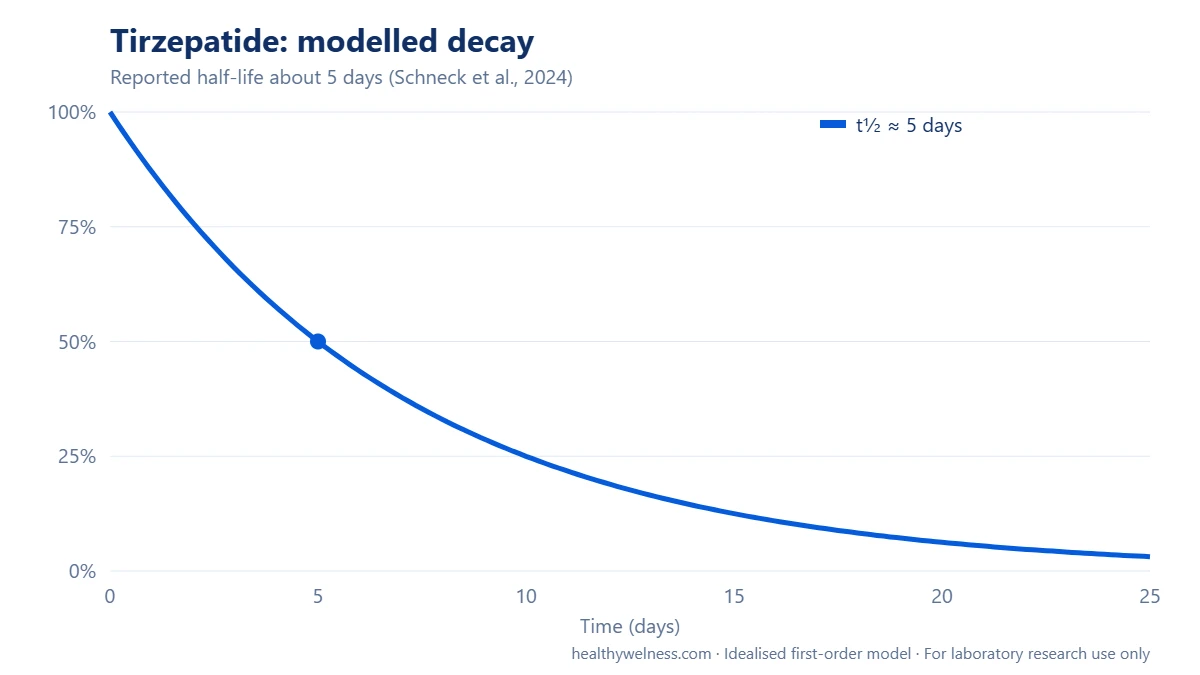
Tirzepatide’s half-life in humans is about 5 days. The figure comes from a population pharmacokinetic model built from 19 pooled studies, and it is also stated in the U.S. prescribing information. Five days is roughly 1,500 times longer than native GLP-1 survives, and the reason is a single structural feature: a fatty acid chain that binds albumin.
For laboratory research use only. The research materials supplied by HealthyWelness are not approved medicines, foods or cosmetics and are not for human or veterinary use. This article summarises published research and is not medical advice.
Key points
- Half-life ≈ 5 days; two-compartment model with first-order absorption and elimination.
- The C20 fatty diacid on Lys20 binds serum albumin, slowing clearance.
- Aib at position 2 blocks DPP-4 cleavage, the enzyme that inactivates native incretins.
- Steady state is approached after about four to five weeks of weekly exposure.
- In-body half-life says nothing about vial stability.
Where the number comes from
| Detail | Value |
|---|---|
| Data source | 19 pooled clinical studies |
| Model structure | Two-compartment, first-order absorption and elimination |
| Body-size relationship | Semimechanistic allometry |
| Half-life | ~5 days |
| Covariate conclusion | Dose adjustment by demographics or subpopulation not indicated |
| Reference | Schneck et al., 2024 |
A population model is a stronger basis than a single study, because it pools many designs and estimates variability as well as the central value.
How the structure produces the half-life
Native GLP-1 is inactivated within minutes by DPP-4 and cleared by the kidneys (Müller et al., 2019). Tirzepatide addresses both routes:
| Feature | Problem it solves |
|---|---|
| Aib at position 2 | DPP-4 cleaves after residue 2 of native incretins; a non-natural residue blocks it |
| C20 fatty diacid on Lys20, via a linker | Binds albumin (~66 kDa), which is too large for glomerular filtration and shields the peptide from proteases |
| C-terminal amide | Resists carboxypeptidases |
| Aib at position 13 | Tunes receptor activity and helical structure |
This is the same strategy semaglutide used, where increasing albumin affinity through the fatty acid and linker was the key to once-weekly exposure (Lau et al., 2015). Tirzepatide’s discovery paper describes it as a fatty-acid-modified peptide designed for once-weekly subcutaneous administration (Coskun et al., 2018).
Comparison within the class
| Peptide | Receptors | Half-life |
|---|---|---|
| Native GLP-1 | GLP-1R | Minutes |
| Tirzepatide | GIPR, GLP-1R | ~5 days |
| Retatrutide | GIPR, GLP-1R, GCGR | ~6 days (Urva et al., 2022) |
| Semaglutide | GLP-1R | ~1 week |
All three engineered peptides land in the same range despite different receptor profiles, which underlines that the half-life is set by the albumin-binding strategy rather than by the targets.
What a 5-day half-life implies
- Accumulation: with weekly exposure and a 5-day half-life, concentrations build before plateauing. Dose escalation schedules in trials partly reflect this.
- Steady state: approached after four to five half-lives, so roughly four to five weeks.
- Washout: similarly four to five half-lives for concentrations to fall to a few percent. This matters for crossover designs and for interpreting measurements taken soon after stopping.
- Sampling: a long half-life means a flat concentration profile, so sparse sampling is usually adequate, unlike for short-acting peptides such as ipamorelin.
Half-life versus stability in the vial
The two are unrelated. In circulation, albumin binding protects tirzepatide. In a reconstituted research vial there is no albumin, and degradation depends on temperature, pH, light and handling. Lipidated peptides can also self-associate in solution, which is a physical rather than chemical form of loss. Store powder at −20 °C and solutions at 2–8 °C, protect from light, and avoid repeated freeze–thaw. The method and molar conversions are in how to reconstitute tirzepatide, appearance checks in tirzepatide powder.
Our tirzepatide research peptide is supplied in 5–60 mg vials. Certificates are available for listed products — contact us for the latest report. Concentrations: peptide reconstitution calculator.
A note on where the figure is quoted
Several different numbers circulate for tirzepatide’s half-life, usually between 4 and 6 days. They are not necessarily in conflict. A population model reports a central estimate with variability around it, single-study estimates depend on sampling schedule and assay, and terminal half-life can differ slightly from the effective half-life that governs accumulation. When a specific figure matters for a calculation, use the population estimate and state which source it came from rather than quoting a round number without attribution.
Open questions
- How much between-subject variability surrounds the 5-day central estimate?
- Does albumin concentration, which varies with nutritional and inflammatory state, measurably change exposure?
- How does albumin in assay buffers shift apparent potency in vitro, and how should that be standardised?
Related research
Frequently asked questions
What is the half-life of tirzepatide?
About 5 days. A population pharmacokinetic model built from 19 pooled studies described tirzepatide with a two-compartment model and a half-life of approximately 5 days, which supports once-weekly administration.
Why is tirzepatide's half-life so long?
A C20 fatty diacid attached to lysine 20 binds serum albumin. Albumin-bound peptide escapes rapid renal filtration and is protected from proteases. Aminoisobutyric acid at position 2 additionally blocks DPP-4 cleavage.
How long until tirzepatide reaches steady state?
By the general rule of four to five half-lives, roughly four to five weeks of regular weekly exposure.
Does body size change tirzepatide's pharmacokinetics?
The population model used an allometric relationship to describe the effect of body size, but the covariate analysis suggested dose adjustment based on demographics or subpopulations was unnecessary.
Does a 5-day half-life mean reconstituted tirzepatide lasts 5 days?
No. Half-life describes clearance from the body, where albumin protects the peptide. A vial of reconstituted research material contains no albumin, and its stability depends on temperature, pH, light and handling.
For laboratory research use only. The research materials supplied by HealthyWelness are not approved medicines, foods or cosmetics and are not for human or veterinary use. This article summarises published research and is not medical advice.
Sources
- Schneck K, et al. Population pharmacokinetics of the GIP/GLP receptor agonist tirzepatide. CPT Pharmacometrics Syst Pharmacol. 2024. PMID: 38356317
- DailyMed. Tirzepatide injection, solution — U.S. prescribing information. U.S. National Library of Medicine.
- Coskun T, et al. LY3298176, a novel dual GIP and GLP-1 receptor agonist for the treatment of type 2 diabetes mellitus: From discovery to clinical proof of concept. Mol Metab. 2018. PMID: 30473097
- Müller TD, et al. Glucagon-like peptide 1 (GLP-1). Mol Metab. 2019. PMID: 31767182
- Lau J, et al. Discovery of the Once-Weekly Glucagon-Like Peptide-1 (GLP-1) Analogue Semaglutide. J Med Chem. 2015. PMID: 26308095
- Urva S, et al. LY3437943, a novel triple GIP, GLP-1, and glucagon receptor agonist in people with type 2 diabetes: a phase 1b, multicentre, double-blind, placebo-controlled, randomised, multiple-ascending dose trial. Lancet. 2022. PMID: 36354040