Is KLOW Peptide Blue? What the Colour Does and Doesn’t Prove
KLOW blend is usually blue because one component, GHK-Cu, carries copper(II). Why the colour appears, what changes it, and why colour is not an identity test.


Cover illustration: AI-generated editorial artwork. Conceptual only; not an exact molecular structure, actual laboratory result or evidence of clinical effects.
Yes, KLOW blend is normally blue, and the colour comes entirely from one component: GHK-Cu, the copper(II) complex of the tripeptide Gly-His-Lys. BPC-157, TB-500 and KPV are colourless. The blue confirms that copper complex is present; it says nothing about the other three peptides.
For laboratory research use only. The research materials supplied by HealthyWelness are not approved medicines, foods or cosmetics and are not for human or veterinary use. This article summarises published research and is not medical advice.
- KLOW blend combines four peptides: GHK-Cu, BPC-157, TB-500 and KPV; only GHK-Cu carries a metal ion.
- In solution, Cu(II)-GHK is a monomeric complex in which copper is held by the terminal amine, an amide nitrogen and the histidine imidazole, with a labile fourth position (Hureau et al., 2011).
- Copper exchange between GHK complexes is fast, and Cu(II)-GHK can be reduced to Cu(I) around −0.62 V with release of the copper ion (Hureau et al., 2011).
- GHK-Cu was stable in water and in pH 4.5–7.4 buffers for at least two weeks at 60 °C but was susceptible to hydrolytic cleavage under basic and oxidative stress (Badenhorst et al., 2016).
- A 2026 review notes that molar copper occupancy and labile copper are rarely measured, even though total peptide content does not reveal them (Mateescu et al., 2026).
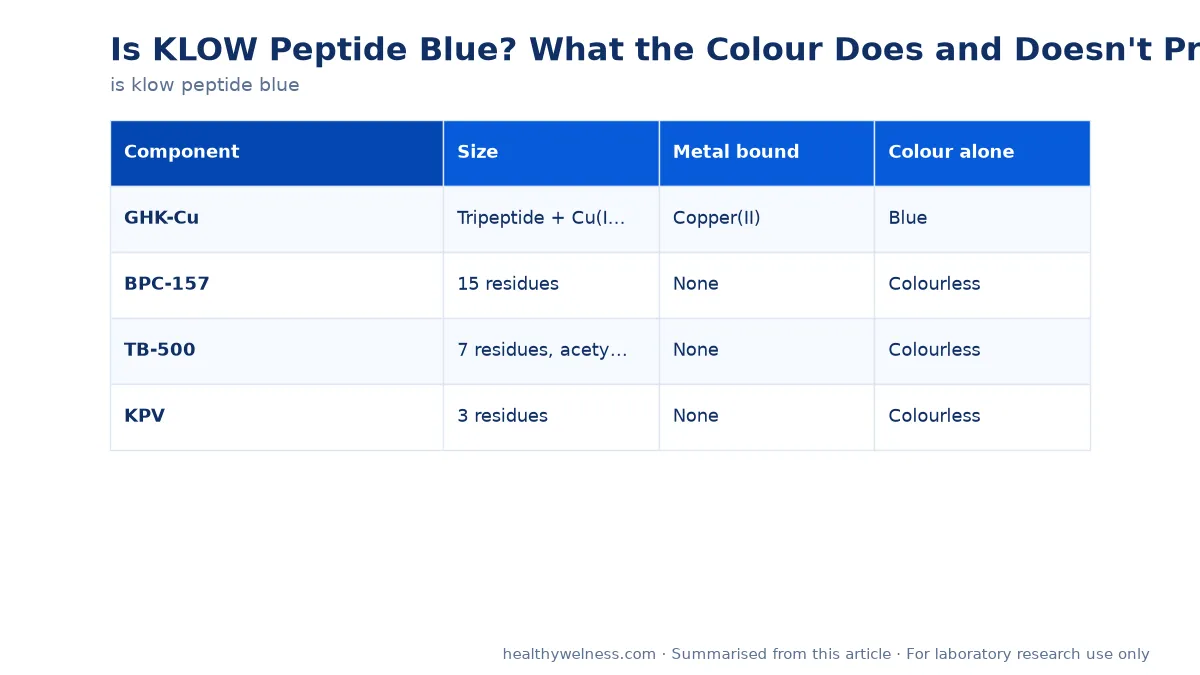
Which component gives the colour
| Component | Size | Metal bound | Colour alone |
|---|---|---|---|
| GHK-Cu | Tripeptide + Cu(II) | Copper(II) | Blue |
| BPC-157 | 15 residues | None | Colourless |
| TB-500 | 7 residues, acetylated | None | Colourless |
| KPV | 3 residues | None | Colourless |
A blue cake or solution therefore reports on one quarter of the blend. Our KLOW blend research material lists its four components; the composition is explained in what is the KLOW blend.
Certificates are available for listed products — contact us for the latest report.
Why copper(II) peptide complexes are blue
Copper(II) has a partly filled set of d-orbitals. When it is surrounded by ligands, those orbitals split in energy, and the complex absorbs visible light at a wavelength set by the size of the split. Copper(II) bound mainly by nitrogen donors absorbs toward the orange-red end of the spectrum, so transmitted light looks blue to violet. That is why copper peptide solutions, including GHK-Cu, have their characteristic colour, and why colourless peptides mixed with them do not change the hue.
The coordination of GHK is well defined. Hureau and colleagues solved the solid-state structure, which is dimeric, and used EPR, HYSCORE, X-ray absorption and NMR to show that in solution the complex is monomeric, with three nitrogen ligands in the equatorial plane and a labile oxygen at the fourth position (Hureau et al., 2011). The square-pyramidal copper site of GHK is so dependable that it has been used as a fusion tag to help proteins crystallise and to phase X-ray structures from the copper signal (Mehr et al., 2020).
What changes the colour
Because the colour comes from the copper’s environment, anything that changes that environment can change the colour. The table summarises the main causes a laboratory is likely to meet.
| Change | Mechanism | Visible result |
|---|---|---|
| Strong chelator present | Copper moves to new ligand | Hue shifts |
| Reducing agent | Cu(II) to Cu(I), copper released | Fades |
| Large pH shift | Ligand protonation changes | Hue shifts or fades |
| Dilution | Less complex per path length | Paler, same hue |
| Hydrolysis of GHK | Peptide cleaved | May shift with time |
Two of these rows come directly from the GHK literature. Copper exchange is fast for Cu(II)-GHK, attributed to a bis-complex with two GHK molecules, so competing ligands can take the copper; and reduction to Cu(I) releases it (Hureau et al., 2011). The stability data add a third: Badenhorst and colleagues found that GHK-Cu was hydrolytically cleaved under basic and oxidative stress, with histidine among the degradation products, though it was stable in water and mildly acidic to neutral buffers for at least two weeks at 60 °C (Badenhorst et al., 2016).
Dilution is not degradation
The most common reason a KLOW solution looks paler than expected is simply concentration. A cake dissolved in a larger volume, or viewed in a thinner tube, transmits more light and appears lighter, with the same hue. A hue change, rather than a lightness change, is the more meaningful signal.
Why colour is not an identity test
It is tempting to treat the blue as a quick quality check. It is a weak one. The table below lists what colour can and cannot reveal about a four-component blend.
| Question | Can colour answer it? |
|---|---|
| Is copper complex present? | Roughly, yes |
| Is it bound to GHK specifically? | No |
| Is BPC-157 present and intact? | No |
| Is TB-500 acetylated correctly? | No |
| Is KPV present? | No |
| What is the copper-to-GHK ratio? | No |
The last row is a point the 2026 GHK-Cu review develops at length. Its authors argue that the literature often treats GHK-Cu as a single ingredient despite variation in coordination state and speciation, and that delivery studies rarely report molar copper occupancy, labile copper, or whether intact complex rather than free GHK and free copper is released (Mateescu et al., 2026). A blue solution could contain excess free copper or a mixture of complexes and look much the same.
The colourless components need their own evidence. KPV, for example, is the C-terminal tripeptide of alpha-MSH and its anti-inflammatory action in mouse peritonitis models was found to differ from that of the core melanocortin peptides and not to act through melanocortin receptors (Getting et al., 2003). Nothing about its presence or integrity shows in the blend’s colour. Reversed-phase HPLC with mass spectrometry, separating and identifying each component, is the method that does; the general approach is described in how to read a peptide COA.
Making appearance useful: record it as data
Colour can still earn a place in a laboratory record if it is captured consistently rather than judged from memory. Four habits turn an impression into something comparable between vials and over time.
- Note the volume and container. The same solution looks different in a 2 mL vial and a 15 mL tube, so record both alongside the description.
- Photograph against a plain white background under the same lighting each time, with the lot number in frame.
- Describe hue and clarity separately: “light blue, clear” is more useful than “looks fine”.
- Where a spectrophotometer is available, record a visible absorbance scan on the day of reconstitution. The copper complex band gives a quantitative baseline, and a later shift in its position or a fall in its height is easier to interpret than a change seen by eye.
None of these steps replaces chromatographic identity testing. They make it easier to notice when such testing is needed, and to show afterwards when a change began.
Handling in the lab
Because the copper complex is labile, buffer choice matters for KLOW more than for blends without a metal. Strong chelators such as EDTA and reducing agents should be kept away from solutions that are meant to retain intact GHK-Cu. Use high-purity water and record the appearance at reconstitution, so that later changes can be judged against a baseline. Concentrations are calculated per component from the net content stated for each; the peptide calculator handles the arithmetic one component at a time. Copper-specific handling is covered in GHK-Cu handling.
Related research
The three-component predecessor is compared in GLOW versus KLOW, and the copper component alone in KLOW versus GHK-Cu.
Frequently asked questions
Is KLOW peptide blue?
Usually, yes. The blend contains GHK-Cu, the copper(II) complex of the tripeptide Gly-His-Lys, and copper(II) bound to nitrogen ligands gives a blue colour. The other three components, BPC-157, TB-500 and KPV, are colourless, so the blue comes from the copper complex alone.
Does a deeper blue mean a stronger or purer blend?
No. Colour intensity depends on how much copper complex is present, the volume and the light path, not on the purity or identity of the other three peptides. A blend could be correctly coloured and still be missing or degraded in a colourless component.
Why might a KLOW solution lose its colour?
Anything that pulls copper away from GHK can change it. Cu(II)-GHK exchanges copper quickly between ligands (Hureau et al., 2011), so strong chelators or competing metal-binding molecules in a buffer can shift the copper. Reduction of Cu(II) to Cu(I), which releases copper from GHK, also removes the blue (Hureau et al., 2011).
Is the blue colour a sign of contamination?
Not by itself. In a blend that is meant to contain GHK-Cu, blue is expected. Unexpected colours such as green or brown, cloudiness or particles are different signals and warrant analytical checking.
How should identity of a KLOW blend be confirmed?
By separating and measuring each component, typically reversed-phase HPLC combined with mass spectrometry. A 2026 review of GHK-Cu also stresses that copper occupancy and labile copper need their own measurement, because total peptide content does not show how much copper is bound (Mateescu et al., 2026).
For laboratory research use only. The research materials supplied by HealthyWelness are not approved medicines, foods or cosmetics and are not for human or veterinary use. This article summarises published research and is not medical advice.
Sources
- Hureau C, et al. X-ray and solution structures of Cu(II) GHK and Cu(II) DAHK complexes: influence on their redox properties. Chemistry. 2011. PMID: 21780203
- Mehr A, et al. The copper(II)-binding tripeptide GHK, a valuable crystallization and phasing tag for macromolecular crystallography. Acta Crystallogr D Struct Biol. 2020. PMID: 33263328
- Badenhorst T, et al. Physicochemical characterization of native glycyl-l-histidyl-l-lysine tripeptide for wound healing and anti-aging: a preformulation study for dermal delivery. Pharm Dev Technol. 2016. PMID: 25384620
- Mateescu DM, et al. GHK-Cu as a Bioactive Metallopeptide and Drug-Delivery Cargo: Coordination Chemistry, Formulation Science, Therapeutic Evidence, and a Translational Roadmap. Pharmaceutics. 2026. PMID: 42797253
- Getting SJ, et al. Dissection of the anti-inflammatory effect of the core and C-terminal (KPV) alpha-melanocyte-stimulating hormone peptides. J Pharmacol Exp Ther. 2003. PMID: 12750433