Cagrilintide Research: Receptor Balance and Structure
Cagrilintide acts across calcitonin and amylin receptors rather than selecting one. The structural work, the balance question and the salt form.

Cover illustration: AI-generated editorial artwork. Conceptual only; not an exact molecular structure, actual laboratory result or evidence of clinical effects.
Cagrilintide has a better-characterised receptor pharmacology than most peptides in a research catalogue, including a 2025 structural study of how it binds. The central idea running through that literature is one word: balance. It acts across a receptor family rather than selecting one member, and whether that distribution matters is treated as an experimental question rather than an assumption.
For laboratory research use only. The research materials supplied by HealthyWelness are not approved medicines, foods or cosmetics and are not for human or veterinary use. This article summarises published research and is not medical advice.
- Cagrilintide, development code AM833, is described as a dual amylin and calcitonin receptor agonist.
- Amylin receptors are formed when a calcitonin receptor associates with a receptor activity-modifying protein.
- A 2025 Nature Communications study reported structural and dynamic features of cagrilintide binding to calcitonin and amylin receptors (Cao et al., PMID 40204768).
- A 2021 study in JPET compared AM833 against six selective and non-selective agonists at calcitonin family receptors (Fletcher et al., PMID 33727283).
- A 2022 study asked whether receptor balance matters, comparing cagrilintide with another dual agonist in preclinical models (Larsen et al., PMID 36242844).
What is an amylin receptor, structurally?
Not a standalone receptor, which is the fact that makes selectivity in this family hard to talk about.
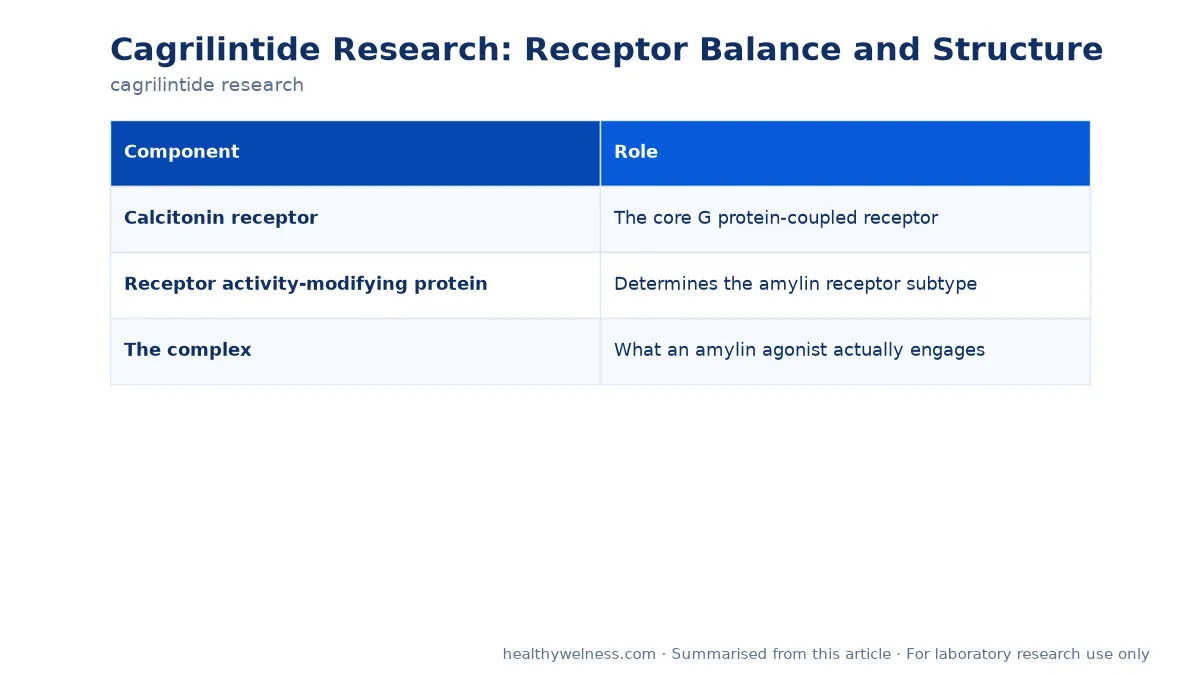
An amylin receptor is formed when the calcitonin receptor associates with a receptor activity-modifying protein. The identity of that accessory protein determines which amylin receptor subtype results. So the same core receptor, paired with different partners, becomes different pharmacological entities.
| Component | Role |
|---|---|
| Calcitonin receptor | The core G protein-coupled receptor |
| Receptor activity-modifying protein | Determines the amylin receptor subtype |
| The complex | What an amylin agonist actually engages |
Two consequences follow, and both are practical rather than theoretical:
- A cell system must express the accessory protein, not just the calcitonin receptor, for an amylin receptor to exist in it at all. An experiment that omits this measures calcitonin receptor pharmacology and calls it amylin pharmacology.
- Selectivity claims mean something different here. For an incretin agonist, selectivity is about which of several distinct receptors is engaged. For an amylin agonist it is about which accessory-protein combination is preferred — a subtler distinction, and harder to establish.
What did the structural work add?
The 2025 study by Cao and colleagues in Nature Communications addressed structural and dynamic features of cagrilintide binding across calcitonin and amylin receptors. Two words in that description carry weight.
Structural means the binding was resolved rather than inferred from functional readouts, which places cagrilintide in a small group of research-catalogue peptides whose receptor interaction has been visualised.
Dynamic matters more than it sounds. A static structure shows one arrangement; dynamic features describe how the complex moves and how the ligand settles into it. For a peptide binding a receptor assembled from two proteins, that flexibility is part of how the accessory protein shapes the binding site.
The 2021 study by Fletcher and colleagues complements this from the pharmacology side, comparing AM833 against six selective and non-selective agonists at calcitonin family receptors. A comparison against six reference compounds in one laboratory is a far stronger basis for a selectivity statement than a single-compound characterisation, and it is the kind of design that makes “dual agonist” a measured description rather than a label.
Does receptor balance actually matter?
The 2022 study by Larsen and colleagues put that question in its title and then tested it, comparing cagrilintide with KBP-336, another dual amylin and calcitonin receptor agonist, on metabolic parameters in preclinical models.
The design is the valuable part. Two compounds of the same class with different receptor balance, compared head to head, is how a balance hypothesis gets tested rather than asserted. For a laboratory reading this literature, it establishes that:
- Balance is treated as a variable within the class, not a fixed property of all dual agonists.
- Comparing two dual agonists is a legitimate experiment, provided the receptor balance of each is known or measured.
- A difference between two dual agonists is not automatically a potency difference. It may be a distribution difference across the family.
The 2026 review by Bailey and colleagues in Peptides places long-acting amylin-related peptides as a class, which is the right orientation before reading any single compound’s papers. The newer selective agonist in this space is covered in eloralintide compared with incretin peptides.
Where does the compound act?
The 2025 study by Carvas and colleagues in EBioMedicine reported that cagrilintide lowers bodyweight through brain amylin receptors 1 and 3 — naming subtypes and a site of action rather than describing an endpoint.
That is the kind of result that makes an experiment designable. If the relevant receptors are central and subtype-specific, then a peripheral preparation lacking those subtypes is the wrong system, and a null result from it says nothing about the compound. Naming receptor subtypes converts “does it work” into “does this system contain the machinery”, which is a question a laboratory can answer before starting.
What does cagrilintide acetate mean on a label?
Acetate is the counterion, and it is the ordinary peptide salt question rather than anything specific to this molecule.
A peptide carrying basic residues is isolated as a salt — there is no neutral form to supply. Reverse-phase purification normally leaves trifluoroacetate behind, and acetate appears after a deliberate exchange step. For concentration work, two things follow:
- The molecular weight used must match the supplied form. Free base and acetate salt differ, and carrying a figure across introduces a systematic error in one direction.
- Net peptide content is a separate figure from purity. Purity describes how much of the peptide material is the right peptide; content describes what share of the vial weight is peptide at all.
The full arithmetic is in peptide counterions: TFA versus acetate, and our reconstitution calculator applies the net correction.
How should it be handled?
As a long engineered peptide carrying a modification intended to extend circulation, which makes it more hydrophobic than a plain peptide and more prone to aggregation under shear.
- Store sealed lyophilized material at −20 °C, dry and dark; warm the vial to room temperature before opening.
- Add diluent down the vial wall and swirl. Do not vortex: foaming drives aggregation at the air–liquid interface.
- Inspect for haze after reconstitution and again after dilution.
- Aliquot on first reconstitution and date each tube.
- Ask for the chromatogram rather than the purity figure alone — at this length deletion impurities are a real synthesis outcome and the ones most likely to co-elute. See how to read a certificate of analysis.
Our cagrilintide research material is supplied for laboratory research use. Certificates are available for listed products — contact us for the latest report. The compound profile is in what cagrilintide is.
Scope note
This material is supplied for laboratory research use only. It is not a medicine, not a supplement, and not for human or veterinary use. The studies cited are referenced as published literature about a molecule.
Open questions
- Which amylin receptor subtypes does cagrilintide prefer, and by how much?
- How do common cell models differ in which accessory proteins they express?
- Does receptor balance predict differences between dual agonists in a given model?
Related research
- What is cagrilintide?
- Cagrilintide and incretin peptides
- Eloralintide compared with incretin peptides
Frequently asked questions
What receptors does cagrilintide act on?
Calcitonin family receptors, including amylin receptors. It is described as a dual amylin and calcitonin receptor agonist, meaning it acts across the family rather than selecting a single receptor, and its development code is AM833.
What is an amylin receptor made of?
A calcitonin receptor in complex with a receptor activity-modifying protein. Which accessory protein is present determines the amylin receptor subtype, which is why selectivity in this family is subtler to establish than at a standalone receptor.
Has cagrilintide's receptor binding been characterised structurally?
Yes. A 2025 Nature Communications study reported structural and dynamic features of cagrilintide binding to calcitonin and amylin receptors, which is a level of evidence most research peptides do not have.
Does receptor balance matter in this class?
A 2022 study asked that question directly in its title, comparing cagrilintide with another dual amylin and calcitonin receptor agonist in preclinical models. Balance across the family is treated as a variable rather than a detail.
What does cagrilintide acetate mean?
Acetate is the counterion. Peptides carrying basic residues are isolated as salts after purification, and acetate is a common form after exchange. It contributes mass that is not peptide, so the molecular weight used in calculations must match the supplied form.
For laboratory research use only. The research materials supplied by HealthyWelness are not approved medicines, foods or cosmetics and are not for human or veterinary use. This article summarises published research and is not medical advice.
Sources
- Cao J, et al. Structural and dynamic features of cagrilintide binding to calcitonin and amylin receptors. Nat Commun. 2025. PMID: 40204768
- Carvas AO, et al. Cagrilintide lowers bodyweight through brain amylin receptors 1 and 3. EBioMedicine. 2025. PMID: 40609154
- Larsen AT, et al. Does receptor balance matter? - Comparing the efficacies of the dual amylin and calcitonin receptor agonists cagrilintide and KBP-336 on metabolic parameters in preclinical models. Biomed Pharmacother. 2022. PMID: 36242844
- Fletcher MM, et al. AM833 Is a Novel Agonist of Calcitonin Family G Protein-Coupled Receptors: Pharmacological Comparison with Six Selective and Nonselective Agonists. J Pharmacol Exp Ther. 2021. PMID: 33727283
- Bailey CJ, et al. Long-acting amylin-related peptides as therapies for obesity and type 2 diabetes. Peptides. 2026. PMID: 41747885