GLOW vs KLOW: One Added Component, Four Questions
KLOW is GLOW with KPV added. What that fourth component contributes, and why a four-part blend is harder to interpret than a three-part one.

Cover illustration: AI-generated editorial artwork. Conceptual only; not an exact molecular structure, actual laboratory result or evidence of clinical effects.
KLOW is GLOW with a fourth component, KPV, added to the same three. That single difference is the whole comparison — and it is also what makes KLOW the harder of the two to interpret, because each added component multiplies the ways an observed effect could have arisen.
For laboratory research use only. The research materials supplied by HealthyWelness are not approved medicines, foods or cosmetics and are not for human or veterinary use. This article summarises published research and is not medical advice.
- GLOW combines three components: GHK-Cu, TB-500 and BPC-157.
- KLOW contains those same three plus KPV, the C-terminal tripeptide of alpha-melanocyte-stimulating hormone.
- KPV has been reported to have anti-inflammatory potential in murine models of inflammatory bowel disease (Kannengiesser et al., 2008).
- Three components allow three pairwise interactions; four allow six, which is why attribution weakens as components are added.
- The published literature covers each component separately; a blend adds a shared diluent and a fixed ratio that none of those studies examined.
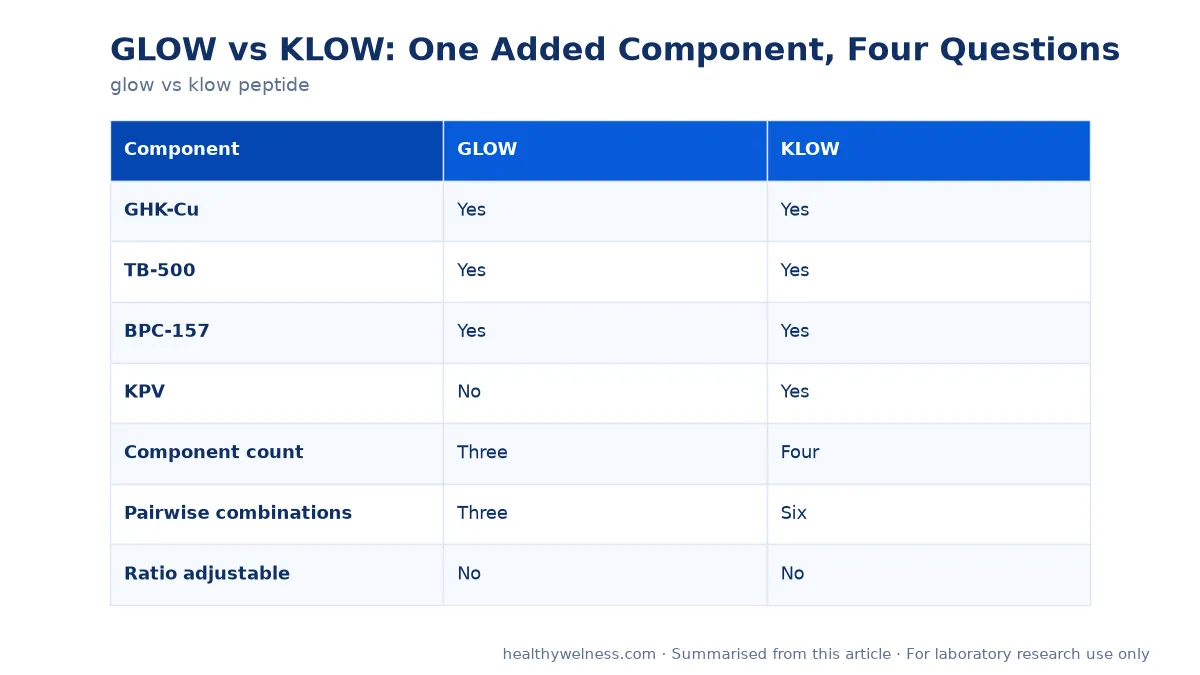
Side by side
| Component | GLOW | KLOW |
|---|---|---|
| GHK-Cu | Yes | Yes |
| TB-500 | Yes | Yes |
| BPC-157 | Yes | Yes |
| KPV | No | Yes |
| Component count | Three | Four |
| Pairwise combinations | Three | Six |
| Ratio adjustable | No | No |
What each component brings its own literature for
The four compounds come from four different research areas, and that is worth stating plainly before any discussion of a combination.
GHK-Cu
A copper-binding tripeptide. Its literature covers the coordination chemistry of the copper complex and its behaviour in skin and connective tissue models; a review has also considered its relationship to oxidative stress and degenerative conditions of ageing (Pickart et al., 2012). The copper is not incidental — the complex, not the bare peptide, is what most of that work studies.
TB-500
A fragment associated with thymosin beta-4. The beta-thymosins are a family of small actin-sequestering peptides, and their defining biochemical property is binding monomeric actin (Hannappel, 2007). Work in this area generally reports on the parent protein or on defined fragments, and the mapping between those and a supplied research fragment is something a specification has to state.
BPC-157
A pentadecapeptide described as a fragment of a gastric protein. Published work examines its role in musculoskeletal soft tissue models (Gwyer et al., 2019). As with the others, the model species and injury model vary across studies and transfer poorly between them.
KPV
The addition that distinguishes KLOW. KPV is the C-terminal tripeptide of alpha-MSH, which makes it a melanocortin-derived fragment rather than a repair peptide by origin. Its reported activity in murine inflammatory bowel disease models (Kannengiesser et al., 2008) and its signalling in human keratinocyte cells alongside alpha-MSH and ACTH (Elliott et al., 2004) come from an immune and dermatological literature, not the tissue-repair literature the other three sit in.
That difference in provenance is the substantive point of the comparison. KLOW is not simply a stronger GLOW; it is GLOW plus a component from a different research area.
Why the blend form constrains what can be concluded
| Design question | Separate vials | Pre-mixed blend |
|---|---|---|
| Set one concentration | Yes | No |
| Omit one component | Yes | No |
| Choose diluent per compound | Yes | No |
| Attribute an effect | Possible | Weak |
| Match a published study | Possible | Rarely |
A fixed ratio is the central constraint. Every published study on these compounds set its own concentration for a single compound; a blend fixes all of them relative to each other at whatever ratio was manufactured. Reproducing any one of those studies from a blend is therefore not possible without the ratio happening to match, which it generally does not.
The shared diluent is the second constraint. Components with different solubility behaviour are being put into one solution chosen for the mixture rather than for any of them.
The arithmetic of attribution
With three components there are three possible two-way combinations. With four there are six, plus four three-way combinations. An effect observed with KLOW and not with GLOW is consistent with KPV acting alone, with KPV interacting with any one of the other three, or with a higher-order combination. Distinguishing those requires the components separately.
What a comparison between the two can establish
Running GLOW alongside KLOW is, in design terms, a single-component omission experiment: the two differ by exactly one ingredient. That is a stronger comparison than most blend-versus-blend pairings allow, and it is worth being precise about what it does and does not deliver.
| Conclusion | Supported? |
|---|---|
| KPV changed the outcome | Yes |
| KPV acted alone to change it | No |
| KPV acted through its known pathway | No |
| The ratio was optimal | No |
The first row holds because the only difference between the arms is KPV. The second does not, because KPV may have changed the outcome by interacting with one of the other three rather than acting independently. The third does not, because the melanocortin literature on KPV was generated in isolation, in different models, at concentrations chosen for those models. The fourth does not, because neither blend’s ratio was arrived at by testing a range.
The missing arm
A comparison that would settle more is KPV on its own, run alongside both blends. Without it, a difference between GLOW and KLOW has no reference point: there is no way to tell whether KPV’s contribution in the mixture resembles its contribution alone. Adding that arm requires KPV as a separate material, which is the practical argument for keeping single components in a catalogue alongside the blends.
Handling in the lab
- A blend’s label weight is the total of all components. Net peptide content per component is the figure a concentration calculation needs, and it has to come from the batch documentation.
- Reconstitution volume sets every component’s concentration at once; there is no way to adjust one. The peptide calculator converts the total into per-component concentrations once the ratio is known.
- Prepare and label with the full component list rather than the blend name, so that a vial found later is interpretable.
- If the experimental question is mechanistic, separate vials are the stronger starting point regardless of which blend is in the catalogue.
Our GLOW blend research material states its component ratio on its own documentation; the KLOW material does the same for its four.
Related research
Each blend has its own profile: what the GLOW blend is and what the KLOW blend is. For the general problem of interpreting pre-mixed combinations see GH peptide blends, and for a two-component case the BPC-157 plus TB-500 blend. A single-component comparison is in GLOW versus GHK-Cu.
A further practical point: because the two blends share three of four components, any batch-to-batch variation in those three affects both arms of a comparison equally only if both arms came from the same manufacturing run. Where they did not, the shared components are a source of difference as much as the unshared one, and the comparison loses the property that made it worth running.
Open questions
Whether KPV interacts with any of the other three components, rather than acting independently alongside them, is unexamined. As of 2026-11-07, a PubMed search combining “KPV” with “GHK” or “BPC 157” or “thymosin beta 4” returned no study examining any such pair; this reports the result of that search and is not evidence that no interaction occurs. Until such work exists, a difference between the two blends is attributable to the presence of KPV but not to any particular mechanism for it.
Frequently asked questions
What is the difference between GLOW and KLOW?
One component. GLOW combines GHK-Cu, TB-500 and BPC-157. KLOW is the same three with KPV added. Everything else that differs between them follows from that single addition.
What does KPV contribute that the other three do not?
A melanocortin-derived fragment with its own separate literature. KPV is the C-terminal tripeptide of alpha-melanocyte-stimulating hormone, and it has been studied in murine models of inflammatory bowel disease (Kannengiesser et al., 2008) and in human keratinocyte signalling (Elliott et al., 2004).
Has either blend been studied as a blend?
Not in peer-reviewed work we have been able to locate. The published literature covers the individual components. A blend introduces a shared diluent and a fixed ratio, neither of which appears in the component studies, so blend behaviour is an extrapolation rather than a finding.
Why is a four-component blend harder to interpret than a three-component one?
Because the number of possible pairwise interactions grows faster than the number of components. Three components have three pairs; four have six. Attribution of any observed effect becomes correspondingly weaker.
Can the components be studied separately instead?
Yes, and for mechanism work that is the stronger design. Separate vials allow each component’s concentration to be set independently and allow a control that omits exactly one component, which a pre-mixed blend cannot provide.
For laboratory research use only. The research materials supplied by HealthyWelness are not approved medicines, foods or cosmetics and are not for human or veterinary use. This article summarises published research and is not medical advice.
Sources
- Kannengiesser K, et al. Melanocortin-derived tripeptide KPV has anti-inflammatory potential in murine models of inflammatory bowel disease. Inflamm Bowel Dis. 2008. PMID: 18092346
- Elliott RJ, et al. alpha-Melanocyte-stimulating hormone, MSH 11-13 KPV and adrenocorticotropic hormone signalling in human keratinocyte cells. J Invest Dermatol. 2004. PMID: 15102092
- Pickart L, et al. The human tripeptide GHK-Cu in prevention of oxidative stress and degenerative conditions of aging: implications for cognitive health. Oxid Med Cell Longev. 2012. PMID: 22666519
- Hannappel E. beta-Thymosins. Ann N Y Acad Sci. 2007. PMID: 17468232
- Gwyer D, et al. Gastric pentadecapeptide body protection compound BPC 157 and its role in accelerating musculoskeletal soft tissue healing. Cell Tissue Res. 2019. PMID: 30915550