KLOW vs GHK-Cu: A Four-Peptide Blend Against One of Its Parts
GHK-Cu is one copper peptide; KLOW adds BPC-157, TB-500 and KPV to it. How the two differ as research materials, and what each component's literature covers.

Cover illustration: AI-generated editorial artwork. Conceptual only; not an exact molecular structure, actual laboratory result or evidence of clinical effects.
GHK-Cu is a single copper-peptide complex; KLOW is a four-peptide blend that contains GHK-Cu together with BPC-157, TB-500 and KPV. The difference for research is attribution: an effect seen with GHK-Cu can be assigned to it, while an effect seen with KLOW could come from any of four components or from their interaction.
For laboratory research use only. The research materials supplied by HealthyWelness are not approved medicines, foods or cosmetics and are not for human or veterinary use. This article summarises published research and is not medical advice.
- GHK-Cu is the copper(II) complex of glycyl-L-histidyl-L-lysine, reported to stimulate collagen, elastin and glycosaminoglycan synthesis and blood vessel and nerve outgrowth (Pickart and Margolina, 2018).
- In 72 rats after ACL reconstruction, GHK-Cu reduced knee laxity and increased graft stiffness at 6 weeks, but neither difference persisted at 12 weeks (Fu et al., 2015).
- KPV, the C-terminal tripeptide of alpha-MSH, reduced leukocyte accumulation in mouse peritonitis without acting through melanocortin receptors (Getting et al., 2003).
- BPC-157 increased growth hormone receptor expression in rat tendon fibroblasts (Chang et al., 2014).
- As of 2026-11-03, PubMed searches for “GHK-Cu BPC-157 TB-500 KPV” and “GHK-Cu KPV” returned no records, and “KLOW peptide” returned only unrelated papers.
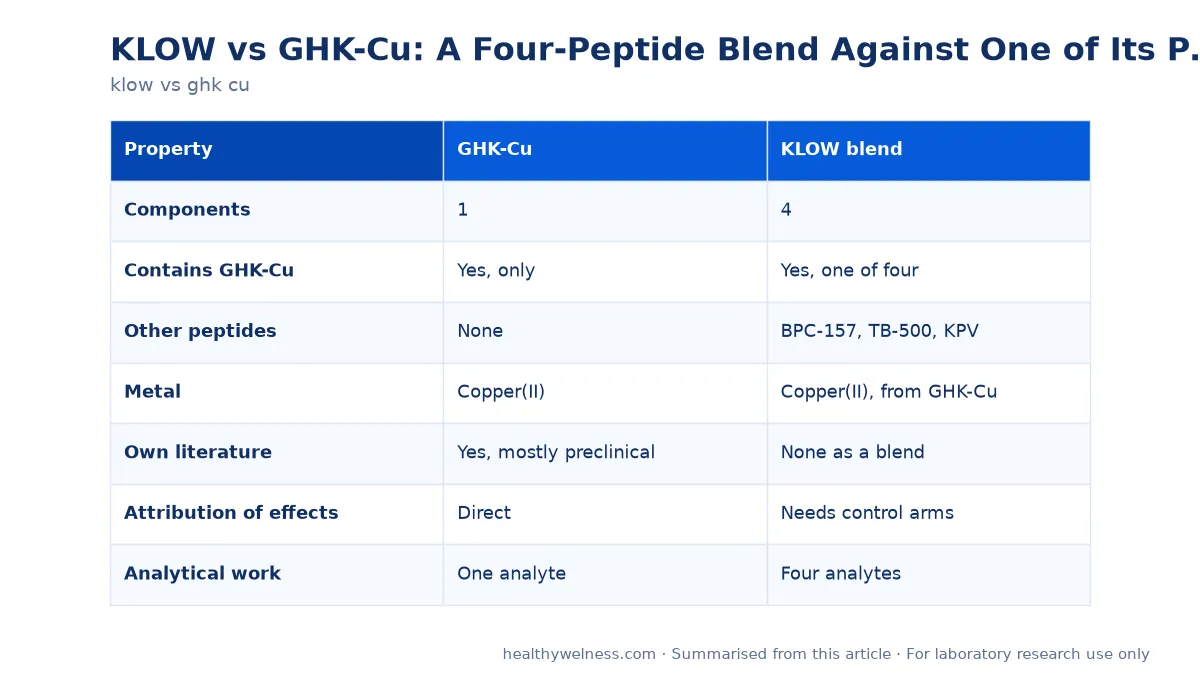
Side by side
| Property | GHK-Cu | KLOW blend |
|---|---|---|
| Components | 1 | 4 |
| Contains GHK-Cu | Yes, only | Yes, one of four |
| Other peptides | None | BPC-157, TB-500, KPV |
| Metal | Copper(II) | Copper(II), from GHK-Cu |
| Own literature | Yes, mostly preclinical | None as a blend |
| Attribution of effects | Direct | Needs control arms |
| Analytical work | One analyte | Four analytes |
Our KLOW blend research material and our GHK-Cu research peptide are listed separately. The blend’s composition is set out in what is the KLOW blend.
Certificates are available for listed products — contact us for the latest report.
What each component brings, and from which model
Each of KLOW’s components has a literature of its own. The table lists one representative finding for each and the model it came from. None of these studies used the blend.
| Component | Representative finding | Model |
|---|---|---|
| GHK-Cu | Transient graft improvement | Rat ACL reconstruction |
| BPC-157 | GH receptor up | Rat tendon fibroblasts |
| TB-500 (Tb4 data) | Cell migration, repair | Mostly full Tb4, review |
| KPV | Less leukocyte influx | Mouse peritonitis |
GHK-Cu
Pickart and Margolina’s review describes GHK as a human peptide that stimulates blood vessel and nerve outgrowth, increases collagen, elastin and glycosaminoglycan synthesis, supports dermal fibroblasts, and has anti-inflammatory and cell-protective actions, and links these diverse effects to gene expression data showing many pathways regulated by GHK (Pickart and Margolina, 2018). The review is written by the peptide’s discoverer and is enthusiastic in tone; it is best read as a map of claims to check rather than as a neutral appraisal.
A controlled animal study gives a more measured picture. Fu and colleagues randomised 72 rats after ACL reconstruction to saline or one of two GHK-Cu concentrations, given intra-articularly once a week for four weeks starting at week 2. At 6 weeks, GHK-Cu groups had a smaller side-to-side difference in knee laxity and the lower concentration gave higher graft stiffness; at 12 weeks neither difference remained, and there was no difference in ultimate load, gait or histology at any time (Fu et al., 2015). The authors described the effect as transient.
The other three
BPC-157 increased growth hormone receptor mRNA and protein in rat Achilles tendon fibroblasts, and adding growth hormone then increased their proliferation (Chang et al., 2014). The repair literature associated with TB-500 is mostly work on full-length thymosin beta-4, which binds actin and promotes cell migration (Goldstein et al., 2012); TB-500 is a short fragment of that protein. KPV reduced polymorphonuclear leukocyte accumulation in crystal-induced peritonitis in mice, did not raise cAMP in macrophages, and kept its effect in mice lacking a functional MC1 receptor, leading the authors to propose an action through inhibition of IL-1 beta rather than melanocortin receptors (Getting et al., 2003).
Why attribution is the central issue
The appeal of a blend is that it combines several lines of research in one vial. The cost is interpretive. If a KLOW experiment shows an effect, at least five explanations are open: any one of the four components, or an interaction between two or more. Distinguishing them requires single-component arms at matched concentrations, and ideally leave-one-out arms. A GHK-Cu experiment needs only a vehicle control.
The arithmetic of control arms grows quickly. Testing four components alone and the full blend needs six groups including vehicle; adding a leave-one-out arm for each component brings it to ten. Leave-one-out arms are the most informative, because they show whether removing a single component changes the blend’s effect, which is the direct test of whether that component contributes.
There is also a chemical reason to keep the copper peptide in view. Copper exchange between GHK complexes is fast (Hureau et al., 2011), and the 2026 GHK-Cu review notes that molar copper occupancy, labile copper and the release of intact complex versus free GHK and free copper are rarely resolved even in single-compound formulations (Mateescu et al., 2026). In a solution that also contains three other peptides, each with amine and carboxylate groups, the copper speciation is harder to predict. A GHK-Cu-only preparation is the better-defined test article for any question about the copper complex itself.
What a blend stability study would have to measure
If the blend itself is the object of study, the first question is not biological but chemical: do the four components stay intact and in the stated proportions once dissolved together? Answering it needs a time-course design with each component tracked individually.
| Measurement | Why it is needed |
|---|---|
| Each peptide by HPLC | Detects selective loss of one component |
| Each peptide by MS | Identifies degradation products |
| Free versus bound copper | Shows whether copper has moved |
| Single-component controls | Separates mixture effects from normal ageing |
GHK-Cu provides a useful reference point. On its own it was stable in water and in pH 4.5 to 7.4 buffers for at least two weeks at 60 °C, but it was hydrolysed under basic and oxidative stress (Badenhorst et al., 2016). Whether that stability holds in the presence of three other peptides has not been reported. The single-component controls in the table are what would show it: if GHK-Cu degrades faster in the blend than alone under the same conditions, the mixture is responsible.
When each makes sense as a research material
| Research question | Better-suited material |
|---|---|
| What does the copper complex do? | GHK-Cu alone |
| Copper speciation, stability | GHK-Cu alone |
| Does a four-part mixture differ from parts? | KLOW plus single arms |
| Analytical method for multi-peptide blends | KLOW |
For most mechanistic questions the single compound is the cleaner choice. The blend becomes the object of study only when the question is about the blend itself, for example whether its components remain stable together, and such a study still needs the single components as references.
Handling in the lab
GHK-Cu alone is hydrophilic and its copper is sensitive to chelators and reducing agents; see GHK-Cu handling. A blend adds the need to calculate concentration for each component separately from its stated net content, which the peptide calculator can do one component at a time, and to verify each component by HPLC with mass spectrometry. Why the blend’s colour is not an identity test is explained in is KLOW peptide blue.
Related research
KLOW’s three-component predecessor is compared in GLOW versus KLOW, and the GHK-Cu-only comparison with that blend in GLOW versus GHK-Cu. KPV is profiled in what is KPV.
Frequently asked questions
What is the difference between KLOW and GHK-Cu?
GHK-Cu is a single compound, the copper(II) complex of the tripeptide Gly-His-Lys. KLOW is a blend that contains GHK-Cu plus three other peptides: BPC-157, TB-500 and KPV. GHK-Cu is therefore one of KLOW’s four components.
Has KLOW been studied as a blend?
As of 2026-11-03, PubMed searches for “GHK-Cu BPC-157 TB-500 KPV” and “GHK-Cu KPV” returned no records, and “KLOW peptide” returned only unrelated papers. Not finding a record does not prove none exists elsewhere. Each component has its own literature, mostly preclinical, and those findings describe the single compounds rather than the mixture.
Why would a researcher choose GHK-Cu alone over KLOW?
Because a single compound allows an effect to be attributed. With four active components, a result could come from any of them or from an interaction, and separating those requires single-component control arms.
What does the GHK-Cu literature report?
Reviews describe effects on collagen and glycosaminoglycan synthesis, blood vessel and nerve outgrowth and anti-inflammatory gene regulation (Pickart and Margolina, 2018). In a rat ACL reconstruction model, GHK-Cu improved laxity and graft stiffness at 6 weeks, but the difference was gone by 12 weeks (Fu et al., 2015).
Does mixing GHK-Cu with other peptides affect its copper?
It can. Copper exchange between GHK complexes is fast (Hureau et al., 2011), and a 2026 review stresses that copper occupancy and labile copper are rarely measured even in single-compound formulations (Mateescu et al., 2026). In a multi-peptide blend those values are harder still to predict.
For laboratory research use only. The research materials supplied by HealthyWelness are not approved medicines, foods or cosmetics and are not for human or veterinary use. This article summarises published research and is not medical advice.
Sources
- Pickart L, et al. Regenerative and Protective Actions of the GHK-Cu Peptide in the Light of the New Gene Data. Int J Mol Sci. 2018. PMID: 29986520
- Fu SC, et al. Tripeptide-copper complex GHK-Cu (II) transiently improved healing outcome in a rat model of ACL reconstruction. J Orthop Res. 2015. PMID: 25731775
- Hureau C, et al. X-ray and solution structures of Cu(II) GHK and Cu(II) DAHK complexes: influence on their redox properties. Chemistry. 2011. PMID: 21780203
- Mateescu DM, et al. GHK-Cu as a Bioactive Metallopeptide and Drug-Delivery Cargo: Coordination Chemistry, Formulation Science, Therapeutic Evidence, and a Translational Roadmap. Pharmaceutics. 2026. PMID: 42797253
- Badenhorst T, et al. Physicochemical characterization of native glycyl-l-histidyl-l-lysine tripeptide for wound healing and anti-aging: a preformulation study for dermal delivery. Pharm Dev Technol. 2016. PMID: 25384620
- Chang CH, et al. Pentadecapeptide BPC 157 enhances the growth hormone receptor expression in tendon fibroblasts. Molecules. 2014. PMID: 25415472
- Goldstein AL, et al. Thymosin β4: a multi-functional regenerative peptide. Basic properties and clinical applications. Expert Opin Biol Ther. 2012. PMID: 22074294
- Getting SJ, et al. Dissection of the anti-inflammatory effect of the core and C-terminal (KPV) alpha-melanocyte-stimulating hormone peptides. J Pharmacol Exp Ther. 2003. PMID: 12750433