What Is P21 (P021)? A CNTF-Derived Peptide Mimetic
P21, also written P021, is a small peptide mimetic derived from ciliary neurotrophic factor. What the published models examined and what they did not.


Cover illustration: AI-generated editorial artwork. Conceptual only; not an exact molecular structure, actual laboratory result or evidence of clinical effects.
P21, written P021 in most of its literature, is a small peptide mimetic derived from ciliary neurotrophic factor. It was designed to carry one arm of a large neurotrophic protein’s activity in a tractable form, and its published work is preclinical and concentrated in rodent models.
For laboratory research use only. The research materials supplied by HealthyWelness are not approved medicines, foods or cosmetics and are not for human or veterinary use. This article summarises published research and is not medical advice.
- P021 is derived from a region of ciliary neurotrophic factor (CNTF), a neurotrophic protein, rather than being a naturally occurring peptide in its own right.
- It is unrelated to the cell cycle protein p21, which is encoded by CDKN1A and shares only the written name.
- Published studies include a triple transgenic mouse model of Alzheimer’s disease pathology (Kazim et al., 2014) and a cognitive-ageing model (Bolognin et al., 2014).
- A CNTF small-molecule peptide mimetic has also been examined in in vitro and in vivo models of CDKL5 deficiency disorder (Mottolese et al., 2024).
- The neurotrophic mimetic approach is reviewed as a class in Kazim et al., 2016, which sets out the rationale for using a small molecule in place of the full protein.
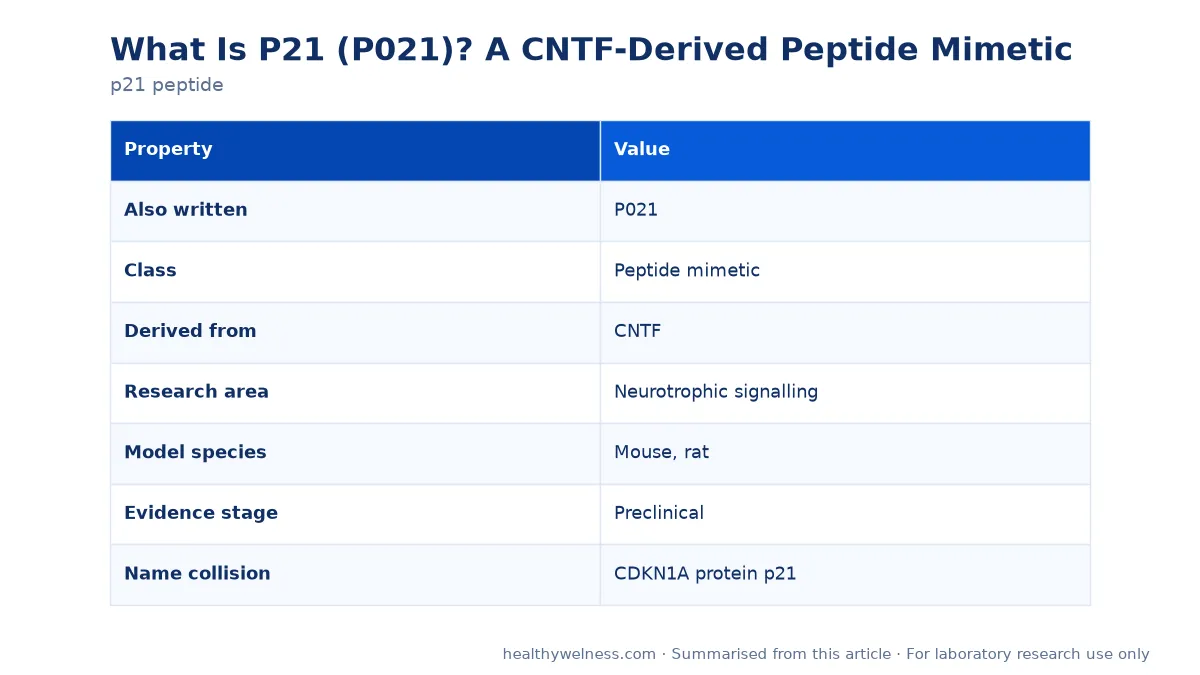
Quick facts
| Property | Value |
|---|---|
| Also written | P021 |
| Class | Peptide mimetic |
| Derived from | CNTF |
| Research area | Neurotrophic signalling |
| Model species | Mouse, rat |
| Evidence stage | Preclinical |
| Name collision | CDKN1A protein p21 |
Sequence, molecular weight and exact mass are not stated here: they depend on the salt form of a given batch and on which construct a supplier has made. The documentation accompanying our P21 research material carries those figures for its own batch.
The name collision is worth settling first
Searching “p21” returns two literatures that have nothing to do with each other.
- p21 (lower case) — the cyclin-dependent kinase inhibitor encoded by CDKN1A, a cell cycle regulator with a very large cancer-biology literature. Also written p21Cip1/Waf1.
- P021 — the CNTF-derived peptide mimetic described here, which appears in neurodegeneration and neurogenesis papers.
Nothing connects them beyond the characters. Any literature search on this compound should use P021, and ideally pair it with “CNTF” or “neurotrophic”, or it will return mostly cell cycle work. This is the single most common source of error in summaries of the compound.
What a neurotrophic mimetic is trying to do
Neurotrophic factors are proteins that support neuronal survival, differentiation and synaptic maintenance. As research tools and as candidate interventions they have two persistent problems: they are large, and they are pleiotropic — a single factor engages several pathways at once.
The mimetic strategy responds to both. A small molecule or short peptide designed around one active region may retain a defined part of the parent protein’s activity while being easier to handle and narrower in what it engages. The approach as a class, and its application to neuroregeneration and synaptic repair, is reviewed in Kazim et al., 2016.
Two caveats come with the strategy and apply to P021 as much as to any other member of the class:
- A mimetic is not the parent molecule. It reproduces an activity, which means the mapping between the mimetic’s effects and CNTF biology has to be demonstrated rather than assumed.
- “Small-molecule peptide mimetic” is a description of design intent, not of mechanism. A receptor interaction still has to be shown.
What the published models examined
| Study | Model | Reported focus |
|---|---|---|
| Kazim et al., 2014 | 3xTg mouse | Chronic oral treatment |
| Bolognin et al., 2014 | Cognitive ageing | Neurogenic/neurotrophic |
| Baazaoui et al., 2017 | Mouse | Dendritic and synaptic |
| Mottolese et al., 2024 | CDKL5 deficiency | In vitro and in vivo |
Read together, these describe a compound studied across several rodent models of neurological dysfunction rather than one. That breadth is a strength of the dataset in one sense and a caution in another: a compound with effects in several unrelated models either engages something general, or the readouts across those models are less independent than they appear.
Where the limitations sit
Three limitations should accompany any summary of this compound.
Species. The work is rodent. Nothing in it establishes behaviour in another species.
Concentration of authorship. A substantial share of the P021 literature comes from a small number of groups. That is normal for a compound at this stage, and it is not a criticism of the work — but independent replication is the thing that converts a concentrated literature into an established one, and it is what a reader should look for.
Readout selection. Cognitive and synaptic endpoints in rodent models vary in how directly they measure the thing their names suggest. Comparing results across the studies above means comparing different readouts, not repetitions of one.
Reading a mimetic’s literature carefully
Compounds designed as mimetics carry a specific reporting risk: results are frequently described in the language of the parent protein, which imports claims the mimetic itself has not demonstrated.
| Phrase to watch | What it assumes |
|---|---|
| “CNTF-like activity” | Equivalence not shown |
| “Neurotrophic effect” | A mechanism, from a readout |
| “Restores” a deficit | Causality from correlation |
| “Small-molecule mimetic” | Design intent, not mechanism |
None of these is dishonest in a primary paper, where the surrounding methods make the basis clear. The distortion happens in summaries, where a readout-level observation is restated as a mechanism-level claim and the model species quietly disappears.
The practical test is to ask, for any statement about this compound, which species it came from and what was actually measured. Where a summary cannot answer both, it has compressed away the part that determines whether the finding transfers.
Handling in the lab
- Use net peptide content from the batch documentation rather than label weight when calculating concentrations; the peptide calculator does the conversion.
- Record the construct and the batch in the experimental notes. For a designed mimetic, “P021” alone does not pin down what was used.
- Store the lyophilized solid as the specification states, and treat a prepared solution as the shorter-lived form.
- When searching the literature for this compound, use P021 with a neurotrophic term to exclude the cell cycle protein.
Related research
For other compounds studied in cognitive and neuroprotective models see what Semax is and what Dihexa is. The general problem of reading a concentrated preclinical literature is covered in what Humanin is.
For the same reason, searches that return this compound should be read with the construct in view. A paper describing “a CNTF small-molecule peptide mimetic” may or may not be describing the same material a supplier lists as P021, and establishing that it is requires the sequence rather than the description.
Open questions
The receptor interaction through which P021 acts is not established in the published work we located. As of 2026-11-07, a PubMed search combining “P021” with “receptor binding” or “CNTF receptor” returned no study characterising a direct binding partner; this describes that search rather than asserting no such work exists. Until it does, the compound is best described as a designed mimetic with reported effects in defined models, not as an agent with a mapped mechanism.
Frequently asked questions
What is P21?
A small-molecule peptide mimetic derived from a region of ciliary neurotrophic factor (CNTF). It is also written P021 in the literature. It was designed to reproduce part of the activity of a much larger neurotrophic protein in a form small enough to be handled as a peptide.
Is P21 the same as the p21 protein?
No, and the name collision causes real confusion. The p21 written in lower case is a cyclin-dependent kinase inhibitor encoded by CDKN1A, a cell cycle protein studied in cancer biology. The research peptide P021 is unrelated to it in sequence, origin and function.
What models has P021 been studied in?
Rodent models of cognitive ageing and of Alzheimer’s disease pathology, including a triple transgenic mouse model (Kazim et al., 2014), a study of dendritic and synaptic deficits (Baazaoui et al., 2017), and a cognitive-ageing model (Bolognin et al., 2014). A CNTF peptide mimetic has also been examined in a CDKL5 deficiency disorder model (Mottolese et al., 2024).
What is a neurotrophic factor mimetic?
A small molecule designed to reproduce a specific activity of a much larger neurotrophic protein. The rationale is that the full protein is difficult to deliver and has broad activity, while a fragment or mimetic may retain one arm of that activity in a more tractable form (Kazim et al., 2016).
How strong is the evidence base?
It is preclinical and concentrated. The published work is in rodent models and a substantial portion comes from a small number of research groups. That concentration is a limitation of the evidence, not a criticism of the studies, and it should be stated in any summary of what is known.
For laboratory research use only. The research materials supplied by HealthyWelness are not approved medicines, foods or cosmetics and are not for human or veterinary use. This article summarises published research and is not medical advice.
Sources
- Kazim SF, et al. Disease modifying effect of chronic oral treatment with a neurotrophic peptidergic compound in a triple transgenic mouse model of Alzheimer's disease. Neurobiol Dis. 2014. PMID: 25046994
- Bolognin S, et al. Rescue of cognitive-aging by administration of a neurogenic and/or neurotrophic compound. Neurobiol Aging. 2014. PMID: 24702821
- Baazaoui N, et al. Prevention of dendritic and synaptic deficits and cognitive impairment with a neurotrophic compound. Alzheimers Res Ther. 2017. PMID: 28655344
- Kazim SF, et al. Neurotrophic factor small-molecule mimetics mediated neuroregeneration and synaptic repair: emerging therapeutic modality for Alzheimer's disease. Mol Neurodegener. 2016. PMID: 27400746
- Mottolese N, et al. Effects of a ciliary neurotrophic factor (CNTF) small-molecule peptide mimetic in an in vitro and in vivo model of CDKL5 deficiency disorder. J Neurodev Disord. 2024. PMID: 39592934