Thymosin Alpha-1 Vial: Identity, Purity and Synthesis Notes
What to confirm on an analytical report for a thymosin alpha-1 vial: the acetylated N-terminus, 28-residue sequence, purity basis and solution handling.


Cover illustration: AI-generated editorial artwork. Conceptual only; not an exact molecular structure, actual laboratory result or evidence of clinical effects.
An analytical report for thymosin alpha-1 has to establish three things: the correct 28-residue sequence, confirmation that the N-terminus is acetylated, and a purity figure whose basis is stated. The acetyl group is the detail most easily lost, because the unacetylated form differs by only 42 mass units.
For laboratory research use only. The research materials supplied by HealthyWelness are not approved medicines, foods or cosmetics and are not for human or veterinary use. This article summarises published research and is not medical advice.
- Thymosin alpha-1 is a synthetic polypeptide corresponding to a peptide naturally occurring in the thymus (Dominari et al., 2020).
- A solid-phase synthesis route for thymosin alpha-1 was published by Wong and Merrifield in 1980, using a Boc-aminoacyl-PAM resin.
- Ancell and colleagues (2001) report peak serum concentrations within two hours and a serum half-life of approximately 2 hours.
- Blood levels returned to baseline within 24 hours in the same pharmacokinetic summary.
- The TESTS phase 3 trial randomised 1106 adults with sepsis across 22 centres in China and found no clear evidence of reduced 28-day mortality (Wu et al., 2025).
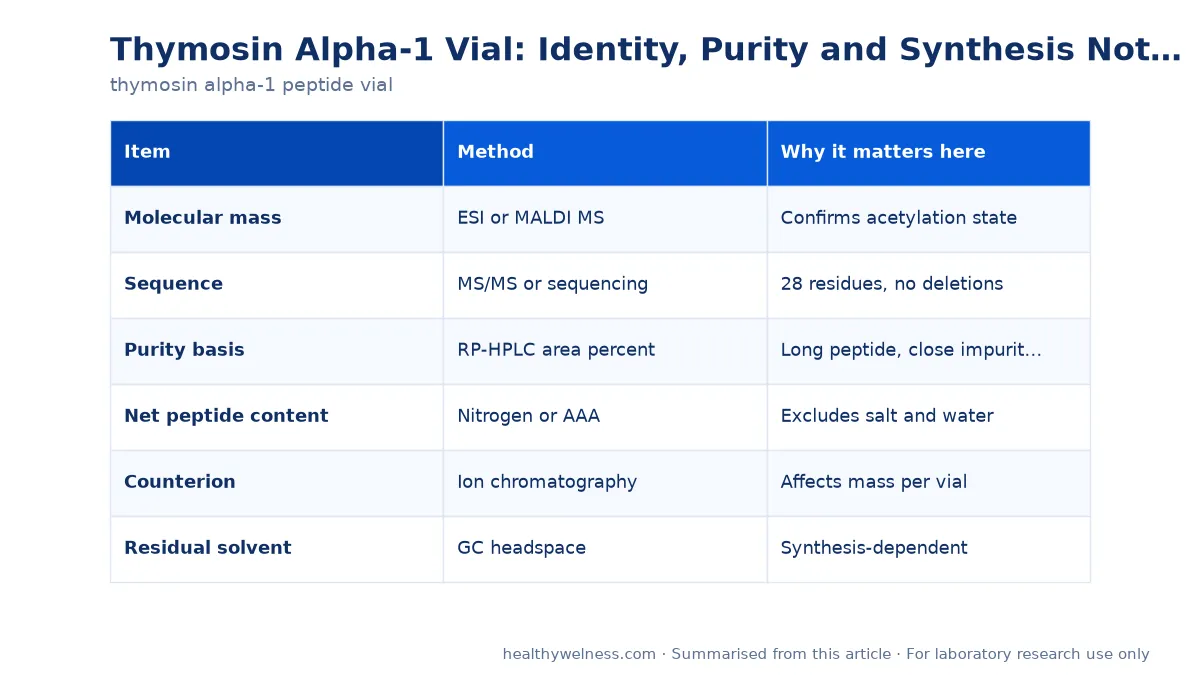
What to check on the report
| Item | Method | Why it matters here |
|---|---|---|
| Molecular mass | ESI or MALDI MS | Confirms acetylation state |
| Sequence | MS/MS or sequencing | 28 residues, no deletions |
| Purity basis | RP-HPLC area percent | Long peptide, close impurities |
| Net peptide content | Nitrogen or AAA | Excludes salt and water |
| Counterion | Ion chromatography | Affects mass per vial |
| Residual solvent | GC headspace | Synthesis-dependent |
The thymosin alpha-1 research peptide is supplied as a lyophilised solid for laboratory use. Composition and research background are in what thymosin alpha-1 is and the research review. Certificates are available for listed products — contact us for the latest report.
Why the acetyl group deserves its own line
Thymosin alpha-1 carries an acetylated N-terminus, and that modification is part of its identity rather than a decoration. In analytical terms the consequence is specific: an N-terminal acetyl group adds 42 mass units, which a mass spectrometer resolves easily but which a purity percentage from a chromatogram may not, because the acetylated and unacetylated forms can elute close together on a reversed-phase column.
This is why a report that gives only a purity figure leaves the most characteristic structural feature unverified. The combination that does establish it is a mass measurement matching the acetylated form plus a sequence confirmation. Neither alone is sufficient: a matching mass with an unexpected sequence is coincidence, and a correct sequence read without the mass leaves the terminal modification open.
Synthesis history as context
Wong and Merrifield’s 1980 Biochemistry paper describes solid-phase synthesis of thymosin alpha-1 on a tert-butyloxycarbonylaminoacyl-4-(oxymethyl)phenylacetamidomethyl resin. The chemistry has moved on, but two things follow from the compound having this long a synthetic history.
First, a 28-residue peptide was a demanding target in 1980 and is routine now, which means the impurity profile of modern material is dominated by different problems — deletion sequences and incomplete deprotection rather than gross coupling failures. Second, decades of method development mean reference standards and published characterisation data exist, so a laboratory has something to compare against. That is not true of every peptide sold as a research material.
The pharmacokinetic figure and what it implies for solutions
Ancell and colleagues’ 2001 review in the American Journal of Health-System Pharmacy gives the clearest reported pharmacokinetics: rapid absorption, peak serum concentrations within two hours, return to baseline within 24 hours, and a serum half-life of approximately 2 hours. A short residence time explains why formulation research followed.
Liu and colleagues’ 2010 study is an example: biodegradable in situ forming poly(lactide-co-glycolide) implants loaded with thymosin alpha-1, examined in vitro and in vivo. Depot formulation work of that kind is a direct response to a peptide that clears quickly, and more recent work has continued along similar lines with liquid crystal depots.
For laboratory handling the relevant inference is modest but useful: a peptide whose biology is studied on a two-hour timescale in circulation is usually prepared fresh, and solution age is a variable worth recording. Preparation steps are in thymosin alpha-1 reconstitution, and concentrations should be calculated from net content with the peptide calculator.
Where a long peptide’s impurities come from
At 28 residues, thymosin alpha-1 sits at the length where the dominant synthesis impurities change character. Short peptides tend to show unreacted intermediates that are easy to separate. Longer chains accumulate single-residue deletions, each of which produces a molecule very close in mass and retention time to the target, so the main peak in a chromatogram may hide several of them unless the gradient is shallow enough to resolve them.
Three consequences follow for reading a report on this peptide. A purity figure obtained with a short, steep gradient is less informative than the same figure from a method designed to resolve close-eluting species, so the method conditions matter as much as the number. A mass spectrum that matches the intended mass does not exclude a deletion elsewhere compensated by another difference, which is why sequence-level confirmation is listed separately above. And residual solvent and counterion figures become more relevant with chain length, because longer syntheses involve more deprotection and cleavage steps, each contributing its own residues to the finished solid.
The clinical record, briefly and accurately
Two sources bracket the clinical picture, and they point in different directions, which is itself the honest summary.
Ancell and colleagues reviewed the trials available in 2001, when the compound was in phase 3 for hepatitis C and phase 2 for hepatitis B. Their account of hepatitis B included four trials in 195 patients, with varying rates of viral DNA clearance across monotherapy, interferon comparison and controlled designs; for hepatitis C, three trials in 162 patients, where one found no significant difference from placebo in normalised serum ALT and two combination trials reported higher response rates than interferon alone. Their own conclusion was that results had been mixed and that effects on morbidity and mortality remained to be seen.
The TESTS trial provides a modern, large, negative result in a different indication. Wu and colleagues randomised 1106 adults aged 18 to 85 with sepsis by sepsis-3 criteria, 1:1, across 22 centres in China between September 2016 and December 2020, stratified by age and centre. In the modified intention-to-treat analysis of 1089 participants, 28-day all-cause mortality was 23.4% with thymosin alpha-1 and 24.1% with placebo (hazard ratio 0.99, 95% CI 0.77 to 1.27; p = 0.93). No secondary or safety outcome differed significantly. Prespecified subgroup analyses suggested potential differential effects by age and by diabetes status, with interaction p values of 0.01 and 0.04 respectively, which the trial design treats as hypothesis-generating rather than conclusive.
| Study | Population | Primary result |
|---|---|---|
| Ancell review, 2001 | Hepatitis B and C trials | Mixed across trials |
| TESTS, 2025 | 1106 adults, sepsis | No mortality difference |
| Dominari review, 2020 | Literature survey | Calls for further study |
Dominari and colleagues’ 2020 review surveys the broader literature on immune function, vaccine response and infection, and concludes by calling for further investigation of the peptide’s antiviral properties. A review that ends with a call for more evidence is describing an open question, and a certificate of analysis has nothing to add to it: the chemical identity of a vial and the clinical standing of a compound are separate matters, and conflating them is the most common error in writing about this peptide. Comparative reading on a related thymic preparation is in thymalin vs thymosin alpha-1.
Frequently asked questions
What makes thymosin alpha-1 harder to characterise than a short peptide?
Length and the N-terminal acetyl group. At 28 residues it is long enough for synthesis-related deletions to be hard to resolve from the main peak, and the acetylation has to be confirmed because the des-acetyl form differs by only 42 mass units.
How long has synthetic thymosin alpha-1 existed?
Since at least 1980, when Wong and Merrifield published a solid-phase synthesis using a tert-butyloxycarbonylaminoacyl-4-(oxymethyl)phenylacetamidomethyl resin. The compound has therefore had decades of synthetic method development behind it.
What half-life has been reported?
Ancell and colleagues (2001) report rapid absorption with peak serum concentrations within two hours, return to baseline within 24 hours, and a serum half-life of approximately 2 hours.
Does a certificate tell you anything about biological activity?
No. Identity and purity are chemical measurements. The immunological activity described in the literature, such as effects on T-cell function, is established in separate biological studies and cannot be read off a chromatogram.
Why does solution stability matter for this peptide specifically?
Because formulation work has focused on it. Liu and colleagues (2010) studied biodegradable in situ forming poly(lactide-co-glycolide) implants for thymosin alpha-1, which is the kind of effort made for a peptide with a short residence time in solution.
For laboratory research use only. The research materials supplied by HealthyWelness are not approved medicines, foods or cosmetics and are not for human or veterinary use. This article summarises published research and is not medical advice.
Sources
- Ancell CD, et al. Thymosin alpha-1. Am J Health Syst Pharm. 2001. PMID: 11381492
- Wong TW, et al. Solid-phase synthesis of thymosin alpha 1 using tert-butyloxycarbonylaminoacyl-4-(oxymethyl)phenylacetamidomethyl-resin. Biochemistry. 1980. PMID: 7190831
- Liu Q, et al. In vitro and in vivo study of thymosin alpha1 biodegradable in situ forming poly(lactide-co-glycolide) implants. Int J Pharm. 2010. PMID: 20650309
- Dominari A, et al. Thymosin alpha 1: A comprehensive review of the literature. World J Virol. 2020. PMID: 33362999
- Wu J, et al. The efficacy and safety of thymosin alpha1 for sepsis (TESTS): multicentre, double blinded, randomised, placebo controlled, phase 3 trial. BMJ. 2025. PMID: 39814420