Noopept vs Semax: Structure, Origin and Animal Research
Noopept vs Semax compared: a Pro-Gly dipeptide ester and an ACTH(4-10) heptapeptide, their origins, rodent BDNF studies and receptor binding data.


Cover illustration: AI-generated editorial artwork. Conceptual only; not an exact molecular structure, actual laboratory result or evidence of clinical effects.
Noopept and Semax are chemically unrelated research compounds that share a Moscow origin and an overlapping set of rodent endpoints, notably hippocampal BDNF expression. Noopept (GVS-111) is a capped Pro-Gly dipeptide ester; Semax is a seven-residue ACTH(4-10) analogue. A few Russian panel studies have tested both side by side in rat and mouse models.
For laboratory research use only. The research materials supplied by HealthyWelness are not approved medicines, foods or cosmetics and are not for human or veterinary use. This article summarises published research and is not medical advice.
- Noopept (GVS-111, omberacetam) is N-phenylacetyl-L-prolylglycine ethyl ester, and its solid-state structure was characterised by NMR, single-crystal and powder X-ray diffraction in 2025 (Araj et al., 2025).
- Semax is the heptapeptide Met-Glu-His-Phe-Pro-Gly-Pro, and a single administration in rats raised hippocampal BDNF protein up to 1.4-fold and exon III BDNF mRNA 3-fold (Dolotov et al., 2006).
- In a rat brain radioligand study, Noopept competed at AMPA receptor sites with an IC50 of 80 microM, while Semax competed at metabotropic glutamate receptor sites with an IC50 of 33 microM (Firstova et al., 2011).
- In HEK293 reporter cells, Noopept at 10 microM increased the DNA-binding activity of HIF-1 but not of CREB, NF-kappaB, p53 or five other transcription factors (Vakhitova et al., 2016).
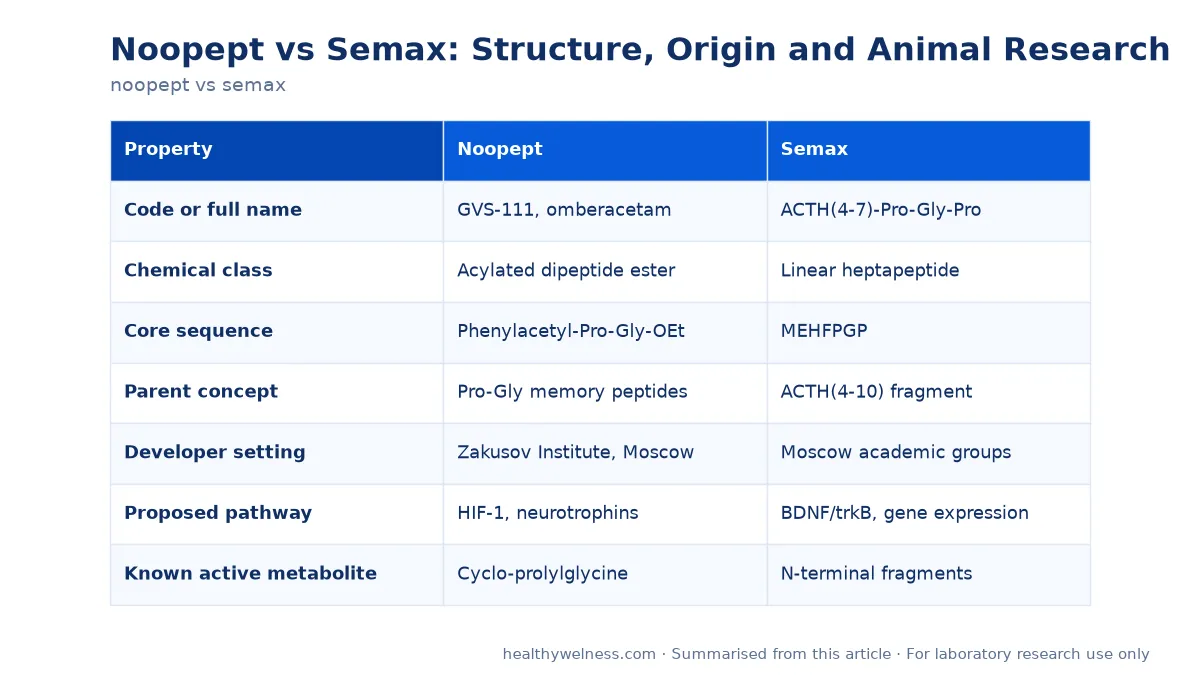
Noopept vs Semax at a glance
| Property | Noopept | Semax |
|---|---|---|
| Code or full name | GVS-111, omberacetam | ACTH(4-7)-Pro-Gly-Pro |
| Chemical class | Acylated dipeptide ester | Linear heptapeptide |
| Core sequence | Phenylacetyl-Pro-Gly-OEt | MEHFPGP |
| Parent concept | Pro-Gly memory peptides | ACTH(4-10) fragment |
| Developer setting | Zakusov Institute, Moscow | Moscow academic groups |
| Proposed pathway | HIF-1, neurotrophins | BDNF/trkB, gene expression |
| Known active metabolite | Cyclo-prolylglycine | N-terminal fragments |
We do not supply Noopept; it is discussed here only as a comparison point. The Semax research peptide is supplied as lyophilised powder for in vitro and animal model work. A full profile of the heptapeptide is in what Semax is, and its comparison with a related anxiolytic heptapeptide is in Semax vs Selank.
Certificates are available for listed products — contact us for the latest report.
Two different routes to a Pro-Gly motif
The most interesting structural link between the two compounds is easy to miss. Both contain a proline followed by a glycine, but they reach it from opposite directions.
Noopept was designed at the Zakusov Institute of Pharmacology as a small, protected dipeptide. The proline nitrogen carries a phenylacetyl group and the glycine carboxyl is closed as an ethyl ester, so neither end is a free peptide terminus. Boyko and colleagues describe the design goal as a short peptide based on endogenous memory-related neuropeptides, but with better enzymatic stability and blood-brain barrier permeability than natural peptides. Araj and colleagues in Warsaw note that the compound is often grouped with the racetams even though its chemical structure differs substantially from piracetam; their 2025 study combined thermal analysis, liquid- and solid-state NMR, X-ray diffraction and DFT calculations, and included a polymorphism screen.
Semax took the opposite approach. It keeps four residues of the native hormone fragment ACTH(4-7), Met-Glu-His-Phe, and appends Pro-Gly-Pro at the C-terminus. The result is a free, unprotected seven-residue peptide. Its stability comes from sequence rather than capping groups: Potaman and colleagues showed in 1991 that, in rat blood and serum, one third to one half of the degrading activity came from a bestatin-sensitive aminopeptidase that removed the first and second N-terminal residues of both ACTH(4-10) and Semax, producing relatively stable intermediates, and that Semax resisted the remaining enzymes better than ACTH(4-10).
| Design feature | Noopept | Semax |
|---|---|---|
| Residue count | 2 (Pro, Gly) | 7 |
| N-terminus | Phenylacetyl cap | Free Met |
| C-terminus | Ethyl ester | Free Pro acid |
| Main degradation noted | Cyclisation to cyclo-Pro-Gly | N-terminal aminopeptidase |
| Fragment with own activity | Cyclo-prolylglycine | Pro-Gly-Pro, intermediates |
In both cases, a breakdown product is thought to contribute. Boyko and colleagues found cyclo-prolylglycine in rat plasma and brain after Noopept, with very different pharmacokinetic parameters from the parent compound but a similar pharmacological spectrum. For Semax, Potaman and colleagues argued from comparable areas under the degradation and accumulation curves that the N-terminally shortened intermediates could contribute to the intact peptide’s effects.
What the rodent BDNF studies actually measured
Neurotrophin expression is the most frequently cited overlap between the two literatures. The two key papers used different methods and should be read with that in mind.
Ostrovskaya and colleagues, also at the Zakusov Institute, measured NGF and BDNF mRNA by Northern blot in rat cortex and hippocampus after single and 28-day Noopept administration. In the hippocampus, both neurotrophin mRNAs rose after acute administration, and long-term administration did not produce tolerance; the authors report it potentiated the effect. In the cortex the picture was different: expression fell below control after a single administration, and long-term administration produced only a slight increase in BDNF.
Dolotov and colleagues measured protein as well as mRNA. After a single Semax administration in rats, hippocampal BDNF protein rose up to 1.4-fold and trkB tyrosine phosphorylation 1.6-fold, while exon III BDNF mRNA rose 3-fold and trkB mRNA 2-fold. Treated animals also showed more conditioned avoidance reactions. The authors proposed that Semax acts by modulating expression and activation of the hippocampal BDNF/trkB system.
The Semax paper therefore covers the receptor side of the pathway and protein levels, while the Noopept paper covers two neurotrophins at the mRNA level and two time courses. Neither included the other compound, and fold-changes from Northern blots and from protein assays are not interchangeable.
Where else the proposed mechanisms diverge
Beyond neurotrophins, each compound has a distinct mechanistic proposal.
- Noopept and HIF-1. Vakhitova and colleagues screened nine transcription factors with luciferase reporters in HEK293 cells. Noopept at 10 microM raised HIF-1 DNA-binding activity only, and added to the effect of CoCl2-induced HIF-1 stabilisation in a concentration-dependent way; piracetam at 1 mM had no significant effect on any factor. Docking placed the L-isomer of Noopept and its N-phenylacetylprolyl metabolite, but not the inactive D-isomer, in the active site of prolyl hydroxylase 2. The authors propose this HIF-positive effect as the primary mechanism.
- Semax and ischaemic gene expression. Medvedeva and colleagues ran a genome-wide transcriptional analysis of rat cortex 3 and 24 hours after permanent middle cerebral artery occlusion. Genes related to the immune response made up over half of the Semax-altered genes, mainly immunoglobulins and chemokines, and 24 vascular-system genes changed at 3 hours and 12 at 24 hours.
A HIF-1 reporter result in a human kidney cell line and a transcriptome from ischaemic rat cortex answer different questions. They describe what each research group chose to examine, not a head-to-head difference between the compounds.
Studies that tested Noopept and Semax together
Unlike many compound pairs, these two have been placed in the same experimental panels, usually alongside other Russian reference compounds.
| Study | Model | Noopept finding | Semax finding |
|---|---|---|---|
| Iasnetsov, 2001 | Cat cortex neurons | Inhibition linked to NMDA | Inhibition linked to M-choline |
| Firstova, 2011 | Rat brain binding | AMPA sites, IC50 80 microM | mGlu sites, IC50 33 microM |
| Vasil’eva, 2012 | BALB/c, C57BL/6 mice | Exploration up, anxiety down | Exploration up, anxiety down |
In the 2001 microelectrode study in immobilised cats, the inhibitory effect of Semax on individual cortical neurons was, in more than half of cases, related to stimulation of M-choline receptors, while that of GVS-111 was related to NMDA receptors. The 2011 radioligand study tested eight compounds on rat brain AMPA, NMDA and metabotropic glutamate receptor binding; the authors described Noopept’s AMPA competition as an order of magnitude weaker than that of nooglutil (IC50 6.4 microM). In the 2012 cross-maze study, all six tested compounds changed exploratory behaviour only in BALB/c mice, the strain with higher baseline anxiety, and Noopept and Semax both also lowered anxiety measures in that strain.
These shared-panel studies are small, in Russian, and available to most readers only as abstracts. They show that, under matched conditions, the two compounds produced overlapping behavioural readouts in mice but bound different glutamate receptor sites in vitro.
Handling in the lab
Because Noopept is a small ester and Semax is a free heptapeptide, they are not interchangeable as laboratory materials. Semax is reconstituted from lyophilised powder in an aqueous solvent, and concentration should be expressed as mg/mL of solution calculated from net peptide content with the peptide calculator. Solvent choice and storage of the reconstituted peptide are covered in Semax reconstitution. The N-terminal aminopeptidase sensitivity reported by Potaman and colleagues is a reason to keep serum-containing media and Semax stock solutions apart until the point of use.
Related research
Semax has also been set against other compounds with very different structures, including the small-molecule angiotensin IV analogue covered in Dihexa vs Semax. The 2025 Warsaw crystallography work remains the most detailed physicochemical description of Noopept itself.
Frequently asked questions
What is the structural difference between Noopept and Semax?
Noopept (GVS-111) is N-phenylacetyl-L-prolylglycine ethyl ester, a capped Pro-Gly dipeptide with an ethyl ester (Araj et al., 2025). Semax is the linear heptapeptide Met-Glu-His-Phe-Pro-Gly-Pro, built from the ACTH(4-7) sequence with a Pro-Gly-Pro extension (Dolotov et al., 2006). One is a small modified dipeptide, the other a seven-residue peptide.
Have Noopept and Semax been tested in the same experiment?
Yes, in at least two Russian panel studies. A rat brain radioligand binding study tested both among eight compounds and reported Noopept competing at AMPA receptor sites (IC50 80 microM) and Semax at metabotropic glutamate sites (IC50 33 microM) (Firstova et al., 2011). A mouse cross-maze study compared both in BALB/c and C57BL/6 strains (Vasil’eva et al., 2012).
Do both compounds affect BDNF expression in rodents?
Both have rat hippocampus reports. Noopept increased NGF and BDNF mRNA in rat hippocampus after single and 28-day administration (Ostrovskaya et al., 2008). Semax produced a maximal 1.4-fold rise in hippocampal BDNF protein and a 3-fold rise in exon III BDNF mRNA in rats (Dolotov et al., 2006). The methods differ, so the magnitudes are not directly comparable.
Is Noopept metabolised into another active compound?
In rats, a Noopept metabolite, cyclo-prolylglycine, was found in plasma and brain. Its pharmacokinetic parameters differed markedly from the parent compound, but the authors reported a similar pharmacological spectrum (Boyko et al., 2018).
How stable is Semax in rat blood?
In rat blood and serum, a bestatin-sensitive aminopeptidase removed the first and second N-terminal residues of both ACTH(4-10) and Semax, and Semax was more stable than ACTH(4-10) against the other degrading enzymes (Potaman et al., 1991).
For laboratory research use only. The research materials supplied by HealthyWelness are not approved medicines, foods or cosmetics and are not for human or veterinary use. This article summarises published research and is not medical advice.
Sources
- Araj SK, et al. Physicochemical and structural analysis of N-phenylacetyl-L-prolylglycine ethyl ester (Noopept) - An active pharmaceutical ingredient with nootropic activity. J Pharm Biomed Anal. 2025. PMID: 39298839
- Ostrovskaya RU, et al. Noopept stimulates the expression of NGF and BDNF in rat hippocampus. Bull Exp Biol Med. 2008. PMID: 19240853
- Vakhitova YV, et al. Molecular Mechanism Underlying the Action of Substituted Pro-Gly Dipeptide Noopept. Acta Naturae. 2016. PMID: 27099787
- Boyko SS, et al. [Pharmacokinetics of noopept and its active metabolite cycloprolyl glycine in rats]. Biomed Khim. 2018. PMID: 30378564
- Dolotov OV, et al. Semax, an analog of ACTH(4-10) with cognitive effects, regulates BDNF and trkB expression in the rat hippocampus. Brain Res. 2006. PMID: 16996037
- Potaman VN, et al. N-terminal degradation of ACTH(4-10) and its synthetic analog semax by the rat blood enzymes. Biochem Biophys Res Commun. 1991. PMID: 1851003
- Medvedeva EV, et al. The peptide semax affects the expression of genes related to the immune and vascular systems in rat brain focal ischemia: genome-wide transcriptional analysis. BMC Genomics. 2014. PMID: 24661604
- Firstova IuIu, et al. [Studying specific effects of nootropic drugs on glutamate receptors in the rat brain]. Eksp Klin Farmakol. 2011. PMID: 21476267
- Vasil'eva EV, et al. [Effects of nootropic drugs on behavior of BALB/c and C57BL/6 mice in the exploratory cross-maze test]. Eksp Klin Farmakol. 2012. PMID: 23025044
- Iasnetsov VV, et al. [Effect of nootropic agents on impulse activity of cerebral cortex neurons]. Eksp Klin Farmakol. 2001. PMID: 11871233